



 Chat with AI
Exam 10: Reporting and Analyzing Long-Term Liabilities

Exam 1: Introducing Financial Accounting270 Questions
Exam 2: Accounting System and Financial Statements236 Questions
Exam 3: Adjusting Accounts for Financial Statements271 Questions
Exam 4: Reporting and Analyzing Merchandising Operations263 Questions
Exam 5: Reporting and Analyzing Inventories218 Questions
Exam 6: Reporting and Analyzing Cash and Internal Controls215 Questions
Exam 7: Reporting and Analyzing Receivables207 Questions
Exam 8: Reporting and Analyzing Long-Term Assets255 Questions
Exam 9: Reporting and Analyzing Current Liabilities224 Questions
Exam 10: Reporting and Analyzing Long-Term Liabilities231 Questions
Exam 11: Reporting and Analyzing Equity248 Questions
Exam 12: Reporting and Analyzing Cash Flows226 Questions
Exam 13: Analyzing and Interpreting Financial Statements223 Questions
Exam 14: Applying Present and Future Values76 Questions
Exam 15: Investments and International Operations215 Questions
Exam 16: Reporting and Analyzing Partnerships168 Questions
Select questions type


A company retires its bonds at 105. The face value is $100,000 and the carrying value of the bonds at the retirement date is $103,745. The issuer's journal entry to record the retirement will include a:
(Multiple Choice)
4.9/5  (86)
(86) Payments on installment notes normally include accrued interest plus a portion of the principal amount borrowed.
(True/False)
4.8/5 (72)
(72) On June 1, a company issued $200,000 of 12% bonds at their par value plus accrued interest. The interest on these bonds is payable semiannually on January 1 and July 1. Prepare the issuer's journal entry to record the bond issuance of June 1.
(Essay)
4.9/5 (72)
(72) Describe the journal entries required to record the issuance of bonds at a premium and the payment of bond interest, including any applicable amortization.
(Essay)
4.7/5 (81)
(81) A premium reduces the interest expense of a bond over its life.
(True/False)
4.9/5 (88)
(88) A contract pledging title to assets as security for a note or bond is known as a(an):
(Multiple Choice)
4.8/5 (74)
(74) Payments on an installment note normally include the accrued interest expense plus a portion of the amount borrowed.
(True/False)
4.8/5 (83)
(83) Wasp Corporation has a loan agreement that provides it with cash today, and the company must pay $25,000 one year from today, $15,000 two years from today, and $5,000 three years from today. Wasp agrees to pay 10% interest. The following are factors from a present value table: 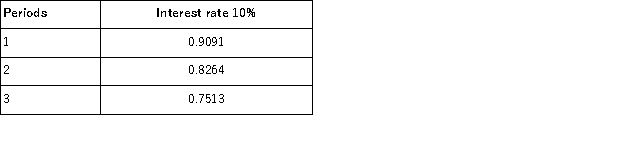 What is the amount of cash that Wasp receives today?
 (Essay)
4.7/5 (83)
(83) A company issued 5-year, 7% bonds with a par value of $100,000. The market rate when the bonds were issued was 6.5%. The company received $102,105 cash for the bonds. Using the straight-line method, the amount of premium amortization per semi-annual interest period is:
(Multiple Choice)
4.8/5 (66)
(66) Morgan Company issues 9%, 20-year bonds with a par value of $750,000 that pay interest semi-annually. The current market rate is 8%. The amount of interest owed to the bondholders for each semiannual interest payment is:
(Multiple Choice)
4.9/5 (85)
(85) Strider Corporation issued 14%, 5-year bonds with a par value of $5,000,000 on January 1, Year 1. Interest is to be paid semiannually on each June 30 and December 31. The bonds are issued at $5,368,035 cash when the market rate for this bond is 12%.
(a) Prepare the general journal entry to record the issuance of the bonds on January 1, year 1.
(b) Show how the bonds would be reported on Strider's balance sheet at January 1, Year 1.
(c) Assume that Strider uses the straight-line method of amortization of any discount or premium on bonds. Prepare the general journal entry to record the first semiannual interest payment on June 30, Year 1.
(Essay)
4.8/5 (76)
(76) When convertible bonds are converted to a company's stock, the carrying value of the bonds is transferred to equity accounts and no gain or loss is recorded.
(True/False)
4.8/5 (85)
(85) A company issued 10-year, 9% bonds with a par value of $500,000 when the market rate was 9.5%. The company received $484,087 in cash proceeds. Using the effective interest method, prepare the issuer's journal entry to record the first semiannual interest payment including the amortization of any bond discount or premium.
(Essay)
5.0/5 (74)
(74) Callable bonds have an option exercisable by the issuer to retire them at a stated dollar amount prior to maturity.
(True/False)
4.8/5 (79)
(79) Interest payments on bonds are determined by multiplying the par value of the bond by the stated contract rate.
(True/False)
4.9/5 (68)
(68) A basic present value concept is that cash paid or received in the future has less value now than the same amount of cash today.
(True/False)
4.9/5 (80)
(80) Explain the amortization of a bond premium. Identify and describe the two amortization methods available.
(Essay)
4.9/5 (82)
(82) Describe the journal entries required to record the issuance of bonds at a discount and the payment of bond interest, including any applicable amortization.
(Essay)
4.9/5 (76)
(76) A company previously issued $2,000,000, 10% bonds, receiving a $120,000 premium. On the current year's interest date, after the bond interest was paid and after 40% of the total premium had been amortized, the company purchased the entire bond issue on the open market at 98 and retired it. Prepare the journal entry to record the retirement of these bonds.
(Essay)
4.7/5 (81)
(81) 
Filters
- Essay(0)
- Multiple Choice(0)
- Short Answer(0)
- True False(0)
- Matching(0)