



 Chat with AI
Exam 13: Analyzing and Interpreting Financial Statements

Exam 1: Introducing Financial Accounting270 Questions
Exam 2: Accounting System and Financial Statements236 Questions
Exam 3: Adjusting Accounts for Financial Statements271 Questions
Exam 4: Reporting and Analyzing Merchandising Operations263 Questions
Exam 5: Reporting and Analyzing Inventories218 Questions
Exam 6: Reporting and Analyzing Cash and Internal Controls215 Questions
Exam 7: Reporting and Analyzing Receivables207 Questions
Exam 8: Reporting and Analyzing Long-Term Assets255 Questions
Exam 9: Reporting and Analyzing Current Liabilities224 Questions
Exam 10: Reporting and Analyzing Long-Term Liabilities231 Questions
Exam 11: Reporting and Analyzing Equity248 Questions
Exam 12: Reporting and Analyzing Cash Flows226 Questions
Exam 13: Analyzing and Interpreting Financial Statements223 Questions
Exam 14: Applying Present and Future Values76 Questions
Exam 15: Investments and International Operations215 Questions
Exam 16: Reporting and Analyzing Partnerships168 Questions
Select questions type


Refer to the following selected financial information from McCormik, LLC. Compute the company's inventory turnover for Year 2. 
(Multiple Choice)
4.9/5  (69)
(69) If a company is comparing this year's financial performance to last year's financial performance, it is using horizontal analysis.
(True/False)
4.9/5 (82)
(82) All of the following are true of financial statement analysis reports, except:
(Multiple Choice)
4.9/5 (81)
(81) Standards for comparison are not generally necessary when making judgments about a company's performance.
(True/False)
4.9/5 (76)
(76) Guidelines (rules-of-thumb) are general standards of comparison developed from:
(Multiple Choice)
4.7/5 (85)
(85) The evaluation of company performance and financial condition includes evaluation of (1) past and current performance, (2) current financial position, and (3) future performance and risk.
(True/False)
4.8/5 (64)
(64) When a company's activities include income-related events not part of normal, continuing operations, the complete income statement could potentially have the following sections:
(Multiple Choice)
4.8/5 (88)
(88) The background on a company, its industry, and its economic setting is usually included in which of the following sections of a financial statement analysis report?
(Multiple Choice)
4.8/5 (87)
(87) The current ratio is calculated as current liabilities divided by current assets.
(True/False)
4.9/5 (96)
(96) The following information is available for the Marr Corporation:  Calculate the company's accounts receivable turnover and its days' sales uncollected.
 (Essay)
4.8/5 (77)
(77) A trend percent, or index number, is calculated by dividing the analysis period amount by the base period amount and multiplying the result by 100.
(True/False)
4.9/5 (76)
(76) Use the following selected information from Wheeler, LLC to determine the 2017 and 2016 trend percentages for cost of goods sold using 2016 as the base. 
(Multiple Choice)
4.8/5 (88)
(88) A company's calendar-year financial data are shown below. The company had total assets of $339,000 and total equity of $144,400 for the prior year. No additional shares of common stock were issued during the year. The December 31 market price per share is $49.50. Cash dividends of $19,500 were paid during the year. Calculate the following ratios for the company:
(a) profit margin ratio
(b) gross margin ratio
(c) return on total assets
(d) return on common stockholders' equity
(e) book value per common share
(f) basic earnings per share
(g) price earnings ratio
(h) dividend yield. 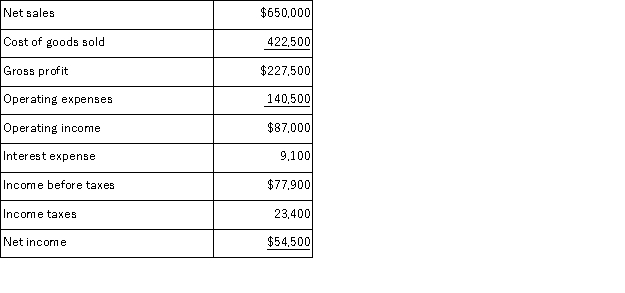

(Essay)
4.8/5 (75)
(75) Refer to the following selected financial information from McCormik, LLC. Compute the company's accounts receivable turnover for Year 2. 
(Multiple Choice)
4.7/5 (94)
(94) All of the following statements regarding a business segment are true except:
(Multiple Choice)
4.8/5 (80)
(80) The debt ratio, the equity ratio, pledged assets to secured liabilities, and times interest earned are all ___________________ ratios.
(Short Answer)
4.8/5 (92)
(92) Jones Corp. reported current assets of $193,000 and current liabilities of $137,000 on its most recent balance sheet. The working capital is:
(Multiple Choice)
4.8/5 (76)
(76) A rough guideline states that for a company with no discounts offered, days' sales uncollected should not exceed 1 1/3 times the days in its credit period.
(True/False)
4.9/5 (82)
(82) For the following financial statement items, calculate trend percentages using 2014 as the base year: 
(Essay)
4.8/5 (70)
(70) 
Filters
- Essay(0)
- Multiple Choice(0)
- Short Answer(0)
- True False(0)
- Matching(0)