



 Chat with AI
Exam 1: Accounting: Information for Decision Making

Exam 1: Accounting: Information for Decision Making116 Questions
Exam 2: Basic Financial Statements115 Questions
Exam 3: The Accounting Cycle: Capturing Economic Events126 Questions
Exam 4: The Accounting Cycle: Accruals and Deferrals117 Questions
Exam 5: The Accounting Cycle: Reporting Financial Results111 Questions
Exam 6: Merchandising Activities122 Questions
Exam 7: Financial Assets182 Questions
Exam 8: Inventories and the Cost of Goods Sold120 Questions
Exam 9: Plant and Intangible Assets141 Questions
Exam 10: Liabilities143 Questions
Exam 11: Stockholders Equity: Paid-In Capital120 Questions
Exam 12: Income and Changes in Retained Earnings125 Questions
Exam 13: Statement of Cash Flows130 Questions
Exam 14: Financial Statement Analysis114 Questions
Exam 15: Global Business and Accounting78 Questions
Exam 16: Management Accounting: a Business Partner104 Questions
Exam 17: Job Order Cost Systems and Overhead Allocations94 Questions
Exam 18: Process Costing65 Questions
Exam 19: Costing and the Value Chain62 Questions
Exam 20: Cost-Volume-Profit Analysis88 Questions
Exam 21: Incremental Analysis70 Questions
Exam 22: Responsibility Accounting and Transfer Pricing72 Questions
Exam 23: Operational Budgeting79 Questions
Exam 24: Standard Cost Systems91 Questions
Exam 25: Rewarding Business Performance53 Questions
Exam 26: Capital Budgeting74 Questions
Exam 27: Forms of Business Organization52 Questions
Exam 28: The Time Value of Money: Future Amounts and Present Values50 Questions
Select questions type


Which of the following events is not a transaction that would be recorded in a company's accounting records?
(Multiple Choice)
4.9/5  (81)
(81) Accounting Terminology
Listed below are 8 accounting terms. 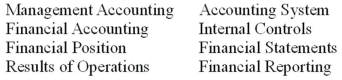 Each of the following statements may (or may not)describe one of these terms.In the space provided,indicate the accounting term described or answer "None" if the statement does not accurately describe any of the terms.
(A.)Information describing the financial resources,obligations,and activities of an economic entity.
(B.)An entity's financial resources and obligations at a point in time.
(C.)Accounting information intended specifically to assist company's management.
(D.)The personnel,procedures,and technology used by an organization to develop accounting information and to communicate this information to decision makers.
(E.)An entity's financial activities during the year.
(F.)Measures used by an organization to guard against errors,waste,and fraud and to assure the reliability of accounting information.
(G.)A plan of financial operations for some future period.
(H.)A written assertion identifying,measuring,and communicating financial information about an economic entity.
Each of the following statements may (or may not)describe one of these terms.In the space provided,indicate the accounting term described or answer "None" if the statement does not accurately describe any of the terms.
(A.)Information describing the financial resources,obligations,and activities of an economic entity.
(B.)An entity's financial resources and obligations at a point in time.
(C.)Accounting information intended specifically to assist company's management.
(D.)The personnel,procedures,and technology used by an organization to develop accounting information and to communicate this information to decision makers.
(E.)An entity's financial activities during the year.
(F.)Measures used by an organization to guard against errors,waste,and fraud and to assure the reliability of accounting information.
(G.)A plan of financial operations for some future period.
(H.)A written assertion identifying,measuring,and communicating financial information about an economic entity. (Essay)
4.8/5 (84)
(84) Management accounting information is oriented toward the future while financial accounting information is historical in nature.
(True/False)
4.8/5 (72)
(72) Accounting terminology
Listed below are nine accounting terms introduced in this chapter:  Each of the following statements may (or may not)describe one of these terms.In the space provided below each statement,indicate the accounting term described,or answer "None" if the statement does not correctly describe any of the terms.More than one statement may describe a single term.
(A.)The repayment to an investor of the amount originally invested in an enterprise.
(B.)An examination of financial statements designed to determine their fairness in relation to generally accepted accounting principles.
(C.)The accounting standards and concepts used in the preparation of financial statements.
(D.)A system of measures designed to assure management that all aspects of the business are operating according to plan.
(E.)A listing of assets,liabilities,and stockholders' equity as of a specific date.
(F.)The payment of an amount for using another's money.
(G.)An activity statement that shows the details of the company's activities involving cash during a period of time.
Each of the following statements may (or may not)describe one of these terms.In the space provided below each statement,indicate the accounting term described,or answer "None" if the statement does not correctly describe any of the terms.More than one statement may describe a single term.
(A.)The repayment to an investor of the amount originally invested in an enterprise.
(B.)An examination of financial statements designed to determine their fairness in relation to generally accepted accounting principles.
(C.)The accounting standards and concepts used in the preparation of financial statements.
(D.)A system of measures designed to assure management that all aspects of the business are operating according to plan.
(E.)A listing of assets,liabilities,and stockholders' equity as of a specific date.
(F.)The payment of an amount for using another's money.
(G.)An activity statement that shows the details of the company's activities involving cash during a period of time. (Essay)
4.8/5 (73)
(73) Which organization best serves the professional needs of a CPA?
(Multiple Choice)
5.0/5 (93)
(93) The FASB takes on a responsibility to do the following,except:
(Multiple Choice)
4.8/5 (75)
(75) The CPA examination is administered by the General Accounting Office of the U.S.Government.
(True/False)
4.8/5 (77)
(77) Management accounting information is oriented toward the future while financial accounting information is historical in nature.
(True/False)
5.0/5 (85)
(85) The annual financial statements of large corporations such as Microsoft or PepsiCo need not be audited by independent certified public accountants,since these firms maintain large accounting departments as part of their organizations.
(True/False)
4.8/5 (88)
(88) The basic purpose of generally accepted accounting principles is to:
(Multiple Choice)
4.9/5 (84)
(84) Development of generally accepted accounting principles
(A.)What is meant by the phrase "generally accepted accounting principles"?
(B.)Give the names of three organizations that currently play an active role in the development of accounting principles in the United States.
(Essay)
4.7/5 (74)
(74) Which financial statement is prepared as of a specific date?
(Multiple Choice)
4.7/5 (73)
(73) Accounting terminology
Listed below are seven accounting organizations introduced in this chapter: 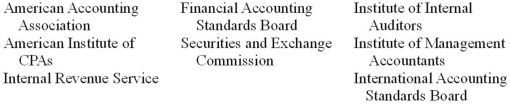 Each of the following statements may (or may not)describe one of these organizations.In the space provided below each statement,indicate the accounting organization described,or answer "None" if the statement does not correctly describe any of the organizations.
(A.)Private sector organization that establishes accounting standards.
(B.)A professional organization that establishes standards for the conduct of professional services other than audits.
(C.)A government organization that establishes financial reporting requirements for publicly-held companies in the United States.
(D.)A federal government agency that audits many other agencies of the federal government and reports its findings to Congress.
(E.)A professional organization dedicated to the improvement of accounting education,research,and practice.
(F.)A professional organization that influences the concepts and ethical practice of management accounting.
(G.)A professional organization that establishes global accounting standards.
Each of the following statements may (or may not)describe one of these organizations.In the space provided below each statement,indicate the accounting organization described,or answer "None" if the statement does not correctly describe any of the organizations.
(A.)Private sector organization that establishes accounting standards.
(B.)A professional organization that establishes standards for the conduct of professional services other than audits.
(C.)A government organization that establishes financial reporting requirements for publicly-held companies in the United States.
(D.)A federal government agency that audits many other agencies of the federal government and reports its findings to Congress.
(E.)A professional organization dedicated to the improvement of accounting education,research,and practice.
(F.)A professional organization that influences the concepts and ethical practice of management accounting.
(G.)A professional organization that establishes global accounting standards. (Essay)
4.9/5 (69)
(69) Financial statements
Briefly describe the balance sheet,the income statement,and the statement of cash flows.
(Essay)
4.8/5 (78)
(78) Establishing international accounting standards is the responsibility of:
(Multiple Choice)
4.8/5 (70)
(70) 
Filters
- Essay(0)
- Multiple Choice(0)
- Short Answer(0)
- True False(0)
- Matching(0)