



 Chat with AI
Exam 18: Process Costing

Exam 1: Accounting: Information for Decision Making116 Questions
Exam 2: Basic Financial Statements115 Questions
Exam 3: The Accounting Cycle: Capturing Economic Events126 Questions
Exam 4: The Accounting Cycle: Accruals and Deferrals117 Questions
Exam 5: The Accounting Cycle: Reporting Financial Results111 Questions
Exam 6: Merchandising Activities122 Questions
Exam 7: Financial Assets182 Questions
Exam 8: Inventories and the Cost of Goods Sold120 Questions
Exam 9: Plant and Intangible Assets141 Questions
Exam 10: Liabilities143 Questions
Exam 11: Stockholders Equity: Paid-In Capital120 Questions
Exam 12: Income and Changes in Retained Earnings125 Questions
Exam 13: Statement of Cash Flows130 Questions
Exam 14: Financial Statement Analysis114 Questions
Exam 15: Global Business and Accounting78 Questions
Exam 16: Management Accounting: a Business Partner104 Questions
Exam 17: Job Order Cost Systems and Overhead Allocations94 Questions
Exam 18: Process Costing65 Questions
Exam 19: Costing and the Value Chain62 Questions
Exam 20: Cost-Volume-Profit Analysis88 Questions
Exam 21: Incremental Analysis70 Questions
Exam 22: Responsibility Accounting and Transfer Pricing72 Questions
Exam 23: Operational Budgeting79 Questions
Exam 24: Standard Cost Systems91 Questions
Exam 25: Rewarding Business Performance53 Questions
Exam 26: Capital Budgeting74 Questions
Exam 27: Forms of Business Organization52 Questions
Exam 28: The Time Value of Money: Future Amounts and Present Values50 Questions
Select questions type


Debiting Work in Process in Department Two and crediting Work in Process in Department One represents costs transferred from Department Two to Department One.
(True/False)
5.0/5  (65)
(65) Process costing system-journal entries
Milton Manufacturing uses a process costing system.Products are processed successively by Department X and Department Y and are then transferred to the finished goods warehouse.Shown below is cost information for Department Y during the month of May: 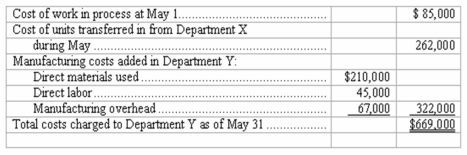 The cost of work in process in Department Y at May 31 has been determined to be $113,500.
In the space provided,prepare a general journal entry to summarize for the month of May each of the following categories of transactions (you may omit explanations):
(a.)The transfer of production from Department X to Department Y.
(b.)The recording of manufacturing costs incurred in Department Y during May.(Use a single journal entry.)
(c.)The transfer of completed units from Department Y to the finished goods warehouse.
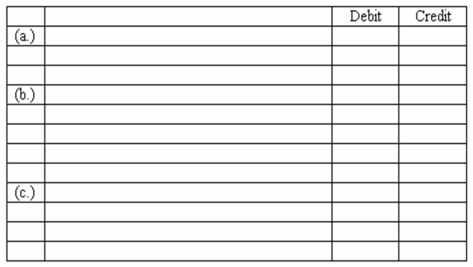
The cost of work in process in Department Y at May 31 has been determined to be $113,500.
In the space provided,prepare a general journal entry to summarize for the month of May each of the following categories of transactions (you may omit explanations):
(a.)The transfer of production from Department X to Department Y.
(b.)The recording of manufacturing costs incurred in Department Y during May.(Use a single journal entry.)
(c.)The transfer of completed units from Department Y to the finished goods warehouse. (Essay)
4.8/5 (75)
(75) In a production cost report,the units in beginning Work in Process are always expressed as equivalent units.
(True/False)
4.8/5 (75)
(75) Job order and process costing systems
There are two distinct types of cost accounting systems: job order costing systems and process costing systems.How does management decide whether to use a job order costing system or a process costing system in any given manufacturing situation? Explain briefly.
(Essay)
4.8/5 (75)
(75) The cost transferred to Cost of Goods Sold is equal to the total manufacturing costs incurred for the units sold.
(True/False)
4.8/5 (83)
(83) United Construction Company,which manufactures residential buildings,would most likely use a process costing system.
(True/False)
4.8/5 (73)
(73) In either a job order or a process costing system,credits to the Materials Inventory account represent:
(Multiple Choice)
4.8/5 (91)
(91) As costs flow from one production department to the next in a process costing system,one Work in Process Inventory account shows all the changes to the units in production.
(True/False)
4.8/5 (74)
(74) A process costing system is suitable for a company with a large volume of standard products produced on a relatively continuous basis,for example,golf balls or petroleum.
(True/False)
4.8/5 (82)
(82) Equivalent units of production significantly differ from units completed and transferred during the period only when no significant differences exist between beginning and ending work in process.
(True/False)
4.8/5 (72)
(72) Process costing system-journal entries
Joyce Industries uses a process costing system.All of the company's manufacturing activities take place in a single processing department.There was no beginning inventory in May.During the month,$60,000 of materials were added and $40,000 of labor and $75,000 of overhead costs were charged to work in process.The entire work in process inventory of 20,000 units was completed and transferred to finished goods.Of these 20,000 units,15,000 were sold on account at $14 per unit.
In the space provided,prepare a general journal entry to summarize each of the following categories of transactions for the month of May (you may omit explanations):
(a.)The recording of manufacturing costs applied to production (use a single journal entry).
(b.)The transfer of completed units from work in process to the finished goods warehouse.
(c.)The sale of 15,000 units manufactured during the month and the related cost of goods sold. 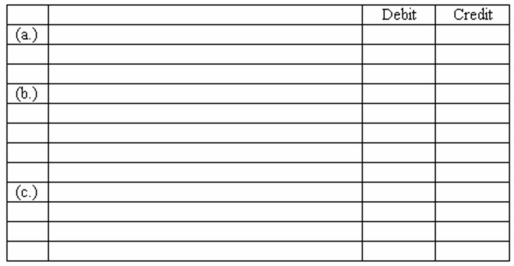
(Essay)
4.7/5 (84)
(84) To identify the cause of a change in a product total unit cost,management may:
(Multiple Choice)
4.9/5 (69)
(69) Equivalent units
What is meant by the term equivalent units? How is this concept used in computing average unit costs?
(Essay)
4.7/5 (93)
(93) Jiffy Company has 3,000 units that are 70% complete.Jiffy's "equivalent units" are 3,000 completed units.
(True/False)
4.9/5 (81)
(81) During the month of August,$582,000 of costs were transferred from the Mixing Department to the Baking Department.The journal entry to summarize the transfer of these costs includes:
(Multiple Choice)
4.9/5 (85)
(85) In most process costing systems,per-unit costs are determined by:
(Multiple Choice)
4.9/5 (72)
(72) Completing 3,000 units which were each 75% complete at the beginning of the period represents 2,250 equivalent units of work during the current period.
If at the beginning of the period 3,000 units were 75% completed,then to complete these units during the current period,the equivalent units = 3,000 × (100% - 75%)= 750 equivalent units.
(True/False)
4.7/5 (82)
(82) 
Filters
- Essay(0)
- Multiple Choice(0)
- Short Answer(0)
- True False(0)
- Matching(0)