



 Chat with AI
Exam 20: Thermal Properties and Processes

Exam 1: Systems of Measurement86 Questions
Exam 2: Motion in One Dimension103 Questions
Exam 3: Motion in Two and Three Dimensions67 Questions
Exam 4: Newtons Laws117 Questions
Exam 5: Applications of Newtons Laws75 Questions
Exam 6: Work and Energy71 Questions
Exam 7: Conservation of Energy73 Questions
Exam 8: Systems of Particles and Conservation of Linear Momentum107 Questions
Exam 9: Rotation119 Questions
Exam 10: Conservation of Angular Momentum67 Questions
Exam 11: Gravity90 Questions
Exam 12: Static Equilibrium and Elasticity65 Questions
Exam 13: Fluids91 Questions
Exam 14: Oscillations138 Questions
Exam 15: Wave Motion122 Questions
Exam 16: Superposition and Standing Waves125 Questions
Exam 17: Temperature and the Kinetic Theory of Gases85 Questions
Exam 18: Heat and the First Law of Thermodynamics114 Questions
Exam 19: The Second Law of Thermodynamics61 Questions
Exam 20: Thermal Properties and Processes54 Questions
Select questions type


A solid sphere at temperature T radiates energy at a rate of R J/s. If the radius of the sphere were doubled (its temperature remains at T), then the rate of radiating energy would go up by a factor of
(Multiple Choice)
4.7/5  (78)
(78) Calculate the rate of heat transfer from a 1.5 m 1.0 m window frame that is made of aluminum. The thickness of the frame is 1 mm and measures 3 cm from inside to outside. The inside room temperature is 25 C and outside temperature is 0 C.
(Multiple Choice)
4.8/5 (77)
(77) Which of the following processes of heat transfer is independent of the area exposed?
(Multiple Choice)
4.9/5 (81)
(81) If is the coefficient of linear expansion of a material at 0ºC, the volume thermal-expansion coefficient of this material at 0ºC is
(Multiple Choice)
4.9/5 (73)
(73) 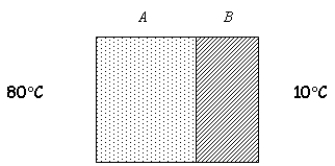 You are testing thermal conduction through a composite material made up of two layers, A and B. Layer A is twice as thick as layer B, and the thermal conductivity of material A is three times higher than that of material B. If the temperature on the outside surface of A is 80 C, and the temperature on the outside surface of B is 10 C, find the temperature at the interface of the two materials once a steady state of heat flow has been established.
 (Multiple Choice)
5.0/5 (74)
(74) A clock pendulum made of aluminum, which has a coefficient of linear expansion of 24 10-6/K, has a period of exactly 1 s at 20ºC. Before a homeowner leaves town for one week, he turns the thermostat down to 10ºC. When he returns, the clock is
(Multiple Choice)
4.8/5 (77)
(77) A certain blackbody radiates 100 W at a temperature of 2000 K. How much power would this body radiate at 3000 K?
(Multiple Choice)
4.8/5 (80)
(80) A thermo keeps a hot drink hot and a cold drink cold for a long time. Shown below is a cut-away section of a thermo with the important features labeled. The reason for the silvered double-wall vacuum chamber is 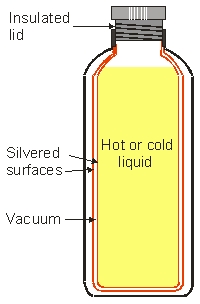
(Multiple Choice)
4.9/5 (73)
(73) A well-known technique for achieving a very tight fit between two components is to "expand by heating and then cool to shrink fit." For example, an aluminum ring of inner radius 5.98 cm needs to be firmly bonded to a cylindrical shaft of radius 6.00 cm (Measurements are at 20 C). Calculate the minimum temperature to which the aluminum ring needs to be heated before it can be slipped over the shaft for fitting.
(Coefficient of linear expansion for Al = 24 10-6/K.)
(Multiple Choice)
4.8/5 (81)
(81) Modern railway tracks consist of continuous welded-steel rails of 1.0-km lengths. If the coefficient of linear expansion of steel is 11 10-6 K-1, by how much would such a rail change in length between the highest summer temperature (40ºC) and the lowest winter temperature (-40ºC)?
(Multiple Choice)
5.0/5 (84)
(84) You are trying to decide what the change in heat loss would be if you put a
100 cm 150 cm and 5-mm thick glass window in an outside wall. The thickness of the wall is 15 cm. If the thermal conductivities of the glass and wall are 0.90 W/m·K and 0.15 W/m·K respectively, calculate the difference in heat loss through thermal conductivity with and without the window when the outside temperature is -10 C and the inside temperature is 15 C.
(Multiple Choice)
4.9/5 (82)
(82) You have cut a hole in the middle of a large sheet of metal. When the sheet is heated, the area of the hole
(Multiple Choice)
4.8/5 (71)
(71) If the thickness of a uniform wall is halved, the rate at which heat is conducted through the wall is
(Multiple Choice)
5.0/5 (83)
(83) 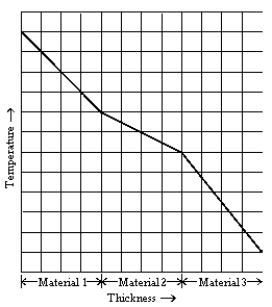 The graph shows temperature as a function of thickness in three adjacent slabs of material of equal thickness. Assuming the heat transfer through the compound slabs is in a steady state, what can you say of these materials?
 (Multiple Choice)
4.8/5 (87)
(87) The coefficient of thermal expansion of water at 20ºC is 0.207 x 10⁻³ K-1 A thin glass tube contains a 75.0 cm column of water at 20ºC. If the thermal expansion of the glass tube is negligible, by how much does the length of the column of water expand when it is heated to 80ºC?
(Multiple Choice)
4.8/5 (94)
(94) If the thickness of a uniform wall is doubled, the rate at which heat is conducted through the wall is
(Multiple Choice)
4.8/5 (82)
(82) 
Filters
- Essay(0)
- Multiple Choice(0)
- Short Answer(0)
- True False(0)
- Matching(0)