



 Chat with AI
Exam 18: Heat and the First Law of Thermodynamics

Exam 1: Systems of Measurement86 Questions
Exam 2: Motion in One Dimension103 Questions
Exam 3: Motion in Two and Three Dimensions67 Questions
Exam 4: Newtons Laws117 Questions
Exam 5: Applications of Newtons Laws75 Questions
Exam 6: Work and Energy71 Questions
Exam 7: Conservation of Energy73 Questions
Exam 8: Systems of Particles and Conservation of Linear Momentum107 Questions
Exam 9: Rotation119 Questions
Exam 10: Conservation of Angular Momentum67 Questions
Exam 11: Gravity90 Questions
Exam 12: Static Equilibrium and Elasticity65 Questions
Exam 13: Fluids91 Questions
Exam 14: Oscillations138 Questions
Exam 15: Wave Motion122 Questions
Exam 16: Superposition and Standing Waves125 Questions
Exam 17: Temperature and the Kinetic Theory of Gases85 Questions
Exam 18: Heat and the First Law of Thermodynamics114 Questions
Exam 19: The Second Law of Thermodynamics61 Questions
Exam 20: Thermal Properties and Processes54 Questions
Select questions type


Use the following to answer question : 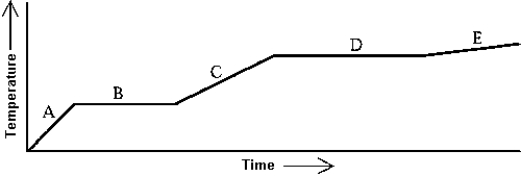 -Heat is added to a substance at a constant rate. The substance starts as a solid and is melted; the liquid is heated and vaporized; finally, the vapor is heated at constant volume. This process is shown in the graph. The specific heat at constant volume of the vapor can be found by
 (Multiple Choice)
4.9/5  (81)
(81) Use the following to answer question : 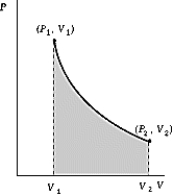 -One mole of an ideal gas ( = 5/3) expands adiabatically and quasistatically from a pressure P1 = 3 atm and a temperature of 30ºC to a pressure P2 = 1 atm. How much work is done by the gas during this process? R = 8.314 J/mol·K = 8.206 L·atm/mol·K.
 (Multiple Choice)
4.8/5 (80)
(80) Use the following to answer question :
-Heat is added to a substance at a constant rate. The substance starts as a solid and is melted; the liquid is heated and vaporized; finally, the vapor is heated. This process is shown in the graph. The specific heat of the solid can be found by
-Heat is added to a substance at a constant rate. The substance starts as a solid and is melted; the liquid is heated and vaporized; finally, the vapor is heated. This process is shown in the graph. The specific heat of the solid can be found by (Multiple Choice)
4.7/5 (70)
(70) If the heat capacities of both ice and steam are 0.5 cal/g · Cº, the quantity of heat required to change 1 g of ice at -10ºC to steam at 120ºC is approximately
(Multiple Choice)
4.9/5 (87)
(87)  An ideal gas undergoes a cyclic expansion and compression along the path a b c a as shown above. The work done along c a of the cycle is the area
 (Multiple Choice)
4.7/5 (82)
(82) A 1.0-kg piece of marble at 100ºC is dropped into 2.5 kg of water at 1.0ºC and the resulting temperature is 7.0ºC. The specific heat of the marble is approximately
(Multiple Choice)
4.8/5 (71)
(71) Use the following to answer question : 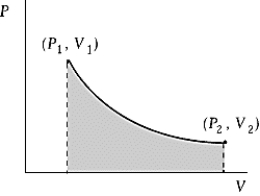 -An ideal gas initially at 100ºC and pressure P1 = 250 kPa occupies a volume V1 = 4.5 L. It undergoes a quasistatic, isothermal expansion until its pressure is reduced to 150 kPa. How much does the internal energy of the gas change during this process? R = 8.314 J/mol·K = 8.206 L·atm/mol·K.
 (Multiple Choice)
4.8/5 (81)
(81)  The work done by a gas on a piston can be obtained from the graph, provided the abscissa represents the
 (Multiple Choice)
4.9/5 (77)
(77) During a certain thermodynamic process, 418 J of work are done on a system and 214 cal of heat are transferred to the system. The change in internal energy during the process is
(Multiple Choice)
4.8/5 (82)
(82) 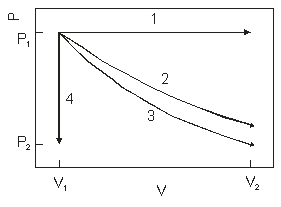 The diagram above show the state of an ideal gas going from (V1,P1) to a final state. Which path best represents adiabatic expansion?
 (Multiple Choice)
4.9/5 (77)
(77) A container contains a 200 mL of 100% proof alcohol (i.e., it has 50% ethyl alcohol and 50% water by volume) at 20 C. How much heat is needed to bring the mixture to the boiling point of the alcohol? (assume that the specific heat in the 100% proof can be treated as due to the alcohol and water separately, and the density, boiling point and specific heat of alcohol are 0.81 g/cm3, 78 C, and 2.4 J/(g.C ), respectively)
(Multiple Choice)
4.7/5 (72)
(72) In a certain thermodynamic process, 1000 cal of heat are added to a gas confined in a cylinder. At the same time, 1000 J of work are done by the gas as it expands. The increase in internal energy of the gas is
(Multiple Choice)
4.9/5 (87)
(87) Use the following to answer question :
-An ideal gas initially at 50ºC and pressure P1 = 100 kPa occupies a volume V1 = 3 L. It undergoes a quasistatic, isothermal expansion until its pressure is reduced to 50 kPa. How much heat enters the gas during this process? R = 8.314 J/mol·K = 8.206 L·atm/mol·K.
-An ideal gas initially at 50ºC and pressure P1 = 100 kPa occupies a volume V1 = 3 L. It undergoes a quasistatic, isothermal expansion until its pressure is reduced to 50 kPa. How much heat enters the gas during this process? R = 8.314 J/mol·K = 8.206 L·atm/mol·K. (Multiple Choice)
4.9/5 (75)
(75)  A reversible heat engine has the PV graph shown. The net work performed in one cycle is approximately
 (Multiple Choice)
4.7/5 (80)
(80) An ideal monatomic gas has a molar heat capacity Cmp at constant pressure. What is the molar heat capacity at constant volume of an ideal diatomic gas?
(Multiple Choice)
4.8/5 (94)
(94) Use the following to answer question : 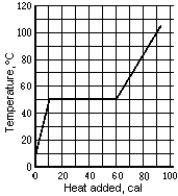 -The graph shows the temperature of a 1.0-g sample of material as heat is added to it. The material is initially a solid at 10ºC. The pressure remains constant, and there is no chemical change. The heat of fusion of the material is
 (Multiple Choice)
4.9/5 (96)
(96) For most metals, the heat capacity goes as C = T + AT3 at low temperatures (~ 100 K), whereas insulators only has the T3 term. Both and A are constants. The two terms in the expression for C suggests
(Multiple Choice)
4.7/5 (83)
(83) 
Filters
- Essay(0)
- Multiple Choice(0)
- Short Answer(0)
- True False(0)
- Matching(0)