



 Chat with AI
Exam 6: Work and Energy

Exam 1: Systems of Measurement86 Questions
Exam 2: Motion in One Dimension103 Questions
Exam 3: Motion in Two and Three Dimensions67 Questions
Exam 4: Newtons Laws117 Questions
Exam 5: Applications of Newtons Laws75 Questions
Exam 6: Work and Energy71 Questions
Exam 7: Conservation of Energy73 Questions
Exam 8: Systems of Particles and Conservation of Linear Momentum107 Questions
Exam 9: Rotation119 Questions
Exam 10: Conservation of Angular Momentum67 Questions
Exam 11: Gravity90 Questions
Exam 12: Static Equilibrium and Elasticity65 Questions
Exam 13: Fluids91 Questions
Exam 14: Oscillations138 Questions
Exam 15: Wave Motion122 Questions
Exam 16: Superposition and Standing Waves125 Questions
Exam 17: Temperature and the Kinetic Theory of Gases85 Questions
Exam 18: Heat and the First Law of Thermodynamics114 Questions
Exam 19: The Second Law of Thermodynamics61 Questions
Exam 20: Thermal Properties and Processes54 Questions
Select questions type


Car drag racing takes place over a distance of a  mile (402 m) from a standing start. If a car (mass 1500 kg) could be propelled forward with a pulling force equal to that of gravity, what would be the change in kinetic energy and the terminal speed of the car (in mph) at the end of the race be? (For comparison, a modern, high-performance sports car may reach a terminal speed of just over 100 mph = 44.7 m/s.)
 (Multiple Choice)
4.9/5  (84)
(84) A particle that is subjected to a variable force travels a distance of 20 m in a straight line in the same direction as the force. The force varies as follows:
First, 5.0 m and F = 0
Next, 5.0 m and F = 3.0 N
Next, 5.0 m and F = 6.0
Last, 5.0 m and F decreases uniformly from 6.0 N to zero
What was the total work done by this force during the full 20-m trip?
(Multiple Choice)
5.0/5 (88)
(88) 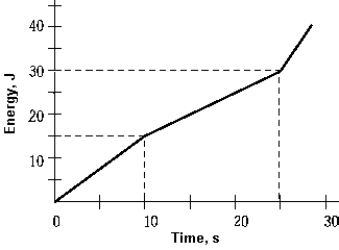 An electrical appliance expends energy as shown in the graph. The power developed in the appliance between t = 15 s and t = 25 s is
 (Multiple Choice)
4.8/5 (83)
(83) Use the figure to answer the question. The graph shows the speed of a light truck of mass 4000 kg coasting on neutral down a level straight road. The truck is slowing down due to air resistance and rolling friction. 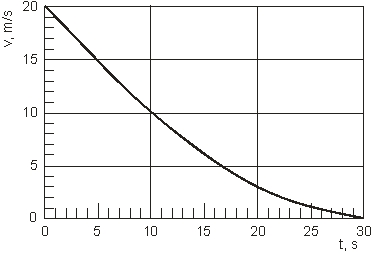 -Estimate the work done per second by the retarding force at t = 5s.
 (Multiple Choice)
4.8/5 (64)
(64) A skier of mass 50 kg is moving at speed 10 m/s at point P1 down a ski slope with negligible friction. What is the skier's kinetic energy when she is at point P2, 20 m below P1? 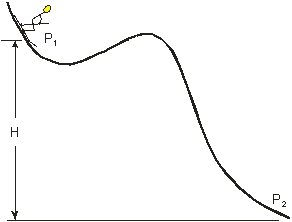
(Multiple Choice)
4.9/5 (80)
(80) If a fighter jet doubles its speed, by what factor should the power from the engine change?
(Multiple Choice)
4.7/5 (79)
(79) 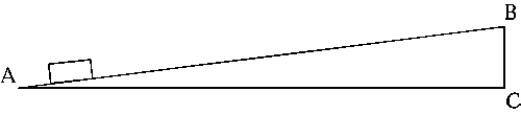 The object in the figure has a mass of 3.45 kg and is pulled up a slope AB, which is 36 m long; the height BC is 3.00 m. There is no friction and the acceleration is constant. The speed v1 at A is 3.5 m/s whereas the speed v2 at B is 5.5 m/s. The average power developed by the motor pulling the object is
 (Multiple Choice)
4.8/5 (90)
(90) Two forces, both of magnitude 12 N and directed 35 degrees either side of the direction of motion, pull a crate 15 m. How much work is done by the forces in moving the crate?
(Multiple Choice)
4.9/5 (79)
(79) 
Filters
- Essay(0)
- Multiple Choice(0)
- Short Answer(0)
- True False(0)
- Matching(0)