



 Chat with AI
Exam 5: Applications of Newtons Laws

Exam 1: Systems of Measurement86 Questions
Exam 2: Motion in One Dimension103 Questions
Exam 3: Motion in Two and Three Dimensions67 Questions
Exam 4: Newtons Laws117 Questions
Exam 5: Applications of Newtons Laws75 Questions
Exam 6: Work and Energy71 Questions
Exam 7: Conservation of Energy73 Questions
Exam 8: Systems of Particles and Conservation of Linear Momentum107 Questions
Exam 9: Rotation119 Questions
Exam 10: Conservation of Angular Momentum67 Questions
Exam 11: Gravity90 Questions
Exam 12: Static Equilibrium and Elasticity65 Questions
Exam 13: Fluids91 Questions
Exam 14: Oscillations138 Questions
Exam 15: Wave Motion122 Questions
Exam 16: Superposition and Standing Waves125 Questions
Exam 17: Temperature and the Kinetic Theory of Gases85 Questions
Exam 18: Heat and the First Law of Thermodynamics114 Questions
Exam 19: The Second Law of Thermodynamics61 Questions
Exam 20: Thermal Properties and Processes54 Questions
Select questions type


A boy is standing at the stern (back) of a boat that is 8.0 m long. There is no friction between the boat and the water. The boy has a mass of 63 kg and the boat has a mass of 780 kg. The bow (front) of the boat is touching a dock and the fore-and-aft axis of the boat is perpendicular to the dock. The boy walks from the stern of the boat to the bow. When he reaches the bow, his distance from the dock is
(Multiple Choice)
4.9/5  (77)
(77) A box (m = 20 kg) is sitting on a horizontal surface. It is connected to a massless hook by a light string passing over a massless pulley wheel. The coefficients of friction between the box and the surface are 0.50 (static) and 0.30 (kinetic). On top of m is a second box M of mass 20 kg. The coefficients of friction between the boxes m and M are 0.80 (static) and 0.60 (kinetic). How much weight needs to be added to the hook until the box just begins to move. 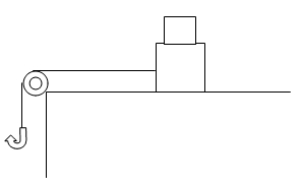
(Multiple Choice)
4.8/5 (77)
(77) The blocks shown in the figures have equal masses and are made of the same material. The velocity is the same in each figure. The total frictional force exerted by the surface on the blocks is 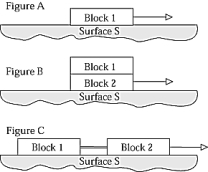
(Multiple Choice)
4.7/5 (95)
(95) The mass of the rectangle in the figure is M, the mass of the ring is M, and the mass of the circle is 3M. The center of mass of the system with respect to the origin O is located at point 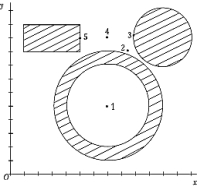
(Multiple Choice)
4.9/5 (77)
(77) A ball of mass m is attached to a thin string and whirled in a vertical circle or radius r. The tension in the string at point e where the ball is moving with speed v is 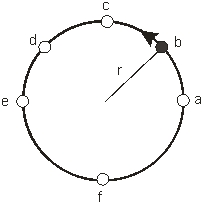
(Multiple Choice)
4.7/5 (74)
(74) A block slides down a frictionless incline. The path at the bottom of the incline is an arc of a circle. The direction of the net force on the block at the bottom of the arc (point P) is along (use the compass rose) 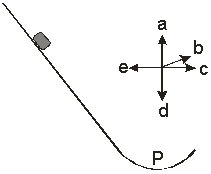
(Multiple Choice)
4.9/5 (85)
(85) If a jet plane doubles the speed, the drag force on the jet plane
(Multiple Choice)
4.9/5 (72)
(72) A car going around a curve of radius R at a speed V experiences a centripetal acceleration ac. What is its acceleration if it goes around a curve of radius 3R at a speed of 2V?
(Multiple Choice)
4.8/5 (74)
(74) The figure shows a top view of a ball on the end of a string traveling counterclockwise in a circular path. Assume that air resistance is negligible. The free-body diagram that best represents the acceleration of the ball is 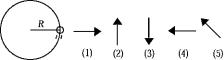
(Multiple Choice)
4.8/5 (72)
(72) A block of mass m is pulled in the direction shown in the figure across a rough surface with a constant acceleration  . The magnitude of the frictional force is
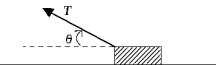
. The magnitude of the frictional force is (Multiple Choice)
4.9/5 (76)
(76) A mass m is placed on a rough incline at an angle to the horizon. A force F is applied up the incline, to prevent the mass from sliding down the incline, and it is just enough to prevent the mass from sliding down the incline. Using the compass rose, the direction of the frictional force is along 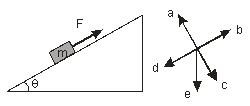
(Multiple Choice)
4.8/5 (88)
(88) A mass m is placed on a rough incline at an angle to the horizon. A force F is applied up the incline so that the mass slides up the incline. Using the compass rose, the direction of the frictional force is along 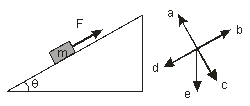
(Multiple Choice)
4.7/5 (72)
(72) A 1.0-kg mass is acted on by a net force of 4.0 N and a 3.0-kg mass is acted on by a net force of 3.0 N, in the directions shown. The acceleration of the center of mass of this system is approximately 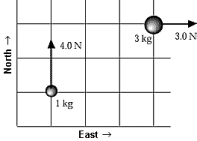
(Multiple Choice)
4.7/5 (80)
(80) In the equation F = bv, F is the force on an object that is moving in a viscous medium, b is a constant, and v is the speed of the falling object. The SI units of the constant b are
(Multiple Choice)
4.8/5 (67)
(67) The figure shows a top view of a ball on the end of a string traveling counterclockwise in a circular path. Assume that air resistance is negligible. The free-body diagram that best represents the net force acting on the ball is 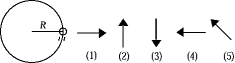
(Multiple Choice)
4.9/5 (66)
(66) A worker pulls horizontally on a rope that is attached to a 10-kg crate resting on a rough floor. The coefficients of static and kinetic friction are 0.5 and 0.3, respectively. The worker pulls with a force of 40 N. The frictional force exerted by the surface is
(Multiple Choice)
4.9/5 (63)
(63) A heavy truck and a light car are traveling at the same speed on the same roadway. If the coefficients of static friction between their tires and the road are the same, which vehicle will be able to stop in the shortest distance? Assume both have the same braking force.
(Multiple Choice)
4.9/5 (87)
(87) A block is placed on a plane whose angle of inclination is 30º. The coefficients of static and kinetic friction for the block on the inclined plane are both 0.2. The block
(Multiple Choice)
4.7/5 (86)
(86) A barbell is 1.5 m long. Three weights, each of mass 20 kg, are hung on the left and two weights of the same mass, on the right. The width of each weight is 4 cm and each group of weights is placed 4 cm from the ends. Where is the center of mass of the barbell as measured from the mid-point, M, of the bar? The bar is of uniform mass and has mass 5 kg, and the retaining collars are of negligible mass. Take to the right as positive. 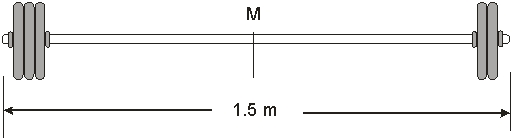
(Multiple Choice)
4.7/5 (87)
(87) 
Filters
- Essay(0)
- Multiple Choice(0)
- Short Answer(0)
- True False(0)
- Matching(0)