



 Chat with AI
Exam 2: Motion in One Dimension

Exam 1: Systems of Measurement86 Questions
Exam 2: Motion in One Dimension103 Questions
Exam 3: Motion in Two and Three Dimensions67 Questions
Exam 4: Newtons Laws117 Questions
Exam 5: Applications of Newtons Laws75 Questions
Exam 6: Work and Energy71 Questions
Exam 7: Conservation of Energy73 Questions
Exam 8: Systems of Particles and Conservation of Linear Momentum107 Questions
Exam 9: Rotation119 Questions
Exam 10: Conservation of Angular Momentum67 Questions
Exam 11: Gravity90 Questions
Exam 12: Static Equilibrium and Elasticity65 Questions
Exam 13: Fluids91 Questions
Exam 14: Oscillations138 Questions
Exam 15: Wave Motion122 Questions
Exam 16: Superposition and Standing Waves125 Questions
Exam 17: Temperature and the Kinetic Theory of Gases85 Questions
Exam 18: Heat and the First Law of Thermodynamics114 Questions
Exam 19: The Second Law of Thermodynamics61 Questions
Exam 20: Thermal Properties and Processes54 Questions
Select questions type


A sandbag is released from a rising air balloon and hits the ground 7 seconds later. From what height was the sandbag dropped from if at the moment of release the balloon was traveling upward at 3 m/s.
(Multiple Choice)
4.9/5  (91)
(91) A river 1.00 mile wide flows with a constant speed of 1.00 mi/h. A woman leaves from a point on the river bank. The woman rows a boat 1.00 mi directly upstream and returns to the starting point. Her speed in still water is 2.00 mi/h. The travel time for the woman is
(Multiple Choice)
4.8/5 (87)
(87) An object is at x = -3 m and has a velocity of - 4 m/s. It is observed to be slowing down. Its acceleration is
(Multiple Choice)
4.9/5 (75)
(75)  A car accelerates uniformly from a velocity of 10 km/h to 30 km/h in one minute. Which graph best describes the motion of the car?
 (Multiple Choice)
4.9/5 (92)
(92) For uniformly accelerated motion, which of the following quantities must be zero?
(Multiple Choice)
4.9/5 (85)
(85) If the speed of particle A is twice that of particle B, the distance particle B travels in a given interval of time as compared with particle A is
(Multiple Choice)
4.7/5 (79)
(79) The acceleration of a vehicle is given by a(t) = At where A is a constant. Its displacement as a function of time is (vo and xo are constants)
(Multiple Choice)
4.9/5 (94)
(94) A particle moves from x1 = 30 cm to x2 = - 40 cm. The displacement of this particle is
(Multiple Choice)
4.9/5 (81)
(81) An object is dropped from rest near the surface of Earth. If the time interval during which it falls is cut in half, the distance it falls will
(Multiple Choice)
4.8/5 (76)
(76) A vehicle is traveling in the -x direction to x = 100 m. It then reverses direction. At the instant when it changes direction, the acceleration of the vehicle is
(Multiple Choice)
4.9/5 (88)
(88)  An object moves along the x axis as shown in the diagram. At which point or points is the magnitude of its velocity a minimum?
 (Multiple Choice)
4.7/5 (84)
(84) Use the following to answer question :  -In which graph of v versus t does the particle end up farthest from its starting point?
 (Multiple Choice)
4.8/5 (81)
(81) 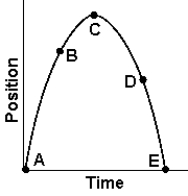 A ball has been thrown vertically upward. The graph shows the ball's position as a function of time. Which one of the following statements best describes the motion of the ball?
 (Multiple Choice)
4.8/5 (71)
(71)  An object moves along the x axis as shown in the diagram. At which point or points is the object instantaneously at rest?
 (Multiple Choice)
4.8/5 (82)
(82) A particle moves from x0 = 30 cm to x = -40 cm in 5 s. The average velocity of the particle during this time interval is
(Multiple Choice)
4.7/5 (81)
(81) A racecar starts from rest and accelerates at a constant rate and reaches a speed of 160 km/h (100 mph) in 6.0 seconds. It continues at this speed for another 5 seconds. What is the car's average speed during the first 11 seconds?
(Multiple Choice)
4.9/5 (75)
(75) If an object is moving at uniform speed in a straight line, its instantaneous velocity halfway through any time interval is
(Multiple Choice)
4.9/5 (81)
(81) A ball is thrown upward from an 80-ft tower with an initial vertical speed of 40 ft/s. If air resistance is ignored, the ball's speed when it reaches the ground will be
(Multiple Choice)
4.9/5 (85)
(85) An object is thrown upward with a velocity of 32 ft/s from a stationary balloon which is 48 ft above the ground. If air resistance is ignored, the total time until the object impacts the ground is
(Multiple Choice)
4.8/5 (75)
(75)  -For this problem, refer to the figure in problem 31. Which interval has the highest magnitude in acceleration?
 (Multiple Choice)
4.9/5 (72)
(72) 
Filters
- Essay(0)
- Multiple Choice(0)
- Short Answer(0)
- True False(0)
- Matching(0)