



 Chat with AI
Exam 4: Integrals

Exam 1: Functions and Limits95 Questions
Exam 2: Derivatives84 Questions
Exam 3: Applications of Differentiation155 Questions
Exam 4: Integrals169 Questions
Exam 5: Applications of Integration70 Questions
Exam 6: Inverse Functions95 Questions
Exam 7: Techniques of Integration124 Questions
Exam 8: Further Applications of Integration87 Questions
Exam 9: Differential Equations67 Questions
Exam 10: Parametric Equations and Polar Coordinates73 Questions
Exam 11: Infinite Sequences and Series158 Questions
Exam 12: Vectors and the Geometry of Space60 Questions
Exam 13: Vector Functions93 Questions
Exam 14: Partial Derivatives132 Questions
Exam 15: Multiple Integrals124 Questions
Exam 16: Vector Calculus137 Questions
Exam 17: Second-Order Differential Equations63 Questions
Exam 18: Final Exam44 Questions
Select questions type


Find the maximum area of a rectangle that can be circumscribed about a given rectangle with length L = 8 and width W = 3. 
(Short Answer)
5.0/5  (93)
(93) What is the shortest possible length of the line segment that is cut off by the first quadrant and is tangent to the curve at some point?
(Multiple Choice)
4.8/5 (63)
(63) Determine where the graph of the function is concave upward and where it is concave downward. Also, find all inflection points of the function.
(Multiple Choice)
4.8/5 (77)
(77) Find the relative extrema, if any, of . Use the Second Derivative Test, if possible.
(Multiple Choice)
4.8/5 (81)
(81) Use Newton's method with the specified initial approximation to find , the third approximation to the root of the given equation. (Give your answer to four decimal places.)
(Short Answer)
4.8/5 (78)
(78) Use Newton's method to obtain an approximation to the root of to within 0.00001.
(Multiple Choice)
4.7/5 (79)
(79) Estimate the absolute minimum value of the function to two decimal places on the interval . 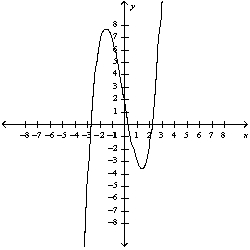 __________
 (Short Answer)
4.7/5 (74)
(74) Find the absolute maximum and absolute minimum values, if any, of the function on [0, 25]
(Multiple Choice)
4.8/5 (81)
(81) A cylindrical tank of height 16 feet is filled with water. Suppose a jet of water flows through an orifice on the tank. It can be shown that the range R (in feet) of the jet of water is given by .
Where should the orifice be located so that the jet of water will have the maximum range? 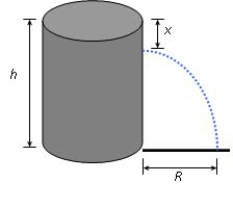
(Short Answer)
4.8/5 (83)
(83) Use Newton's method to approximate the zero of between and using . Continue until two successive approximations differ by less than 0.00001.
(Short Answer)
4.8/5 (75)
(75) Find the position function of a particle moving along a coordinate line that satisfies the given condition. , s(1) = -1
(Short Answer)
4.9/5 (82)
(82) Find a cubic function that has a local maximum value of at 1 and a local minimum value of -1,184 at 7.
(Short Answer)
4.7/5 (79)
(79) How many points of inflection are on the graph of the function?
(Multiple Choice)
4.8/5 (89)
(89) Find the absolute maximum and absolute minimum values, if any, of the function on
(Short Answer)
4.9/5 (83)
(83) 
Filters
- Essay(0)
- Multiple Choice(0)
- Short Answer(0)
- True False(0)
- Matching(0)