



 Chat with AI
Exam 3: Applications of Differentiation

Exam 1: Functions and Limits117 Questions
Exam 2: Derivatives151 Questions
Exam 3: Applications of Differentiation153 Questions
Exam 4: Integrals95 Questions
Exam 5: Applications of Integration120 Questions
Exam 6: Inverse Functions127 Questions
Exam 7: Techniques of Integration124 Questions
Exam 8: Further Applications of Integration86 Questions
Exam 9: Differential Equations67 Questions
Exam 10: Parametric Equations and Polar Coordinates72 Questions
Exam 11: Infinite Sequences and Series158 Questions
Exam 12: Vectors and the Geometry of Space60 Questions
Exam 13: Vector Functions93 Questions
Exam 14: Partial Derivatives132 Questions
Exam 15: Multiple Integrals124 Questions
Exam 16: Vector Calculus137 Questions
Exam 17: Second-Order Differential Equations63 Questions
Exam 18: Final Exam44 Questions
Select questions type


Suppose the line  is tangent to the curve
 when
 . If Newton's method is used to locate a root of the equation
 and the initial approximation is
 , find the second approximation
 .
is tangent to the curve when . If Newton's method is used to locate a root of the equation and the initial approximation is , find the second approximation . (Essay)
4.8/5  (71)
(71) 

Sketch the graph of the function 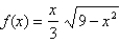 using the curve-sketching guidelines.
 (Multiple Choice)
5.0/5 (87)
(87) The graph of the derivative  of a continuous function f is shown. On what intervals is f decreasing?

of a continuous function f is shown. On what intervals is f decreasing? (Essay)
4.8/5 (76)
(76) Verify that the function satisfies the three hypotheses of Rolle's Theorem on the given interval. Then find all numbers c that satisfy the conclusion of Rolle's Theorem. 
(Multiple Choice)
4.8/5 (84)
(84) Given  . (a) Find the intervals on which f is increasing or decreasing. (b) Find the relative maxima and relative minima of F.
 (Multiple Choice)
4.9/5 (77)
(77) The sum of two positive numbers is  . What is the smallest possible value of the sum of their squares?
 (Essay)
4.7/5 (82)
(82) Use Newton's method to approximate the zero of  between
 and
 using
 . Continue until two successive approximations differ by less than 0.00001.
between and using . Continue until two successive approximations differ by less than 0.00001. (Short Answer)
4.9/5 (71)
(71)  .
Given  .
(a) Find the intervals on which f is increasing or decreasing.
(b) Find the relative maxima and relative minima of f.
.
(a) Find the intervals on which f is increasing or decreasing.
(b) Find the relative maxima and relative minima of f. (Essay)
4.9/5 (81)
(81) The graph of the first derivative  of a function f is shown below. At what values of x does f have a local maximum or minimum?

of a function f is shown below. At what values of x does f have a local maximum or minimum? (Short Answer)
4.7/5 (74)
(74)  .
Find the position function of a particle moving along a coordinate line that satisfies the given condition. 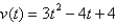 , s(1) = -1
 (Essay)
4.8/5 (81)
(81) Sketch the graph of the function  using the curve-sketching guidelines.
 (Essay)
4.8/5 (93)
(93) Let f (x) = 4x3 - 5x2 + x - 2 and g (x) = 4x3
a.Plot the graph of f and g using the same viewing window: [-5, 5] ´ [-5, 5].
b.Plot the graph of f and g using the same viewing window: [-50, 50] ´ [-100,000, 100,000]
c.Explain why the graphs of f and g that you obtained in part (b) seem coalesce as x increases or decreases without bound.
(Essay)
5.0/5 (75)
(75) Sketch the graph of  on
 and find its absolute maximum and absolute minimum values, if any.
on and find its absolute maximum and absolute minimum values, if any. (Essay)
4.8/5 (79)
(79) What is the shortest possible length of the line segment that is cut off by the first quadrant and is tangent to the curve  at some point?
 (Multiple Choice)
5.0/5 (67)
(67) Determine where the graph of the function  is concave upward and where it is concave downward. Also, find all inflection points of the function.
 (Multiple Choice)
4.8/5 (83)
(83) The function  satisfies the hypotheses of the Mean Value Theorem on the interval
 . Find all values of c that satisfy the conclusion of the theorem.
satisfies the hypotheses of the Mean Value Theorem on the interval . Find all values of c that satisfy the conclusion of the theorem. (Essay)
4.9/5 (69)
(69) A company estimates that the marginal cost (in dollars per item) of producing items is  . If the cost of producing one item is $560 find the cost of producing 400 items.
 (Essay)
4.8/5 (88)
(88) 
Filters
- Essay(0)
- Multiple Choice(0)
- Short Answer(0)
- True False(0)
- Matching(0)