



 Chat with AI
Exam 4: Integrals

Exam 1: Functions and Limits117 Questions
Exam 2: Derivatives151 Questions
Exam 3: Applications of Differentiation153 Questions
Exam 4: Integrals95 Questions
Exam 5: Applications of Integration120 Questions
Exam 6: Inverse Functions127 Questions
Exam 7: Techniques of Integration124 Questions
Exam 8: Further Applications of Integration86 Questions
Exam 9: Differential Equations67 Questions
Exam 10: Parametric Equations and Polar Coordinates72 Questions
Exam 11: Infinite Sequences and Series158 Questions
Exam 12: Vectors and the Geometry of Space60 Questions
Exam 13: Vector Functions93 Questions
Exam 14: Partial Derivatives132 Questions
Exam 15: Multiple Integrals124 Questions
Exam 16: Vector Calculus137 Questions
Exam 17: Second-Order Differential Equations63 Questions
Exam 18: Final Exam44 Questions
Select questions type


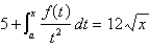 for
 and some number
a.

Let 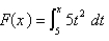 .
a.Use Part 1 of the Fundamental Theorem of Calculus to find
 .
b.Use Part 2 of the Fundamental Theorem of Calculus to integrate
 to obtain an alternative expression for F(x).
c.Differentiate the expression for F(x) found in part (b).The Fundamental Theorem of Calculus, Part 1
If f is continuous on [a, b], then the function F defined by
 is differentiable on (a, b), and
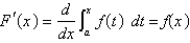 The Fundamental Theorem of Calculus, Part 2
If f is continuous on [a, b], then
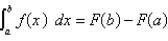 where F is any antiderivative of f, that is,
 .
.
a.Use Part 1 of the Fundamental Theorem of Calculus to find .
b.Use Part 2 of the Fundamental Theorem of Calculus to integrate to obtain an alternative expression for F(x).
c.Differentiate the expression for F(x) found in part (b).The Fundamental Theorem of Calculus, Part 1
If f is continuous on [a, b], then the function F defined by
is differentiable on (a, b), and
The Fundamental Theorem of Calculus, Part 2
If f is continuous on [a, b], then
where F is any antiderivative of f, that is, . (Essay)
4.8/5  (83)
(83)  ,

The table gives the values of a function obtained from an experiment. Use the values to estimate  using three equal subintervals with left endpoints.
w
0
1
2
3
4
5
6
f (w)
9.7
9.1
7.7
6.1
4.2
-6.6
-10.3
using three equal subintervals with left endpoints.
w
0
1
2
3
4
5
6
f (w)
9.7
9.1
7.7
6.1
4.2
-6.6
-10.3 (Short Answer)
4.8/5 (77)
(77)  .


Use the Midpoint Rule with  to approximate the integral. Round the answer to 3 decimal places.

to approximate the integral. Round the answer to 3 decimal places. (Essay)
4.7/5 (86)
(86) The acceleration function (in m / s2) and the initial velocity are given for a particle moving along a line. Find the velocity at time t and the distance traveled during the given time interval. 
(Multiple Choice)
4.8/5 (79)
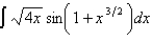
(79) 
The given expression is the limit of a Riemann sum of a function f on [a, b]. Write this expression as a definite integral on [a, b]. 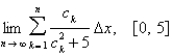
(Multiple Choice)
4.8/5 (80)
(80) The velocity function (in meters per second) is given for a particle moving along a line. Find the distance traveled by the particle during the given time interval. 
(Multiple Choice)
4.9/5 (71)
(71) 

Filters
- Essay(0)
- Multiple Choice(0)
- Short Answer(0)
- True False(0)
- Matching(0)