



 Chat with AI
Exam 11: Infinite Sequences and Series

Exam 1: Functions and Limits117 Questions
Exam 2: Derivatives151 Questions
Exam 3: Applications of Differentiation153 Questions
Exam 4: Integrals95 Questions
Exam 5: Applications of Integration120 Questions
Exam 6: Inverse Functions127 Questions
Exam 7: Techniques of Integration124 Questions
Exam 8: Further Applications of Integration86 Questions
Exam 9: Differential Equations67 Questions
Exam 10: Parametric Equations and Polar Coordinates72 Questions
Exam 11: Infinite Sequences and Series158 Questions
Exam 12: Vectors and the Geometry of Space60 Questions
Exam 13: Vector Functions93 Questions
Exam 14: Partial Derivatives132 Questions
Exam 15: Multiple Integrals124 Questions
Exam 16: Vector Calculus137 Questions
Exam 17: Second-Order Differential Equations63 Questions
Exam 18: Final Exam44 Questions
Select questions type


 .

If $600 is invested at  interest, compounded annually, then after n years the investment is worth
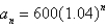 dollars. Find the size of investment after 7 years.
interest, compounded annually, then after n years the investment is worth dollars. Find the size of investment after 7 years. (Multiple Choice)
4.7/5  (85)
(85) Determine whether the geometric series converges or diverges. If it converges, find its sum. 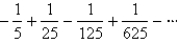
(Multiple Choice)
4.9/5 (89)
(89) Find a power series representation for the function and determine the radius of convergence. 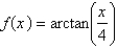
(Essay)
4.8/5 (72)
(72) Determine whether the series is absolutely convergent, conditionally convergent, or divergent. 
(Short Answer)
4.8/5 (91)
(91) 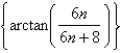
Determine whether the series is absolutely convergent, conditionally convergent, or divergent. 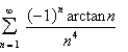
(Multiple Choice)
4.8/5 (82)
(82) Find the radius of convergence and the interval of convergence of the power series. 
(Essay)
4.9/5 (75)
(75) Determine whether the given series is convergent or divergent. 
(Short Answer)
4.8/5 (84)
(84) Find the radius of convergence and the interval of convergence of the power series. 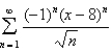
(Multiple Choice)
4.8/5 (77)
(77) 
Use the power series for 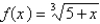 to estimate
 correct to four decimal places.
to estimate correct to four decimal places. (Multiple Choice)
5.0/5 (89)
(89) 
Determine whether the series is convergent or divergent. If it is convergent, write its sum. Otherwise write divergent. 
(Short Answer)
4.8/5 (71)
(71) An annuity is a sequence of payments made at regular intervals. Suppose that a sum of $200 is deposited at the end of each month into an account earning interest at the rate of 12% per year compounded monthly. Then the amount on deposit at the end of the  month is
 .
Consider the sequence
 defined by
 (a) Find the
 term of the sequence, and interpret your result.
(b) Evaluate
 and interpret your result.
month is .
Consider the sequence defined by (a) Find the term of the sequence, and interpret your result.
(b) Evaluate and interpret your result. (Essay)
4.9/5 (83)
(83) Find the partial sum  of the series
 . Give your answer to five decimal places.
of the series . Give your answer to five decimal places. (Essay)
4.9/5 (67)
(67) Determine whether the given series is convergent or divergent. 
(Short Answer)
4.9/5 (91)
(91) Determine whether the series is absolutely convergent, conditionally convergent, or divergent. 
(Short Answer)
5.0/5 (94)
(94) Determine whether the sequence converges or diverges. If it converges, find the limit. 
(Multiple Choice)
5.0/5 (75)
(75) 
Filters
- Essay(0)
- Multiple Choice(0)
- Short Answer(0)
- True False(0)
- Matching(0)