



 Chat with AI
Exam 5: Light

Exam 1: Why Learn Astronomy92 Questions
Exam 2: Patterns in the Skymotions of Earth96 Questions
Exam 3: Motion of Astronomical Bodies91 Questions
Exam 4: Gravity and Orbits88 Questions
Exam 5: Light87 Questions
Exam 6: The Tools of the Astronomer94 Questions
Exam 7: The Birth and Evolution of Planetary Systems87 Questions
Exam 8: The Terrestrial Planets and Earths Moon99 Questions
Exam 9: Atmospheres of the Terrestrial Planets92 Questions
Exam 10: Worlds of Gas and Liquid the Giant Planets92 Questions
Exam 11: Planetary Adornmentsmoons and Rings93 Questions
Exam 12: Dwarf Planets and Small Solar System Bodies89 Questions
Exam 13: Taking the Measure of Stars88 Questions
Exam 14: Our Starthe Sun88 Questions
Exam 15: Star Formation and the Interstellar Medium89 Questions
Exam 16: Evolution of Low-Mass Stars90 Questions
Exam 17: Evolution of High-Mass Stars90 Questions
Exam 18: Relativity and Black Holes90 Questions
Exam 19: The Expanding Universe90 Questions
Exam 20: Galaxies95 Questions
Exam 21: The Milky Waya Normal Spiral Galaxy96 Questions
Exam 22: Modern Cosmology92 Questions
Exam 23: Large-Scale Structure in the Universe65 Questions
Exam 24: Life61 Questions
Select questions type


The speed of light was first determined by which scientist?
(Multiple Choice)
4.9/5  (76)
(76) If the Sun instantaneously stopped giving off light, what would happen on Earth?
(Multiple Choice)
4.8/5 (89)
(89) The n = 5 electronic energy level in a hydrogen atom is 1.5 *10 - 19 J higher than the n = 3 level. If an electron moves from the n = 5 level to the n = 3 level, then a photon of wavelength:
(Multiple Choice)
4.8/5 (72)
(72) Which of the following photons carry the smallest amount of energy?
(Multiple Choice)
4.9/5 (79)
(79) 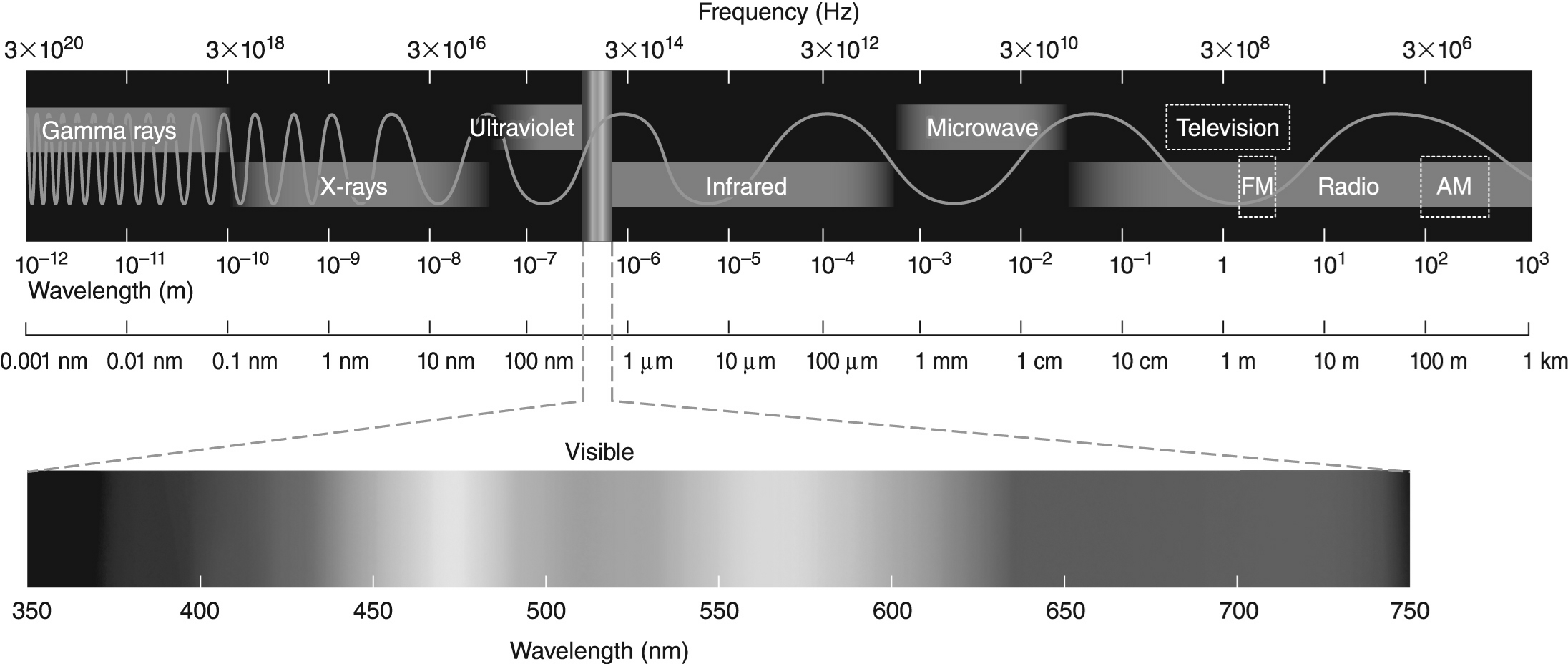 Figure 1
-If Jupiter has a temperature of 165 K, then at what wavelength does its spectrum peak? Use the electromagnetic spectrum in Figure 1 to answer this question.
Figure 1
-If Jupiter has a temperature of 165 K, then at what wavelength does its spectrum peak? Use the electromagnetic spectrum in Figure 1 to answer this question. (Multiple Choice)
4.8/5 (75)
(75) Your average body temperature is approximately 310 K, thus most of the light you radiate is at ultraviolet wavelengths.
(True/False)
4.8/5 (81)
(81) How can the average temperature of the Earth stay approximately constant, even though the Earth is always getting energy from the Sun?
(Essay)
4.8/5 (83)
(83) A thin cloud of cool gas on top of a hotter blackbody will radiate an emission spectrum.
(True/False)
4.8/5 (57)
(57) How does the speed of light traveling through a medium (such as air or glass) compare to the speed of light in a vacuum?
(Multiple Choice)
4.8/5 (74)
(74) The period of a wave is inversely proportional to the frequency of that wave.
(True/False)
5.0/5 (70)
(70) Figure 1
-If the typical temperature of a red giant is 3000 K, at what wavelength is its radiation the brightest? Use the electromagnetic spectrum in Figure 1 to help you answer this question.
Figure 1
-If the typical temperature of a red giant is 3000 K, at what wavelength is its radiation the brightest? Use the electromagnetic spectrum in Figure 1 to help you answer this question. (Multiple Choice)
4.8/5 (75)
(75) The spaceship shown in the figure below is traveling at a speed of 15,000 km/s to the left while it sends out a signal with a wavelength of 4 meters. 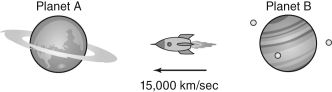 If astronomers living on planets A and B measure the radio waves coming from the space ship, what wavelengths will they measure?
 (Multiple Choice)
4.8/5 (82)
(82) Imagine you observed three different stars: a red star, a blue star, and a yellow star. You are able to determine that each of these stars has the same radius. Answer each question below and explain how you know.
A: Which star is hottest?
B: Which star is the most luminous?
C: Which star is the brightest?
(Essay)
4.8/5 (79)
(79) For a star that lies in the plane of Earth's orbit around the Sun, how does the observed wavelength of the hydrogen absorption line at 656.28 nm in its spectrum change in wavelength (if at all) with the time of year?
(Essay)
4.8/5 (75)
(75) Imagine you see a streetlamp that is 100 meters away from you and is 10,000 times more luminous than a firefly. How close would you have to be to the firefly to make it look as bright as the streetlamp?
(Essay)
4.8/5 (79)
(79) 
Filters
- Essay(0)
- Multiple Choice(0)
- Short Answer(0)
- True False(0)
- Matching(0)