



 Chat with AI
Exam 5: Light

Exam 1: Why Learn Astronomy92 Questions
Exam 2: Patterns in the Skymotions of Earth96 Questions
Exam 3: Motion of Astronomical Bodies91 Questions
Exam 4: Gravity and Orbits88 Questions
Exam 5: Light87 Questions
Exam 6: The Tools of the Astronomer94 Questions
Exam 7: The Birth and Evolution of Planetary Systems87 Questions
Exam 8: The Terrestrial Planets and Earths Moon99 Questions
Exam 9: Atmospheres of the Terrestrial Planets92 Questions
Exam 10: Worlds of Gas and Liquid the Giant Planets92 Questions
Exam 11: Planetary Adornmentsmoons and Rings93 Questions
Exam 12: Dwarf Planets and Small Solar System Bodies89 Questions
Exam 13: Taking the Measure of Stars88 Questions
Exam 14: Our Starthe Sun88 Questions
Exam 15: Star Formation and the Interstellar Medium89 Questions
Exam 16: Evolution of Low-Mass Stars90 Questions
Exam 17: Evolution of High-Mass Stars90 Questions
Exam 18: Relativity and Black Holes90 Questions
Exam 19: The Expanding Universe90 Questions
Exam 20: Galaxies95 Questions
Exam 21: The Milky Waya Normal Spiral Galaxy96 Questions
Exam 22: Modern Cosmology92 Questions
Exam 23: Large-Scale Structure in the Universe65 Questions
Exam 24: Life61 Questions
Select questions type


If you were driving down a deserted country road and you saw a light in the distance, what would you need to measure or know about it in order to calculate how far away it was?
(Essay)
4.9/5  (68)
(68) An emission line is produced when an atom absorbs a photon of a specific energy.
(True/False)
4.8/5 (72)
(72) You observe the spectrum of two stars. A section of these spectra are shown below. The spectra are different because star A is: 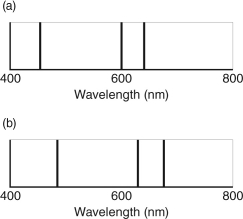
(Multiple Choice)
4.9/5 (84)
(84) If you want a blackbody's peak wavelength to be cut in half, by how much do you need to increase its temperature?
(Essay)
4.9/5 (76)
(76) As a blackbody becomes hotter, it also becomes _________ and _________.
(Multiple Choice)
4.9/5 (78)
(78) 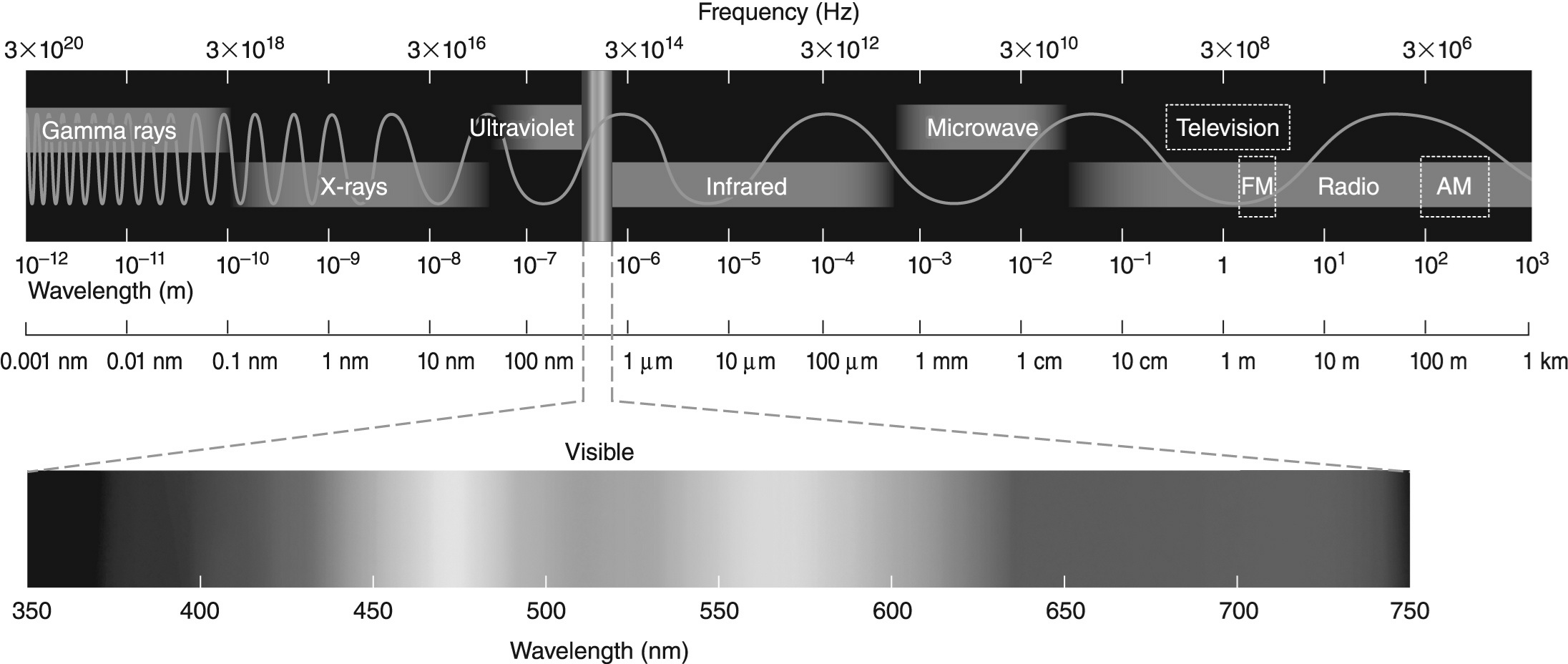 Figure 1
-Describe, in your own words, the fundamental problem with the Bohr model of the atom. (That is, why doesn't an electron orbit a nucleus like a planet does the Sun?)
Figure 1
-Describe, in your own words, the fundamental problem with the Bohr model of the atom. (That is, why doesn't an electron orbit a nucleus like a planet does the Sun?) (Essay)
4.8/5 (88)
(88) Compare two blackbody objects, one at 200 K and one at 400 K. How much larger is the flux from the 400 K object, compared to the flux from the 200 K object?
(Multiple Choice)
4.7/5 (85)
(85) Star C and star D have the same luminosity. Star C is twice as far away from Earth as star D. How do the brightnesses of stars C and D compare?
(Multiple Choice)
4.8/5 (91)
(91) If Saturn has a semimajor axis of 10 AU and an albedo of 0.7, what is its expected temperature?
(Multiple Choice)
4.9/5 (80)
(80) If the wavelength of a beam of light were to double, how would that affect its frequency?
(Multiple Choice)
4.7/5 (66)
(66) The luminosity of an object is independent of its distance from you.
(True/False)
4.8/5 (73)
(73) The emission lines of a given atom occur at the exact same energies as that atom's absorption lines.
(True/False)
4.7/5 (68)
(68) Which of the following factors does NOT directly influence the temperature of a planet?
(Multiple Choice)
4.8/5 (84)
(84) Why do some stars in the sky appear blue, while other stars appear red?
(Multiple Choice)
4.9/5 (85)
(85) Einstein showed that the _________ could be explained if photons carried quantized amounts of energy.
(Multiple Choice)
4.9/5 (76)
(76) Cooler objects radiate more of their total light at shorter wavelengths than hotter objects.
(True/False)
4.8/5 (71)
(71) Name four physical properties of an object that we can determine by analyzing the radiation that it emits, and briefly describe how these properties are determined. Cite the names of any laws that apply.
(Essay)
4.7/5 (71)
(71) 
Filters
- Essay(0)
- Multiple Choice(0)
- Short Answer(0)
- True False(0)
- Matching(0)