



 Chat with AI
Exam 11: Planetary Adornmentsmoons and Rings

Exam 1: Why Learn Astronomy92 Questions
Exam 2: Patterns in the Skymotions of Earth96 Questions
Exam 3: Motion of Astronomical Bodies91 Questions
Exam 4: Gravity and Orbits88 Questions
Exam 5: Light87 Questions
Exam 6: The Tools of the Astronomer94 Questions
Exam 7: The Birth and Evolution of Planetary Systems87 Questions
Exam 8: The Terrestrial Planets and Earths Moon99 Questions
Exam 9: Atmospheres of the Terrestrial Planets92 Questions
Exam 10: Worlds of Gas and Liquid the Giant Planets92 Questions
Exam 11: Planetary Adornmentsmoons and Rings93 Questions
Exam 12: Dwarf Planets and Small Solar System Bodies89 Questions
Exam 13: Taking the Measure of Stars88 Questions
Exam 14: Our Starthe Sun88 Questions
Exam 15: Star Formation and the Interstellar Medium89 Questions
Exam 16: Evolution of Low-Mass Stars90 Questions
Exam 17: Evolution of High-Mass Stars90 Questions
Exam 18: Relativity and Black Holes90 Questions
Exam 19: The Expanding Universe90 Questions
Exam 20: Galaxies95 Questions
Exam 21: The Milky Waya Normal Spiral Galaxy96 Questions
Exam 22: Modern Cosmology92 Questions
Exam 23: Large-Scale Structure in the Universe65 Questions
Exam 24: Life61 Questions
Select questions type


The density of particles in a planet's rings can be measured using:
(Multiple Choice)
4.8/5  (87)
(87) From where does Titan's thick, nitrogen-rich atmosphere likely arise?
(Multiple Choice)
4.8/5 (77)
(77) Saturn's rings are much brighter than the rings of the other giant planets because:
(Multiple Choice)
4.9/5 (68)
(68) 
Extremophiles exist on Earth in both extremely cold and hot environments, but only in places where sunlight allows photosynthesis to occur.
(True/False)
4.8/5 (75)
(75) Through what process do some living organisms find energy to survive deep under the ocean?
(Multiple Choice)
4.9/5 (64)
(64) How does the thickness of Saturn's bright ring system compare to its diameter?
(Multiple Choice)
4.8/5 (64)
(64) In terms of the surfaces of moons, brighter surfaces usually indicate older surfaces.
(True/False)
4.7/5 (71)
(71) Assume that we discover a new moon of Jupiter. It orbits Jupiter at a large distance and in the opposite direction that Jupiter rotates. It is much smaller than most of Jupiter's other moons and has a density close to that of Earth rocks. Therefore, this moon is most likely:
(Multiple Choice)
4.9/5 (73)
(73) 
The varied colors found on Io's surface are due to the presence of various molecules containing:
(Multiple Choice)
4.7/5 (85)
(85) Explain how pictures such as the one shown below are taken. Where must the camera be in relation to the planet and the Sun? Why do the rings appear so bright from this direction? 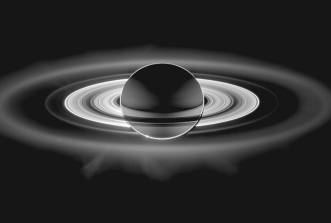
(Essay)
4.9/5 (77)
(77) What is the most likely reason that a planet's rings would reflect more than 50 percent of the sunlight they receive?
(Multiple Choice)
5.0/5 (67)
(67) 
Filters
- Essay(0)
- Multiple Choice(0)
- Short Answer(0)
- True False(0)
- Matching(0)