



 Chat with AI
Exam 16: Evolution of Low-Mass Stars

Exam 1: Why Learn Astronomy92 Questions
Exam 2: Patterns in the Skymotions of Earth96 Questions
Exam 3: Motion of Astronomical Bodies91 Questions
Exam 4: Gravity and Orbits88 Questions
Exam 5: Light87 Questions
Exam 6: The Tools of the Astronomer94 Questions
Exam 7: The Birth and Evolution of Planetary Systems87 Questions
Exam 8: The Terrestrial Planets and Earths Moon99 Questions
Exam 9: Atmospheres of the Terrestrial Planets92 Questions
Exam 10: Worlds of Gas and Liquid the Giant Planets92 Questions
Exam 11: Planetary Adornmentsmoons and Rings93 Questions
Exam 12: Dwarf Planets and Small Solar System Bodies89 Questions
Exam 13: Taking the Measure of Stars88 Questions
Exam 14: Our Starthe Sun88 Questions
Exam 15: Star Formation and the Interstellar Medium89 Questions
Exam 16: Evolution of Low-Mass Stars90 Questions
Exam 17: Evolution of High-Mass Stars90 Questions
Exam 18: Relativity and Black Holes90 Questions
Exam 19: The Expanding Universe90 Questions
Exam 20: Galaxies95 Questions
Exam 21: The Milky Waya Normal Spiral Galaxy96 Questions
Exam 22: Modern Cosmology92 Questions
Exam 23: Large-Scale Structure in the Universe65 Questions
Exam 24: Life61 Questions
Select questions type


The more massive a star is, the more hydrogen it has to burn, and the longer its main-sequence lifetime lasts.
(True/False)
4.8/5  (76)
(76) If a main-sequence star were gaining mass by being in an interacting binary system, what would happen to that star's luminosity and why?
(Multiple Choice)
4.8/5 (83)
(83) How can the core of a star be degenerate with respect to the electrons but nondegenerate with respect to the nuclei?
(Essay)
4.7/5 (64)
(64) Explain the two different forms of pressure that support the core of a low-mass main-sequence star and the core of a low-mass red giant star.
(Essay)
5.0/5 (80)
(80) If there were mixing processes in a main-sequence star with a radiative zone (there aren't) that churned up all the material in the interior, we would expect that the main-sequence lifetime would be _________ because _________.
(Multiple Choice)
4.8/5 (87)
(87) The Ring Nebula is a planetary nebula that currently has a radius of 1.2 * 1013 km and an expansion velocity of 250 km/s. Approximately how long ago did its parent star die and eject its outer layers?
(Multiple Choice)
4.8/5 (81)
(81) Once the core of a low-mass main-sequence star runs out of hydrogen, fusion in the star stops until the core temperature is high enough for helium fusion to begin.
(True/False)
4.7/5 (64)
(64) A white dwarf star has a luminosity equal to 10- 4 L and a temperature twice that of the Sun (i.e., T =10,600 K). What is the radius of the white dwarf, expressed as a ratio to the solar radius?
(Essay)
4.8/5 (87)
(87) Using the data in the table below, identify the spectral type of a star that has a main-sequence lifetime of about 10 billion years. 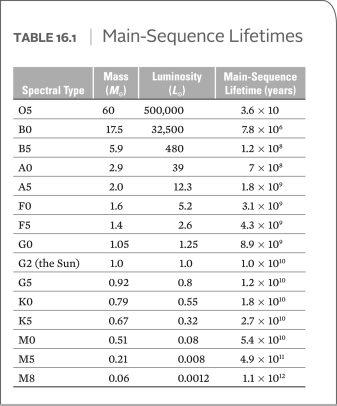
(Multiple Choice)
4.8/5 (79)
(79) Consider a red giant star with a luminosity of 200 L and a radius of 50 R . Using the luminosity-temperature-radius relationship (L R2T 4), calculate how hot this star's surface temperature will be compared to the Sun, whose temperature is 5,800 K.
(Essay)
5.0/5 (89)
(89) Describe the structure of a red giant star just before the helium flash takes place. How does this compare to the structure of a horizontal-branch star?
(Essay)
4.9/5 (82)
(82) If the Milky Way formed stars at approximately a constant rate over the last 14 billion years, what fraction of the M-type stars that ever formed in it can still be found as main-sequence stars today? Note that M-type stars have a mass of approximately 0.5 M .
(Multiple Choice)
4.9/5 (87)
(87) Calculate the main-sequence lifetimes of the following stars of different spectral types: B0 (18 M ), B5 (6 M ), A5 (2 M ), F5 (1.3 M ), and M0 (0.5 M ). What trend do you notice in your results?
(Essay)
4.8/5 (80)
(80) A star's surface temperature during the horizontal branch phase is determined primarily by its:
(Multiple Choice)
4.9/5 (81)
(81) If a main-sequence star's core temperature increased, fusion reaction rates would decrease because the protons would be moving faster.
(True/False)
4.9/5 (82)
(82) Binary stars can evolve to become novae and supernovae because small differences in the stars' masses can mean large differences in their main-sequence lifetimes.
(True/False)
4.8/5 (77)
(77) 
Filters
- Essay(0)
- Multiple Choice(0)
- Short Answer(0)
- True False(0)
- Matching(0)