



 Chat with AI
Exam 16: Evolution of Low-Mass Stars

Exam 1: Why Learn Astronomy92 Questions
Exam 2: Patterns in the Skymotions of Earth96 Questions
Exam 3: Motion of Astronomical Bodies91 Questions
Exam 4: Gravity and Orbits88 Questions
Exam 5: Light87 Questions
Exam 6: The Tools of the Astronomer94 Questions
Exam 7: The Birth and Evolution of Planetary Systems87 Questions
Exam 8: The Terrestrial Planets and Earths Moon99 Questions
Exam 9: Atmospheres of the Terrestrial Planets92 Questions
Exam 10: Worlds of Gas and Liquid the Giant Planets92 Questions
Exam 11: Planetary Adornmentsmoons and Rings93 Questions
Exam 12: Dwarf Planets and Small Solar System Bodies89 Questions
Exam 13: Taking the Measure of Stars88 Questions
Exam 14: Our Starthe Sun88 Questions
Exam 15: Star Formation and the Interstellar Medium89 Questions
Exam 16: Evolution of Low-Mass Stars90 Questions
Exam 17: Evolution of High-Mass Stars90 Questions
Exam 18: Relativity and Black Holes90 Questions
Exam 19: The Expanding Universe90 Questions
Exam 20: Galaxies95 Questions
Exam 21: The Milky Waya Normal Spiral Galaxy96 Questions
Exam 22: Modern Cosmology92 Questions
Exam 23: Large-Scale Structure in the Universe65 Questions
Exam 24: Life61 Questions
Select questions type


When helium fusion begins in the core of a red giant star, the situation quickly gets out of control because electron-degeneracy pressure does not respond to changes in:
(Multiple Choice)
4.9/5  (86)
(86) For low-mass main-sequence stars in hydrostatic equilibrium, at any interior radius there exists a balance between the downward gravitational force at that radius and:
(Multiple Choice)
4.9/5 (69)
(69) What ionizes the gas in a planetary nebula and makes it visible?
(Multiple Choice)
4.9/5 (73)
(73) Using this diagram, identify the star with the smallest radius. 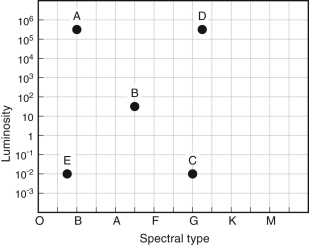
(Multiple Choice)
4.7/5 (85)
(85) Asymptotic giant-branch stars have _________ luminosities, _________ radii, and _________ escape velocities.
(Multiple Choice)
4.9/5 (70)
(70) What factor is most important in determining a star's position on the main sequence and subsequent evolution?
(Multiple Choice)
4.9/5 (66)
(66) During evolutionary phase A in the figure below, the star is _________. In evolutionary phase B, it is _________. 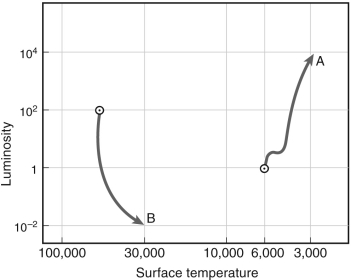
(Multiple Choice)
4.7/5 (78)
(78) When a star burns hydrogen in a shell, it will never produce as much energy (per unit time) as when it burns hydrogen in the core because the core has a higher temperature.
(True/False)
5.0/5 (78)
(78) When a star depletes its core supply of hydrogen, _________ causes the core to collapse while increased gas _________ is exerted on the atmosphere.
(Multiple Choice)
4.8/5 (72)
(72) A star like the Sun will lose about _________ of its mass before it evolves to become a white dwarf.
(Multiple Choice)
4.8/5 (80)
(80) Why does the core of a main-sequence star have to be hotter to burn helium into carbon than hydrogen into helium?
(Essay)
4.8/5 (79)
(79) A low-mass main-sequence star's climb up the red giant branch is halted by:
(Multiple Choice)
4.9/5 (83)
(83) The evolutionary cutoff between low- and high-mass stars occurs at approximately:
(Multiple Choice)
4.9/5 (77)
(77) You observe a 0.8 M white dwarf in a binary orbit around a main-sequence star of mass 1.4 M . Which of the following is most likely the original mass of the star that became the white dwarf?
(Multiple Choice)
4.8/5 (93)
(93) When a low-mass star becomes an AGB star and has a temperature of 3300 K, at what wavelength will it shine the brightest?
(Multiple Choice)
5.0/5 (84)
(84) As a white dwarf star gradually cools, its radius stays approximately constant. What is happening to the white dwarf's luminosity?
(Multiple Choice)
4.7/5 (80)
(80) What types of stars cause Type I supernovae, and what makes them explode?
(Essay)
4.8/5 (73)
(73) 
Filters
- Essay(0)
- Multiple Choice(0)
- Short Answer(0)
- True False(0)
- Matching(0)