



 Chat with AI
Exam 17: Evolution of High-Mass Stars

Exam 1: Why Learn Astronomy92 Questions
Exam 2: Patterns in the Skymotions of Earth96 Questions
Exam 3: Motion of Astronomical Bodies91 Questions
Exam 4: Gravity and Orbits88 Questions
Exam 5: Light87 Questions
Exam 6: The Tools of the Astronomer94 Questions
Exam 7: The Birth and Evolution of Planetary Systems87 Questions
Exam 8: The Terrestrial Planets and Earths Moon99 Questions
Exam 9: Atmospheres of the Terrestrial Planets92 Questions
Exam 10: Worlds of Gas and Liquid the Giant Planets92 Questions
Exam 11: Planetary Adornmentsmoons and Rings93 Questions
Exam 12: Dwarf Planets and Small Solar System Bodies89 Questions
Exam 13: Taking the Measure of Stars88 Questions
Exam 14: Our Starthe Sun88 Questions
Exam 15: Star Formation and the Interstellar Medium89 Questions
Exam 16: Evolution of Low-Mass Stars90 Questions
Exam 17: Evolution of High-Mass Stars90 Questions
Exam 18: Relativity and Black Holes90 Questions
Exam 19: The Expanding Universe90 Questions
Exam 20: Galaxies95 Questions
Exam 21: The Milky Waya Normal Spiral Galaxy96 Questions
Exam 22: Modern Cosmology92 Questions
Exam 23: Large-Scale Structure in the Universe65 Questions
Exam 24: Life61 Questions
Select questions type


Once silicon burning begins to fuse iron in the core of a high-mass main-sequence star, it only has a few __________ left to live.
(Multiple Choice)
4.9/5  (89)
(89) An iron core cannot support a massive main-sequence star because:
(Multiple Choice)
4.7/5 (75)
(75) The acceleration from gravity on the surface of a neutron star can be how large compared to the value on the surface of the Earth? For reference, the typical mass of a neutron star is 2 M and its radius is approximately 10 km.
(Multiple Choice)
4.8/5 (74)
(74) Neutron stars are sometimes found in binary systems, where matter overflowing from a companion star and accreting onto the neutron star will produce X-rays and other energetic phenomena.
(True/False)
4.9/5 (72)
(72) 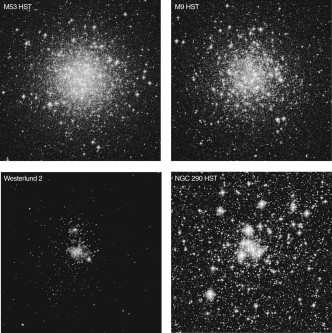
The nuclear reaction that releases the most energy per kilogram is:
(Multiple Choice)
4.9/5 (101)
(101) Suppose you measured H-R diagrams for the two star clusters pictured below. Which of the following statements is true? 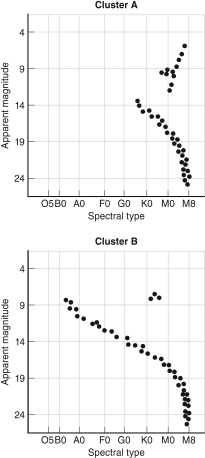
(Multiple Choice)
4.8/5 (91)
(91) Describe the physical mechanism that causes pulsations in Cepheid variables.
(Essay)
4.9/5 (79)
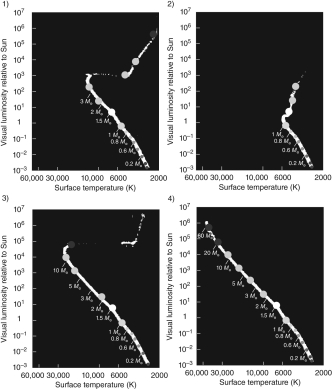
(79) 

Filters
- Essay(0)
- Multiple Choice(0)
- Short Answer(0)
- True False(0)
- Matching(0)