



 Chat with AI
Exam 17: Evolution of High-Mass Stars

Exam 1: Why Learn Astronomy92 Questions
Exam 2: Patterns in the Skymotions of Earth96 Questions
Exam 3: Motion of Astronomical Bodies91 Questions
Exam 4: Gravity and Orbits88 Questions
Exam 5: Light87 Questions
Exam 6: The Tools of the Astronomer94 Questions
Exam 7: The Birth and Evolution of Planetary Systems87 Questions
Exam 8: The Terrestrial Planets and Earths Moon99 Questions
Exam 9: Atmospheres of the Terrestrial Planets92 Questions
Exam 10: Worlds of Gas and Liquid the Giant Planets92 Questions
Exam 11: Planetary Adornmentsmoons and Rings93 Questions
Exam 12: Dwarf Planets and Small Solar System Bodies89 Questions
Exam 13: Taking the Measure of Stars88 Questions
Exam 14: Our Starthe Sun88 Questions
Exam 15: Star Formation and the Interstellar Medium89 Questions
Exam 16: Evolution of Low-Mass Stars90 Questions
Exam 17: Evolution of High-Mass Stars90 Questions
Exam 18: Relativity and Black Holes90 Questions
Exam 19: The Expanding Universe90 Questions
Exam 20: Galaxies95 Questions
Exam 21: The Milky Waya Normal Spiral Galaxy96 Questions
Exam 22: Modern Cosmology92 Questions
Exam 23: Large-Scale Structure in the Universe65 Questions
Exam 24: Life61 Questions
Select questions type


What characteristic of a star cluster is used to determine its age?
(Multiple Choice)
4.9/5  (77)
(77) Name three processes that speed the collapse of the core of a dying high-mass star.
(Essay)
4.9/5 (79)
(79) Essentially all the elements heavier than iron in our Milky Way were formed:
(Multiple Choice)
4.9/5 (78)
(78) Massive stars synthesize chemical elements going from helium up to iron:
(Multiple Choice)
4.8/5 (78)
(78) Fusion reactions that create chemical elements heavier than oxygen require energy input; thus, these reactions cannot provide a star with power.
(True/False)
4.7/5 (80)
(80) Using the formula g = GMNS/R2NS, calculate the acceleration of gravity on a neutron star of mass 3 solar masses and radius 10 km, and express this in terms of the acceleration of gravity on the surface of the Earth (g = 9.8 m/s2).
(Multiple Choice)
4.8/5 (74)
(74) If a 25M main-sequence star loses mass at a rate of 10 - 6 M /yr, then how much mass will it lose in its lifetime of 3 million years?
(Multiple Choice)
4.8/5 (85)
(85) What is one way that massive stars differ from low-mass stars?
(Multiple Choice)
4.9/5 (89)
(89) We can determine the age of a star cluster by measuring the color of the reddest red giant stars in the cluster.
(True/False)
4.8/5 (90)
(90) The principal means by which high-mass stars generate energy on the main sequence is called:
(Multiple Choice)
4.7/5 (94)
(94) The densest state of matter found in nature occurs inside a white dwarf star.
(True/False)
4.9/5 (103)
(103) Suppose the Milky Way makes 10 new stars per year and only 1 out of 5,000 will explode as a supernova. What would be the average time between supernova explosions in the Milky Way?
(Multiple Choice)
4.9/5 (83)
(83) We can determine the age of a star cluster because stars of different masses go through their lives at different rates.
(True/False)
4.8/5 (91)
(91) Suppose you measured H-R diagrams for the two star clusters pictured below. Which cluster is older? Which cluster is farther away? Explain why. 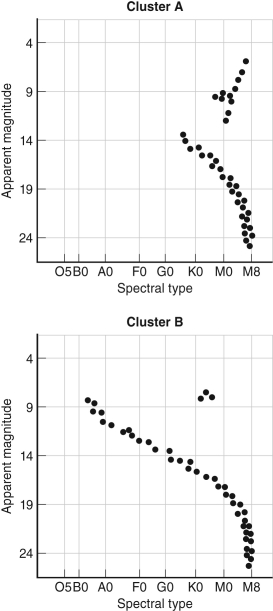
(Essay)
4.9/5 (79)
(79) The main difference between Cepheid stars and RR Lyrae stars is:
(Multiple Choice)
5.0/5 (71)
(71) Type I and Type II supernovae are approximately equal in luminosity.
(True/False)
4.8/5 (92)
(92) 
Filters
- Essay(0)
- Multiple Choice(0)
- Short Answer(0)
- True False(0)
- Matching(0)