



 Chat with AI
Exam 20: Galaxies

Exam 1: Why Learn Astronomy92 Questions
Exam 2: Patterns in the Skymotions of Earth96 Questions
Exam 3: Motion of Astronomical Bodies91 Questions
Exam 4: Gravity and Orbits88 Questions
Exam 5: Light87 Questions
Exam 6: The Tools of the Astronomer94 Questions
Exam 7: The Birth and Evolution of Planetary Systems87 Questions
Exam 8: The Terrestrial Planets and Earths Moon99 Questions
Exam 9: Atmospheres of the Terrestrial Planets92 Questions
Exam 10: Worlds of Gas and Liquid the Giant Planets92 Questions
Exam 11: Planetary Adornmentsmoons and Rings93 Questions
Exam 12: Dwarf Planets and Small Solar System Bodies89 Questions
Exam 13: Taking the Measure of Stars88 Questions
Exam 14: Our Starthe Sun88 Questions
Exam 15: Star Formation and the Interstellar Medium89 Questions
Exam 16: Evolution of Low-Mass Stars90 Questions
Exam 17: Evolution of High-Mass Stars90 Questions
Exam 18: Relativity and Black Holes90 Questions
Exam 19: The Expanding Universe90 Questions
Exam 20: Galaxies95 Questions
Exam 21: The Milky Waya Normal Spiral Galaxy96 Questions
Exam 22: Modern Cosmology92 Questions
Exam 23: Large-Scale Structure in the Universe65 Questions
Exam 24: Life61 Questions
Select questions type


How did Hubble use his tuning fork diagram to classify galaxies? Is there any significance to this organization?
(Essay)
4.9/5  (81)
(81) Why do rotation curves of galaxies imply that dark matter exists?
(Multiple Choice)
4.8/5 (72)
(72) If you measure the velocity of a cloud of gas that is rotating around the center of a galaxy in a circular orbit with radius R, you can determine:
(Multiple Choice)
4.7/5 (81)
(81) What is the most likely candidate for making up the dark matter in galaxies?
(Essay)
4.8/5 (77)
(77) How did astronomers determine that elliptical galaxies are composed mostly of dark matter?
(Multiple Choice)
4.9/5 (92)
(92) What is the approximate percentage of nearby galaxies that contain AGNs?
(Multiple Choice)
4.8/5 (99)
(99) If the rotational speed of the gas in the disk of a spiral galaxy is 200 km/s at a distance of 25,000 pc from its center, then what is the mass enclosed within this radius?
(Multiple Choice)
4.9/5 (76)
(76) We know AGN are about the size of our Solar System because of how fast they change in brightness over time.
(True/False)
4.9/5 (82)
(82) What do the formation of the Solar System and the existence of AGNs have in common?
(Multiple Choice)
4.7/5 (83)
(83) If there is a 2 million M black hole at the center of our galaxy, why is our own galaxy not an AGN?
(Essay)
5.0/5 (80)
(80) You observe a quasar that varies in brightness over a period of 50 days as shown in the figure below. Using these data, estimate the size of the AGN region in AU. 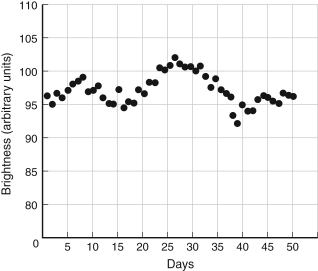
(Multiple Choice)
4.9/5 (66)
(66) 
Filters
- Essay(0)
- Multiple Choice(0)
- Short Answer(0)
- True False(0)
- Matching(0)