



 Chat with AI
Exam 20: Galaxies

Exam 1: Why Learn Astronomy92 Questions
Exam 2: Patterns in the Skymotions of Earth96 Questions
Exam 3: Motion of Astronomical Bodies91 Questions
Exam 4: Gravity and Orbits88 Questions
Exam 5: Light87 Questions
Exam 6: The Tools of the Astronomer94 Questions
Exam 7: The Birth and Evolution of Planetary Systems87 Questions
Exam 8: The Terrestrial Planets and Earths Moon99 Questions
Exam 9: Atmospheres of the Terrestrial Planets92 Questions
Exam 10: Worlds of Gas and Liquid the Giant Planets92 Questions
Exam 11: Planetary Adornmentsmoons and Rings93 Questions
Exam 12: Dwarf Planets and Small Solar System Bodies89 Questions
Exam 13: Taking the Measure of Stars88 Questions
Exam 14: Our Starthe Sun88 Questions
Exam 15: Star Formation and the Interstellar Medium89 Questions
Exam 16: Evolution of Low-Mass Stars90 Questions
Exam 17: Evolution of High-Mass Stars90 Questions
Exam 18: Relativity and Black Holes90 Questions
Exam 19: The Expanding Universe90 Questions
Exam 20: Galaxies95 Questions
Exam 21: The Milky Waya Normal Spiral Galaxy96 Questions
Exam 22: Modern Cosmology92 Questions
Exam 23: Large-Scale Structure in the Universe65 Questions
Exam 24: Life61 Questions
Select questions type


How do we measure directly that AGNs have black holes at their centers?
(Multiple Choice)
4.8/5  (86)
(86) If you observed a gas cloud orbiting in a disk of a spiral galaxy that was located 10,000 pc from the center and it rotated with a speed of 300 km/s, what is the mass of the galaxy interior to gas cloud's orbit?
(Multiple Choice)
4.7/5 (93)
(93) If the rotational speed of the gas in the disk of a spiral galaxy is 100 km/s at a distance of 26,000 light-years from its center, then what is the mass enclosed within this radius? If the mass of luminous matter inside this radius is 5 billion M then what fraction of the galaxy's mass is made of dark matter?
(Essay)
4.8/5 (85)
(85) Today in our local universe, approximately 30 percent of galaxies are AGNs.
(True/False)
4.9/5 (85)
(85) We interpret the fact that we saw more AGNs in the past than we do today to indicate that:
(Multiple Choice)
5.0/5 (97)
(97) The image below was probably taken in ____________ wavelengths because _______________________. 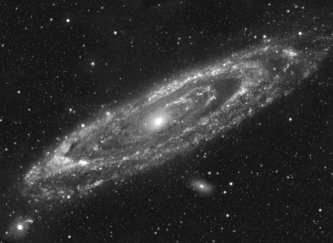
(Multiple Choice)
4.8/5 (76)
(76) Two elliptical galaxies have the same apparent size and brightness. Galaxy A appears lumpy, and it is possible to observe individual stars and star clusters. The other one, galaxy B, appears very smooth, with no fine detail. Which one is likely to be more luminous?
(Multiple Choice)
4.9/5 (81)
(81) We know that spiral galaxies contain dark matter because the gas in the disk rotates with a velocity that decreases in a way that is proportional to r -1/2.
(True/False)
4.9/5 (95)
(95) What do the broad emission lines in quasar spectra tell astronomers about these objects?
(Multiple Choice)
4.9/5 (83)
(83) The type of AGN we see depends mostly on the angle at which we view the galaxy.
(True/False)
4.9/5 (82)
(82) The Hubble tuning fork diagram represents an evolutionary diagram of galaxies from elliptical to spiral.
(True/False)
4.8/5 (72)
(72) In spiral galaxies, the size of the central bulge is correlated with the:
(Multiple Choice)
4.8/5 (79)
(79) How do we know that AGNs have sizes on the order of our Solar System?
(Multiple Choice)
4.9/5 (98)
(98) Dark matter consists of material that emits radiation at wavelengths other than visible light.
(True/False)
4.9/5 (81)
(81) Long-lasting spiral density waves occur in the disk of a spiral galaxy when:
(Multiple Choice)
5.0/5 (75)
(75) Give three examples of types of active galactic nuclei and give one reason why each is unique.
(Essay)
4.8/5 (89)
(89) Roughly what percentage of the total mass of a galaxy is made up of luminous, or normal, matter?
(Multiple Choice)
4.7/5 (90)
(90) 
Filters
- Essay(0)
- Multiple Choice(0)
- Short Answer(0)
- True False(0)
- Matching(0)