



 Chat with AI
Exam 22: Modern Cosmology

Exam 1: Why Learn Astronomy92 Questions
Exam 2: Patterns in the Skymotions of Earth96 Questions
Exam 3: Motion of Astronomical Bodies91 Questions
Exam 4: Gravity and Orbits88 Questions
Exam 5: Light87 Questions
Exam 6: The Tools of the Astronomer94 Questions
Exam 7: The Birth and Evolution of Planetary Systems87 Questions
Exam 8: The Terrestrial Planets and Earths Moon99 Questions
Exam 9: Atmospheres of the Terrestrial Planets92 Questions
Exam 10: Worlds of Gas and Liquid the Giant Planets92 Questions
Exam 11: Planetary Adornmentsmoons and Rings93 Questions
Exam 12: Dwarf Planets and Small Solar System Bodies89 Questions
Exam 13: Taking the Measure of Stars88 Questions
Exam 14: Our Starthe Sun88 Questions
Exam 15: Star Formation and the Interstellar Medium89 Questions
Exam 16: Evolution of Low-Mass Stars90 Questions
Exam 17: Evolution of High-Mass Stars90 Questions
Exam 18: Relativity and Black Holes90 Questions
Exam 19: The Expanding Universe90 Questions
Exam 20: Galaxies95 Questions
Exam 21: The Milky Waya Normal Spiral Galaxy96 Questions
Exam 22: Modern Cosmology92 Questions
Exam 23: Large-Scale Structure in the Universe65 Questions
Exam 24: Life61 Questions
Select questions type


Directly after the Big Bang, the universe was filled with a variety of charged particles, antiparticles, and photons.
(True/False)
4.8/5  (87)
(87) 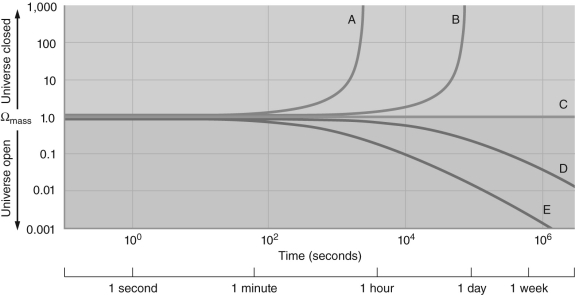 Figure 2
-Figure 2 shows a graph of the value of mass as a function of time in a universe with no dark energy. The five different curves correspond to universes with slightly different values for mass one second after the Big Bang. Which line corresponds to a universe with the smallest value of mass one second after the Big Bang?
Figure 2
-Figure 2 shows a graph of the value of mass as a function of time in a universe with no dark energy. The five different curves correspond to universes with slightly different values for mass one second after the Big Bang. Which line corresponds to a universe with the smallest value of mass one second after the Big Bang? (Multiple Choice)
4.7/5 (74)
(74) Current observations suggest that the density of luminous matter, all matter, and dark energy are:
(Multiple Choice)
4.9/5 (80)
(80) In some particle physics theories, the universe must have more than three spatial dimensions, but we experience only three. Why would we not see the other spatial dimensions?
(Multiple Choice)
4.9/5 (77)
(77) In the superstring theory that successfully unites gravity and quantum mechanics, the universe must have 11 dimensions (10 spatial and 1 temporal).
(True/False)
5.0/5 (86)
(86) 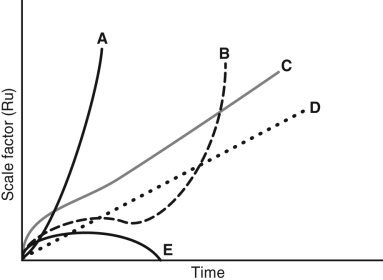 Figure 1
-Figure 1 shows five graphs of the scale factor of the universe as a function of time. Which of these graphs would occur for a universe with mass 1 and 1 = 0?
Figure 1
-Figure 1 shows five graphs of the scale factor of the universe as a function of time. Which of these graphs would occur for a universe with mass 1 and 1 = 0? (Multiple Choice)
4.8/5 (86)
(86) If the fate of the universe were determined SOLELY by what we currently know to be the total mass of the universe in luminous and dark matter (excluding dark energy), astronomers would predict that we live in a universe that will:
(Multiple Choice)
4.8/5 (86)
(86) Observations of Type I supernovae in distant galaxies confirm that the expansion of the universe is decreasing over time.
(True/False)
4.7/5 (62)
(62) If dark energy is currently causing the expansion rate of the universe to increase with time, does this mean that you should worry that the Sun, the Earth, and your body itself are expanding? Why or why not?
(Essay)
4.9/5 (87)
(87) According to superstring theory, how are different varieties of elementary particles similar? How do they differ?
(Essay)
4.9/5 (80)
(80) What is the difference between a grand unified theory and a theory of everything?
(Essay)
4.8/5 (79)
(79) Astronomers have confirmed the Grand Unified Theory by observing that protons decay in laboratory experiments.
(True/False)
4.7/5 (88)
(88) In a universe with no dark energy, what will happen to the expansion of the universe in the future if: (a) mass 1, (b) mass= 1, and (c) mass 1?
(Essay)
4.8/5 (97)
(97) If there were enough mass to slow down the expansion rate of the universe, how would the Hubble constant measured using very distant galaxies be different from what is observed in galaxies that are closer to us? Explain your answer. Is this what we observe in our universe?
(Essay)
4.8/5 (85)
(85) Soon after the Big Bang, we believe the four fundamental forces of nature were united into one superforce, and __________ was the first to split off from the others.
(Multiple Choice)
4.9/5 (98)
(98) In a universe with an accelerating expansion rate, the actual age of the universe is __________ the Hubble time.
(Multiple Choice)
4.9/5 (86)
(86) Explain why astronomers cannot accurately model the exact history of the universe in the first few fractions of a second after the Big Bang.
(Essay)
4.9/5 (86)
(86) If the Hubble constant were larger than it is, how would that change the measured age of the universe? Explain your answer.
(Essay)
4.9/5 (75)
(75) 
Filters
- Essay(0)
- Multiple Choice(0)
- Short Answer(0)
- True False(0)
- Matching(0)