



 Chat with AI
Exam 22: Modern Cosmology

Exam 1: Why Learn Astronomy92 Questions
Exam 2: Patterns in the Skymotions of Earth96 Questions
Exam 3: Motion of Astronomical Bodies91 Questions
Exam 4: Gravity and Orbits88 Questions
Exam 5: Light87 Questions
Exam 6: The Tools of the Astronomer94 Questions
Exam 7: The Birth and Evolution of Planetary Systems87 Questions
Exam 8: The Terrestrial Planets and Earths Moon99 Questions
Exam 9: Atmospheres of the Terrestrial Planets92 Questions
Exam 10: Worlds of Gas and Liquid the Giant Planets92 Questions
Exam 11: Planetary Adornmentsmoons and Rings93 Questions
Exam 12: Dwarf Planets and Small Solar System Bodies89 Questions
Exam 13: Taking the Measure of Stars88 Questions
Exam 14: Our Starthe Sun88 Questions
Exam 15: Star Formation and the Interstellar Medium89 Questions
Exam 16: Evolution of Low-Mass Stars90 Questions
Exam 17: Evolution of High-Mass Stars90 Questions
Exam 18: Relativity and Black Holes90 Questions
Exam 19: The Expanding Universe90 Questions
Exam 20: Galaxies95 Questions
Exam 21: The Milky Waya Normal Spiral Galaxy96 Questions
Exam 22: Modern Cosmology92 Questions
Exam 23: Large-Scale Structure in the Universe65 Questions
Exam 24: Life61 Questions
Select questions type


What two properties of the universe are determined by the values of mass and ?
(Multiple Choice)
4.9/5  (84)
(84) To verify whether or not some grand unified theories are correct, physicists are searching for:
(Multiple Choice)
4.9/5 (80)
(80) The ratio of the density of luminous matter in our universe to the critical density is 0.3.
(True/False)
4.9/5 (80)
(80) Explain why inflation could be lead to an infinite number of multiverses inside our own universe. Are they likely to be similar or different than our own universe?
(Essay)
4.9/5 (86)
(86) Which of the following is a FALSE statement about inflation?
(Multiple Choice)
4.9/5 (77)
(77) The theory of inflation assumes that at some point in the future dark energy will decay and the universe will expand rapidly by a factor of 1030.
(True/False)
4.9/5 (79)
(79) In a closed (spherical) universe, the sum of the angles in a triangle is:
(Multiple Choice)
4.8/5 (77)
(77) In the early universe, which type of particle and anti-particle first stopped being spontaneously formed out of photons in the CMB?
(Multiple Choice)
4.7/5 (79)
(79) What can simultaneously solve both the flatness and horizon problems in cosmology?
(Multiple Choice)
4.8/5 (78)
(78) 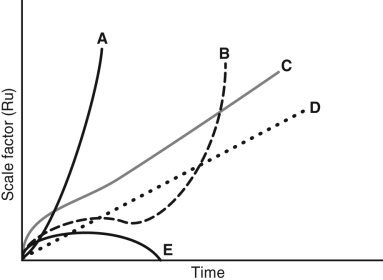 Figure 1
-Figure 1 shows five graphs of the scale factor of the universe as a function of time. Which of these graphs would occur for a universe with mass 1 and 0?
Figure 1
-Figure 1 shows five graphs of the scale factor of the universe as a function of time. Which of these graphs would occur for a universe with mass 1 and 0? (Multiple Choice)
4.7/5 (77)
(77) In quantum electrodynamics (QED), what mediates the electromagnetic force between particles?
(Essay)
4.9/5 (75)
(75) According to the theory of inflation. when the universe was approximately 1 second old, its size grew by a factor of 1030.
(True/False)
4.8/5 (71)
(71) Gravity acts to __________ the expansion of the universe, and dark energy acts to __________ the expansion.
(Multiple Choice)
4.9/5 (70)
(70) The three fundamental forces of nature are gravity, electromagnetism, and the strong force.
(True/False)
4.9/5 (89)
(89) Observations of Type I supernovae in distant galaxies have shown that:
(Multiple Choice)
4.9/5 (82)
(82) Why does a unified force split to become two separate forces?
(Multiple Choice)
4.8/5 (87)
(87) The observations that show that the expansion of the universe is speeding up tell us the universe must contain:
(Multiple Choice)
4.8/5 (73)
(73) If gravity were slowing down the expansion of the universe, how would very distant galaxies differ from nearby galaxies?
(Multiple Choice)
4.9/5 (80)
(80) How would astronomers describe the antiparticle of an electron?
(Multiple Choice)
4.9/5 (78)
(78) Explain what the uncertainty principle means, and how it relates to the horizon problem.
(Essay)
4.9/5 (73)
(73) 
Filters
- Essay(0)
- Multiple Choice(0)
- Short Answer(0)
- True False(0)
- Matching(0)