



 Chat with AI
Exam 17: Molecules

Exam 1: The Electric Field I: Discrete Charge Distributions87 Questions
Exam 2: The Electric Field II: Continuous Charge Distributions75 Questions
Exam 3: Electric Potential108 Questions
Exam 4: Capacitance73 Questions
Exam 5: Electric Current and Direct-Current Circuits160 Questions
Exam 6: The Magnetic Field71 Questions
Exam 7: Sources of the Magnetic Field115 Questions
Exam 8: Magnetic Induction84 Questions
Exam 9: Alternating-Current Circuits119 Questions
Exam 10: Maxwells Equations and Electromagnetic Waves61 Questions
Exam 11: Properties of Light116 Questions
Exam 12: Optical Images143 Questions
Exam 13: Interference and Diffraction116 Questions
Exam 14: Wave Particle Duality and Quantum Physics153 Questions
Exam 15: Applications of the Schrodinger Equation54 Questions
Exam 16: Atoms128 Questions
Exam 17: Molecules44 Questions
Exam 18: Solids and the Theory of Conduction83 Questions
Exam 19: Relativity83 Questions
Exam 20: Nuclear Physics135 Questions
Exam 21: Elementary Particles and the Beginning of the Universe68 Questions
Select questions type


The measured minimum potential energy of a NaCl molecule at stable equilibrium distance of 0.236 nm is -5.7 eV. If the Na+ and Cl- are treated as point charges, the electrostatic potential energy is
(Multiple Choice)
4.7/5  (79)
(79) The mass of the cesium atom is 133 u and that of the chlorine atom is 35.5 u. The reduced mass of CsCl is approximately
(Multiple Choice)
4.8/5 (83)
(83) Transitions within a given set of rotational energy levels yield photons in the _________ portion of the electromagnetic spectrum.
(Multiple Choice)
4.9/5 (78)
(78) The reduced mass of a system of two particles whose masses are m1 and m2 is
(Multiple Choice)
5.0/5 (84)
(84) The _______ bond is the consequence of proton sharing between two atoms.
(Multiple Choice)
4.8/5 (73)
(73) Transitions between vibrational states of different electronic states result in the emission of photons in or near the _______ portion of the electromagnetic spectrum.
(Multiple Choice)
4.8/5 (92)
(92) The magnetron of a microwave oven generates a frequency of 2.45 GHz. This frequency corresponds to the first vibrational level,  , of a water molecule. Assuming that the energy is given by
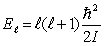 , the moment of inertia of the water molecule is
, of a water molecule. Assuming that the energy is given by , the moment of inertia of the water molecule is (Multiple Choice)
4.7/5 (91)
(91) 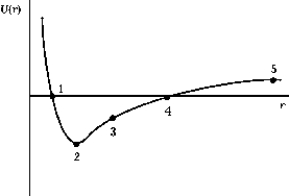 The graph shows the potential energy of the Na+ and Cl- ions as a function of their separation. The point that corresponds to the equilibrium separation is
 (Multiple Choice)
4.8/5 (82)
(82) From the frequency of vibration the effective force constant of the HCl molecule is found to be 840 N/m. In order to appreciate the stiffness of the binding force, or imaginary "spring," between the H and Cl, calculate how far a spring of the same stiffness would extend if a 10 kg weight were hung from it.
(Multiple Choice)
4.8/5 (80)
(80) If the H2 molecule has a rotational energy of E0r = 0.040 MeV, what is the average distance between the two atoms?
(Multiple Choice)
4.9/5 (84)
(84) The energies due to the electronic excitations of a molecule are of the order of 1 eV, whereas
(Multiple Choice)
4.9/5 (90)
(90) If the equilibrium separation of Na+ and F- ions is 0.193 nm, then their electrostatic potential energy (with U = 0 at infinite separation) must be approximately
(Multiple Choice)
4.9/5 (71)
(71) Which of the following statements about covalent bonding is true?
(Multiple Choice)
4.9/5 (82)
(82) The energy required to ionize sodium is 5.14 eV. If the energy needed to form Na+ and F- ions from neutral sodium and fluorine atoms is 1.69 eV, the electron affinity of fluorine is
(Multiple Choice)
4.9/5 (75)
(75) The _______ bond is responsible for the bonding of most salts.
(Multiple Choice)
5.0/5 (67)
(67) 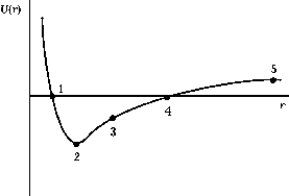 The graph shows the potential energy of the Na+ and Cl- ions as a function of their separation. The point that corresponds to the dissociation energy is
 (Multiple Choice)
4.9/5 (87)
(87) The reduced mass of a two-body system in which the masses of the bodies are 2 u and
5 u is
(Multiple Choice)
4.9/5 (72)
(72) The reduced mass of a two-body system is 2.1 u. If one of the masses is 3 u, then what is the mass of the second body?
(Multiple Choice)
5.0/5 (69)
(69) The energy released by an atom's acquisition of one electron is called its
(Multiple Choice)
4.9/5 (75)
(75) When examined with a grating spectrograph, the discharge from helium gas has bright radiation at a relatively few discrete wavelengths; the discharge from nitrogen gas has radiation in bands with a very large number of discrete wavelengths. What is the reason for this difference in the spectra of these two gases?
(Multiple Choice)
4.9/5 (76)
(76) 
Filters
- Essay(0)
- Multiple Choice(0)
- Short Answer(0)
- True False(0)
- Matching(0)