



 Chat with AI
Exam 15: Applications of the Schrodinger Equation

Exam 1: The Electric Field I: Discrete Charge Distributions87 Questions
Exam 2: The Electric Field II: Continuous Charge Distributions75 Questions
Exam 3: Electric Potential108 Questions
Exam 4: Capacitance73 Questions
Exam 5: Electric Current and Direct-Current Circuits160 Questions
Exam 6: The Magnetic Field71 Questions
Exam 7: Sources of the Magnetic Field115 Questions
Exam 8: Magnetic Induction84 Questions
Exam 9: Alternating-Current Circuits119 Questions
Exam 10: Maxwells Equations and Electromagnetic Waves61 Questions
Exam 11: Properties of Light116 Questions
Exam 12: Optical Images143 Questions
Exam 13: Interference and Diffraction116 Questions
Exam 14: Wave Particle Duality and Quantum Physics153 Questions
Exam 15: Applications of the Schrodinger Equation54 Questions
Exam 16: Atoms128 Questions
Exam 17: Molecules44 Questions
Exam 18: Solids and the Theory of Conduction83 Questions
Exam 19: Relativity83 Questions
Exam 20: Nuclear Physics135 Questions
Exam 21: Elementary Particles and the Beginning of the Universe68 Questions
Select questions type


A particle is in a three-dimensional box with L3 = L2 = 3L1. The lowest energy level is
(Multiple Choice)
4.7/5  (76)
(76) Suppose the natural frequency of oscillation for H2 is 1012 Hz, the effective spring constant between the two H atoms is of the order
(Multiple Choice)
4.9/5 (74)
(74) An electron is confined in a two-dimensional box where U(x,y) = 0 for x = 0 to L, and y = 0 to 3L, and U(x,y) = infinity outside these boundaries. If L = 0.5 nm then calculate the energy of the first doubly degenerate levels.
(Multiple Choice)
4.9/5 (90)
(90) 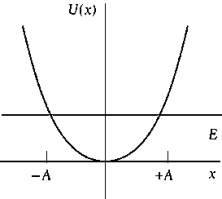 The potential energy function shown in the above figure
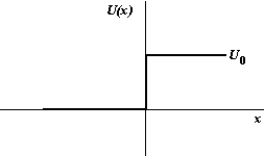 When a particle of energy E encounters the step function shown in the figure,
 (Multiple Choice)
4.9/5 (78)
(78) The energy in the first excited state of an electron confined to a one-dimensional box of length L = 0.3 nm is
(Multiple Choice)
4.8/5 (86)
(86) 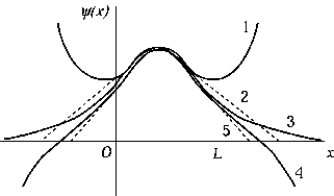 The curve that best represents the ground-state energy for a finite square well is
 (Multiple Choice)
4.8/5 (69)
(69) A particle is in a three-dimensional box with L3 = L2 = 3L1. The energy level E1,1,2 is
(Multiple Choice)
4.8/5 (81)
(81) Match each of the wave function on the left for a particle in a finite square well with the corresponding probability distributions on the right, in the order (a), (b), and (c).
(a) 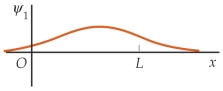 (I)
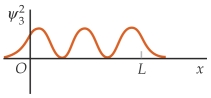 (b)
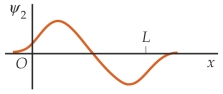 (II)
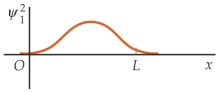 (c)
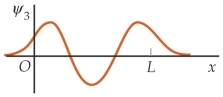 (III)
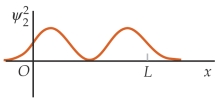
(I) (b) (II) (c) (III) (Multiple Choice)
5.0/5 (82)
(82) The probability of penetration of a rectangular barrier ________ with the barrier thickness.
(Multiple Choice)
4.8/5 (84)
(84) A particle of energy E0 traveling in a region in which the potential energy is zero is incident on a potential barrier of height U0 = 0.4E0. The probability that the particle will be reflected is
(Multiple Choice)
4.8/5 (84)
(84) The energy in the ground state of an electron confined to a one-dimensional box of length L = 0.2 nm is
(Multiple Choice)
4.8/5 (76)
(76) Particles that have symmetric wave functions and are not subject to the Pauli exclusion principle are called
(Multiple Choice)
4.9/5 (82)
(82) A particle of kinetic energy E0 traveling in a region in which the potential energy is zero is then incident on a potential barrier of height U0. What is the ratio of E0/U0 so that the reflection co-efficient is 75%? (Assume E0 is much less than the rest mass energy of the particle.)
(Multiple Choice)
4.8/5 (84)
(84) In three dimensions, the Schrödinger equation for the infinite square-well potential
(Multiple Choice)
4.9/5 (66)
(66) Suppose the natural frequency of oscillation for H2 is 1012 Hz and the amplitude of oscillation is 10-12 m, the total energy of the harmonic oscillator is of the order
(Multiple Choice)
4.8/5 (65)
(65) 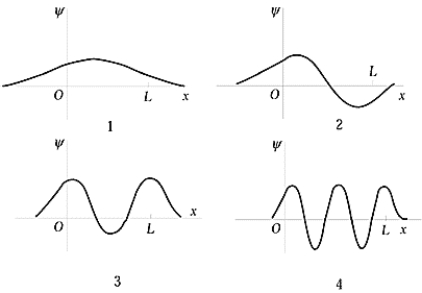 The graph that shows the third state for a particle in a finite square well is
 (Multiple Choice)
5.0/5 (79)
(79) 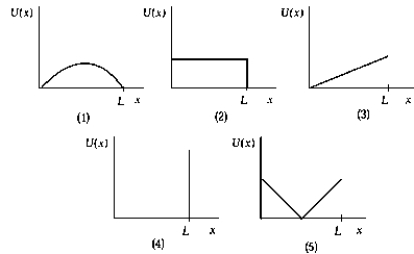 The graph that represents the potential energy for a one-dimensional box from x = 0 to x = L is
 (Multiple Choice)
5.0/5 (86)
(86) 
Filters
- Essay(0)
- Multiple Choice(0)
- Short Answer(0)
- True False(0)
- Matching(0)