



 Chat with AI
Exam 14: Wave Particle Duality and Quantum Physics

Exam 1: The Electric Field I: Discrete Charge Distributions87 Questions
Exam 2: The Electric Field II: Continuous Charge Distributions75 Questions
Exam 3: Electric Potential108 Questions
Exam 4: Capacitance73 Questions
Exam 5: Electric Current and Direct-Current Circuits160 Questions
Exam 6: The Magnetic Field71 Questions
Exam 7: Sources of the Magnetic Field115 Questions
Exam 8: Magnetic Induction84 Questions
Exam 9: Alternating-Current Circuits119 Questions
Exam 10: Maxwells Equations and Electromagnetic Waves61 Questions
Exam 11: Properties of Light116 Questions
Exam 12: Optical Images143 Questions
Exam 13: Interference and Diffraction116 Questions
Exam 14: Wave Particle Duality and Quantum Physics153 Questions
Exam 15: Applications of the Schrodinger Equation54 Questions
Exam 16: Atoms128 Questions
Exam 17: Molecules44 Questions
Exam 18: Solids and the Theory of Conduction83 Questions
Exam 19: Relativity83 Questions
Exam 20: Nuclear Physics135 Questions
Exam 21: Elementary Particles and the Beginning of the Universe68 Questions
Select questions type


An electron that is not localized in space is described by the wave function = A sin (kx - t). The kinetic energy of the electron is 10 keV. The value of is approximately
(Multiple Choice)
4.8/5  (80)
(80) 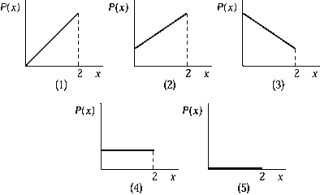 A classical point particle moves back and forth with constant speed between two walls at x = 0 and x = 2 cm. Which graph best represents its probability density Function P(x)?
 (Multiple Choice)
4.8/5 (88)
(88) Calculate the wavelength of light of energy 1 keV divided by the de Broglie wavelength of a proton of kinetic energy 1 meV.
(Multiple Choice)
4.9/5 (86)
(86) You want to make simultaneous measurements of the position and velocity of an electron that is moving in the positive-x direction. If the velocity is measured to an accuracy of 10-7 m/s, the limit of accuracy with which you can locate the electron is approximately
(Multiple Choice)
4.8/5 (83)
(83) Use the following figure to answer the next questions. 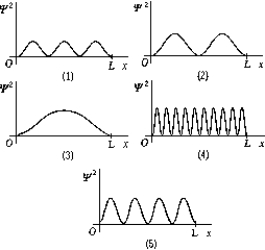 -The graphs show 2 as a function of x for a particle in a one-dimensional box of length L. The graph that represents the second excited state is
 (Multiple Choice)
4.9/5 (76)
(76) What is the shift in wavelength of a photon scattered off an electron at 160º?
(Multiple Choice)
4.7/5 (85)
(85) An electron has a kinetic energy of 1.5 eV. If its momentum is uncertain by ± 2.5%, the minimum uncertainty in its position is approximately
(Multiple Choice)
4.8/5 (78)
(78) A gamma-ray photon of energy 1.00 MeV scatters off an electron at an angle perpendicular to its original direction. Calculate the kinetic energy of the recoiling electron.
(Multiple Choice)
5.0/5 (74)
(74) Use the following equation statement to answer the next four questions.
The normalized wave functions for the infinite square-well potential are
n = (2/L)1/2 sin(n x/L)
You may find it useful to use  sin2 d = 2/4 - ( sin 2 /4 - (cos 2 /8 + C
-The expectation value <x> for a particle in its first excited (n = 2) state in a box of length L is
sin2 d = 2/4 - ( sin 2 /4 - (cos 2 /8 + C
-The expectation value <x> for a particle in its first excited (n = 2) state in a box of length L is (Multiple Choice)
4.9/5 (85)
(85) Suppose that the world could be changed so that the de Broglie wavelength of a 40-kg runner who goes 100 m in 10.0 s was 5 m. Assuming that all other constants remain the same, the value of Planck's constant would have to be
(Multiple Choice)
5.0/5 (89)
(89) Use the following figure for the next two problems. 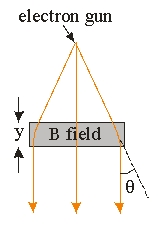 -The electrons coming out of the electron gun in an electron microscope are being accelerated by a potential of 100 kV. The electrons then pass through a region of magnetic field of distance y = 8 cm which points perpendicularly to the direction of travel of the electron. What is the strength of the magnetic field needed to deflect the electron by an angle of = 25 ? (Ignore any relativistic effect. 1 Gauss = 10-4 T)
 (Multiple Choice)
4.8/5 (70)
(70) Use the following figure to answer the next questions.
-The graphs show 2 as a function of x for a particle in a one-dimensional box of length L. The graph that represents the third excited state is
-The graphs show 2 as a function of x for a particle in a one-dimensional box of length L. The graph that represents the third excited state is (Multiple Choice)
4.9/5 (73)
(73) The wave function for a particle between x = -4 cm and 4 cm is given by 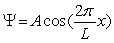 where L = 8 cm. Outside this range, the wave function is equal to zero. The value of A is
 (Multiple Choice)
4.9/5 (82)
(82) An electron (me = 9.11* 10-31 kg) traveling with a velocity of 1.1 *106 m/s has a
De Broglie wavelength of approximately
(Multiple Choice)
4.9/5 (81)
(81) In a photoelectric experiment, the threshold frequency for a material is 3.2 * 1014 Hz. An electron ejected from this surface by a photon of frequency 9.4 * 1014 Hz can be stopped by a stopping potential of
(Multiple Choice)
4.9/5 (80)
(80) In the photoelectric effect, the work function depends on the
(Multiple Choice)
5.0/5 (78)
(78) The maximum wavelength for the photoemission of electrons from a metal surface depends on
(Multiple Choice)
4.9/5 (75)
(75) Use the following equation statement to answer the next four questions.
The normalized wave functions for the infinite square-well potential are
n = (2/L)1/2 sin(n x/L)
You may find it useful to use sin2 d = 2/4 - ( sin 2 /4 - (cos 2 /8 + C
-The expectation value <x> for a particle in its second excited (n = 3) state in a box of length L is
sin2 d = 2/4 - ( sin 2 /4 - (cos 2 /8 + C
-The expectation value <x> for a particle in its second excited (n = 3) state in a box of length L is (Multiple Choice)
5.0/5 (92)
(92) Magnetic Resonance Imaging (MRI) is a much used noninvasive diagnostic technique in medicine. The radio frequency photons used have energies of about 10-7 eV. What wavelength does this correspond to?
(Multiple Choice)
5.0/5 (96)
(96) 
Filters
- Essay(0)
- Multiple Choice(0)
- Short Answer(0)
- True False(0)
- Matching(0)