



 Chat with AI
Exam 11: Properties of Light

Exam 1: The Electric Field I: Discrete Charge Distributions87 Questions
Exam 2: The Electric Field II: Continuous Charge Distributions75 Questions
Exam 3: Electric Potential108 Questions
Exam 4: Capacitance73 Questions
Exam 5: Electric Current and Direct-Current Circuits160 Questions
Exam 6: The Magnetic Field71 Questions
Exam 7: Sources of the Magnetic Field115 Questions
Exam 8: Magnetic Induction84 Questions
Exam 9: Alternating-Current Circuits119 Questions
Exam 10: Maxwells Equations and Electromagnetic Waves61 Questions
Exam 11: Properties of Light116 Questions
Exam 12: Optical Images143 Questions
Exam 13: Interference and Diffraction116 Questions
Exam 14: Wave Particle Duality and Quantum Physics153 Questions
Exam 15: Applications of the Schrodinger Equation54 Questions
Exam 16: Atoms128 Questions
Exam 17: Molecules44 Questions
Exam 18: Solids and the Theory of Conduction83 Questions
Exam 19: Relativity83 Questions
Exam 20: Nuclear Physics135 Questions
Exam 21: Elementary Particles and the Beginning of the Universe68 Questions
Select questions type


Light known to be polarized in the horizontal direction is incident on a polarizing sheet. It is observed that only 15 percent of the intensity of the incident light is transmitted through the sheet. What angle does the transmission axis of the sheet make with the horizontal?
(Multiple Choice)
4.8/5  (75)
(75) The index of refraction of water is approximately 1.33. The angle of incidence for maximum polarization by reflection from water is approximately
(Multiple Choice)
4.7/5 (83)
(83)  You place a point source of light at the bottom of a pool of water 1.00 m deep. The source emits rays upward in all directions. You notice that a circle of light is formed by the rays that are refracted into the air and that the rays outside of this circle are reflected back into the water. The index of refraction of water is 1.33. The radius R of the circle at the surface of the water is approximately
 (Multiple Choice)
4.9/5 (82)
(82)  A ray of light in glass is incident on a glass-air interface as shown. You would expect the ray to pass through
 (Multiple Choice)
4.9/5 (85)
(85) Use the following figure for the next two problems. 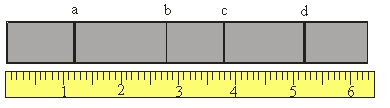 -The film shows the line spectrum of an unknown element. If the wavelengths of lines (a), (b) and (c) are 410 nm, 500 nm and 556 nm respectively, then the color of line (d) is
 (Multiple Choice)
4.9/5 (79)
(79) The index of refraction of a sample of glass cannot be determined by measuring the
(Multiple Choice)
4.7/5 (78)
(78)  The light ray that passes through the prism and emerges at the angle of minimum deviation for that ray is
 (Multiple Choice)
4.8/5 (84)
(84)  Light from an underwater source at O impinges upon a water-air interface. The critical angle is
 (Multiple Choice)
4.8/5 (84)
(84) Light is an electromagnetic wave. When visible light is plane polarized,
(Multiple Choice)
4.8/5 (83)
(83) Light is incident on a piece of glass in air at an angle of 37.0º from the normal. If the index of refraction of the glass is 1.50, the angle that the refracted ray makes with the normal is approximately
(Multiple Choice)
4.7/5 (74)
(74) You see a fish in water at an apparent depth of 1.83 m. The actual depth of the fish, if the index of refraction of the water relative to air is 4/3, must be
(Multiple Choice)
4.9/5 (80)
(80)  A light ray traveling in glass strikes a glass-water surface. At angles greater than c the light ray is totally internally reflected. The value of c is
 (Multiple Choice)
5.0/5 (69)
(69)  An air prism is immersed in water. A ray of monochromatic light strikes one face as shown. The emerging ray is
 (Multiple Choice)
4.8/5 (77)
(77) A 60 prism has a refractive index of 1.64 for blue light and 1.61 for red light. Calculate the difference in the angle of emergence from the opposite face of the prism for a beam of red and a beam of blue light that are both incident at an angle of 60o.
(Multiple Choice)
4.7/5 (75)
(75) You shine light of frequency 4.00* 1014 Hz through a glass plate whose index of refraction for this light is 1.50. The wavelength of this light in the glass is approximately
(Multiple Choice)
4.9/5 (83)
(83) The minimum angle of deviation produced by a glass prism (n = 1.70 for the light used) whose apex angle is 45º is approximately
(Multiple Choice)
4.7/5 (74)
(74) Light is reflected from the surface of a lake (n = 1.33). What is the angle of incidence for which the reflected light is 100 percent polarized?
(Multiple Choice)
5.0/5 (73)
(73) 
Filters
- Essay(0)
- Multiple Choice(0)
- Short Answer(0)
- True False(0)
- Matching(0)