



 Chat with AI
Exam 4: Capacitance

Exam 1: The Electric Field I: Discrete Charge Distributions87 Questions
Exam 2: The Electric Field II: Continuous Charge Distributions75 Questions
Exam 3: Electric Potential108 Questions
Exam 4: Capacitance73 Questions
Exam 5: Electric Current and Direct-Current Circuits160 Questions
Exam 6: The Magnetic Field71 Questions
Exam 7: Sources of the Magnetic Field115 Questions
Exam 8: Magnetic Induction84 Questions
Exam 9: Alternating-Current Circuits119 Questions
Exam 10: Maxwells Equations and Electromagnetic Waves61 Questions
Exam 11: Properties of Light116 Questions
Exam 12: Optical Images143 Questions
Exam 13: Interference and Diffraction116 Questions
Exam 14: Wave Particle Duality and Quantum Physics153 Questions
Exam 15: Applications of the Schrodinger Equation54 Questions
Exam 16: Atoms128 Questions
Exam 17: Molecules44 Questions
Exam 18: Solids and the Theory of Conduction83 Questions
Exam 19: Relativity83 Questions
Exam 20: Nuclear Physics135 Questions
Exam 21: Elementary Particles and the Beginning of the Universe68 Questions
Select questions type


You connect two 12- F capacitors and a 6- F capacitor in parallel. The equivalent capacitance of the combination is
(Multiple Choice)
5.0/5  (87)
(87) A capacitor is made with two strips of metal foil, each 2.5 cm wide by 50 cm long, with a 0.70- m thick strip of paper ( = 3.7) sandwiched between them. The capacitor is rolled up to save space. What is the capacitance of this device? (The permittivity of free space 0 = 8.85 *10-12 F/m.)
(Multiple Choice)
4.8/5 (82)
(82) A capacitor of capacitance C holds a charge Q when the potential difference across the plates is V. If the charge Q on the plates is doubled to 2Q,
(Multiple Choice)
4.8/5 (80)
(80) Three capacitors 2 F, 4 F and 8 F are connected in parallel across a 120-V source. The charge on the 4 F capacitor is
(Multiple Choice)
4.7/5 (81)
(81) 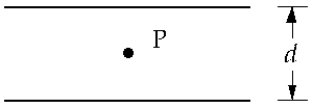 Two flat parallel plates are d = 0.40 cm apart. The potential difference between the plates is 360 V. The electric field at the point P at the center is approximately
 (Multiple Choice)
4.9/5 (83)
(83) A coaxial cable consists of a wire of radius 0.30 mm and an outer conducting shell of radius 1.0 mm. Its capacitance for a 2 m length of the cable is approximately
(Multiple Choice)
4.8/5 (87)
(87) If a capacitor of capacitance 2.0 µF is given a charge of 1.0 mC, the potential difference across the capacitor is
(Multiple Choice)
4.8/5 (90)
(90) A coaxial cable consists of a wire of radius 1.0 mm and an outer conducting shell of radius 8 mm. A 20 V potential difference is applied between the wire and the shell. What is the energy stored in a 2 m length of the cable?
(Multiple Choice)
5.0/5 (86)
(86) A parallel-plate capacitor has square plates of side 8.0 cm separated by 0.80 mm. If you charge this capacitor to 15 V, the amount of charge transferred from one plate to the other is
(Multiple Choice)
5.0/5 (83)
(83) A capacitor, C1 = 5.0 F, is charged up to 8 V. It is then connected to a second uncharged capacitor C2 = 2.5 F. The voltage across the capacitor C1 after the system has come to equilibrium is
(Multiple Choice)
5.0/5 (75)
(75) The space between the inner wire of radius a = 1 mm of a co-axial cable and the conducting shield of radius b = 8 mm is made of nylon ( = 4.2). The capacitance per meter is
(Multiple Choice)
4.9/5 (74)
(74) A coaxial cable consists of a wire of radius 1.0 mm and an outer conducting shell of radius 8 mm. A 20 V potential difference is applied between the wire and the shell. What is the energy stored per meter of the cable?
(Multiple Choice)
4.7/5 (76)
(76) 
Filters
- Essay(0)
- Multiple Choice(0)
- Short Answer(0)
- True False(0)
- Matching(0)