



 Chat with AI
Exam 40: Nuclear Physics

Exam 1: Systems of Measurement86 Questions
Exam 2: Motion in One Dimension83 Questions
Exam 3: Motion in Two and Three Dimensions60 Questions
Exam 4: Newtons Laws106 Questions
Exam 5: Applications of Newtons Laws73 Questions
Exam 6: Work and Energy60 Questions
Exam 7: Conservation of Energy56 Questions
Exam 8: Systems of Particles and Conservation of Linear Momentum92 Questions
Exam 9: Rotation105 Questions
Exam 10: Conservation of Angular Momentum66 Questions
Exam 11: Gravity84 Questions
Exam 12: Static Equilibrium and Elasticity58 Questions
Exam 13: Fluids77 Questions
Exam 14: Oscillations126 Questions
Exam 15: Wave Motion112 Questions
Exam 16: Superposition and Standing Waves87 Questions
Exam 17: Temperature and the Kinetic Theory of Gases78 Questions
Exam 18: Heat and the First Law of Thermodynamics100 Questions
Exam 19: The Second Law of Thermodynamics59 Questions
Exam 20: Thermal Properties and Processes50 Questions
Exam 21: The Electric Field I: Discrete Charge Distributions55 Questions
Exam 22: The Electric Field Ii: Continuous Charge Distributions64 Questions
Exam 23: Electric Potential87 Questions
Exam 24: Capacitance63 Questions
Exam 25: Electric Current and Direct-Current Circuits107 Questions
Exam 26: The Magnetic Field33 Questions
Exam 27: Sources of the Magnetic Field86 Questions
Exam 28: Magnetic Induction56 Questions
Exam 29: Alternating-Current Circuits106 Questions
Exam 30: Maxwells Equations and Electromagnetic Waves57 Questions
Exam 31: Properties of Light82 Questions
Exam 32: Optical Images106 Questions
Exam 33: Interference and Diffraction91 Questions
Exam 34: Wave Particle Duality and Quantum Physics140 Questions
Exam 35: Applications of the Schrodinger Equation42 Questions
Exam 36: Atoms113 Questions
Exam 37: Molecules39 Questions
Exam 38: Solids and the Theory of Conduction75 Questions
Exam 39: Relativity82 Questions
Exam 40: Nuclear Physics107 Questions
Exam 41: Elementary Particles and the Beginning of the Universe68 Questions
Select questions type


Radon (Rn)is a gas.Its nucleus decays with the emission of an alpha particle to form an isotope of polonium (Po):  The masses of the particles are:
 The rest energy of a unified mass unit is 931.5 MeV.The kinetic energy of the ejected particles is
The masses of the particles are:
The rest energy of a unified mass unit is 931.5 MeV.The kinetic energy of the ejected particles is (Multiple Choice)
5.0/5  (81)
(81) For most nuclei,the total binding energy is proportional to the number of nucleons.This leads to the conclusion that nuclear forces show the property of
(Multiple Choice)
4.9/5 (88)
(88) A flux of 1014 n/m2 · s is incident on an  foil that is 0.10 cm thick.The density of aluminum is 2.7 103 kg/m3.The number of neutrons reacting with the aluminum is 106 n/m2 · s.The cross section for this reaction is approximately
 (Multiple Choice)
4.9/5 (75)
(75) A light-water reactor uses _______ as fuel,and a heavy-water reactor uses _______ as fuel.
(Multiple Choice)
4.7/5 (77)
(77) In Positron Emission Tomography (or PET)scans,a very small amount of a radioactive drug is given to a patient.Fluorine-18 doped or labeled fluorodeoxyglucose,also called FDG,is a radioactive version of the sugar glucose with a half-life of 110 minutes.Once injected into the body,it will go to places where glucose is used for energy.For example,FDG will go to the brain,and,in particular,to those parts of the brain that are actively burning glucose for energy.A variety of different images are observed depending on the parts of the brain being used in certain tasks,such as reading or listening.If the patient came back at the same time the next day after their initial injection for a further scan,how much of the original Fluorine-18 activity would remain?
(Multiple Choice)
4.8/5 (89)
(89) Use the following atomic masses.  -The emission of one beta particle (an electron)from the nucleus of an atom produces a change of
 (Multiple Choice)
4.8/5 (90)
(90) One way to think about the low binding energy per nucleon for low A numbers is 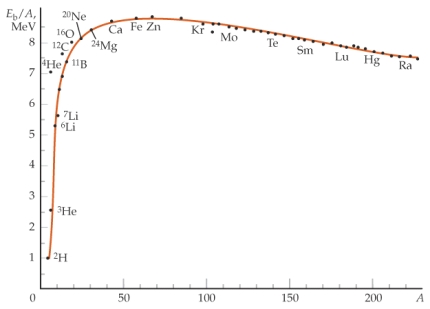
(Multiple Choice)
4.7/5 (73)
(73) Two alpha particles approach each other until they are 10-8 cm apart.The force exerted by one of the particles on the other is approximately
(Multiple Choice)
4.9/5 (87)
(87) Rutherford's experiments,in which he bombarded a very thin gold foil with alpha particles,showed that
(Multiple Choice)
4.9/5 (93)
(93) Which of the following is a negatively charged particle found in the nucleus of an atom?
(Multiple Choice)
4.9/5 (88)
(88) The speed of alpha particles from 210Po is 1.6 107 m/s.The recoil atom will have a speed of approximately
(Multiple Choice)
4.7/5 (89)
(89) The Federal Aviation Administration limits the number of hours flight crews can be at high altitudes, 10,000 m.One of the reasons is because
(Multiple Choice)
4.8/5 (77)
(77) The nuclear reaction process in which a heavy nucleus splits into two roughly equal parts is known as
(Multiple Choice)
4.9/5 (86)
(86) The element that would best serve as a control rod in a nuclear reactor is 
(Multiple Choice)
4.7/5 (81)
(81) Radon 222Rn is a radioactive gas produced as part of the natural decay chain of uranium.Because it is a gas,it can pose a health problem through inhalation,especially when high concentrations accumulate in homes.Suppose 5 108 radon atoms are present in a basement at some time.If the basement is sealed and left,then how many radon atoms remain after a month (31 days)? (The half-life of 222Rn is 3.82 days.)
(Multiple Choice)
4.9/5 (68)
(68) If the radioactivity of thorium C decreases to one-half in 1 h,in another 60 min its activity,compared with that at the beginning of the first hour,will be
(Multiple Choice)
4.7/5 (78)
(78) A radioactive nucleus with Z = 92 and A = 235 decays through a series of alpha,beta,and gamma emissions to a stable nucleus with Z = 82 and A = 207.The number of alpha particles and the number of beta particles emitted during the entire process are
(Multiple Choice)
4.9/5 (88)
(88) 
Filters
- Essay(0)
- Multiple Choice(0)
- Short Answer(0)
- True False(0)
- Matching(0)