



 Chat with AI
Exam 36: Atoms

Exam 1: Systems of Measurement86 Questions
Exam 2: Motion in One Dimension83 Questions
Exam 3: Motion in Two and Three Dimensions60 Questions
Exam 4: Newtons Laws106 Questions
Exam 5: Applications of Newtons Laws73 Questions
Exam 6: Work and Energy60 Questions
Exam 7: Conservation of Energy56 Questions
Exam 8: Systems of Particles and Conservation of Linear Momentum92 Questions
Exam 9: Rotation105 Questions
Exam 10: Conservation of Angular Momentum66 Questions
Exam 11: Gravity84 Questions
Exam 12: Static Equilibrium and Elasticity58 Questions
Exam 13: Fluids77 Questions
Exam 14: Oscillations126 Questions
Exam 15: Wave Motion112 Questions
Exam 16: Superposition and Standing Waves87 Questions
Exam 17: Temperature and the Kinetic Theory of Gases78 Questions
Exam 18: Heat and the First Law of Thermodynamics100 Questions
Exam 19: The Second Law of Thermodynamics59 Questions
Exam 20: Thermal Properties and Processes50 Questions
Exam 21: The Electric Field I: Discrete Charge Distributions55 Questions
Exam 22: The Electric Field Ii: Continuous Charge Distributions64 Questions
Exam 23: Electric Potential87 Questions
Exam 24: Capacitance63 Questions
Exam 25: Electric Current and Direct-Current Circuits107 Questions
Exam 26: The Magnetic Field33 Questions
Exam 27: Sources of the Magnetic Field86 Questions
Exam 28: Magnetic Induction56 Questions
Exam 29: Alternating-Current Circuits106 Questions
Exam 30: Maxwells Equations and Electromagnetic Waves57 Questions
Exam 31: Properties of Light82 Questions
Exam 32: Optical Images106 Questions
Exam 33: Interference and Diffraction91 Questions
Exam 34: Wave Particle Duality and Quantum Physics140 Questions
Exam 35: Applications of the Schrodinger Equation42 Questions
Exam 36: Atoms113 Questions
Exam 37: Molecules39 Questions
Exam 38: Solids and the Theory of Conduction75 Questions
Exam 39: Relativity82 Questions
Exam 40: Nuclear Physics107 Questions
Exam 41: Elementary Particles and the Beginning of the Universe68 Questions
Select questions type


An electron in a hydrogen atom jumps from the n = 5 to n = 3 level.Is a photon absorbed or emitted in this process? What is the wavelength of the photon? State whether the photon is in the visible,ultraviolet,or infrared range of the electro-magnetic spectrum.
(Multiple Choice)
4.7/5  (83)
(83) Use the following figure for the next problem. 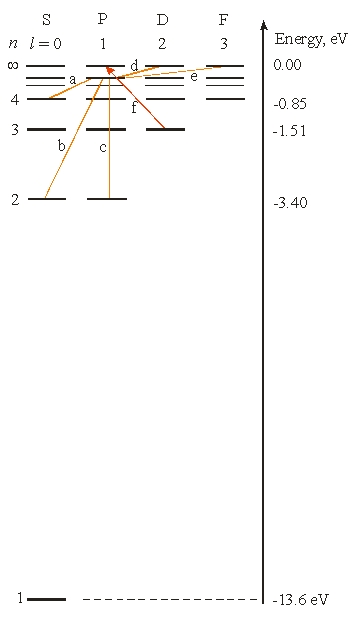 -Which of the following transitions from (a)to (e)is(are)not allowed?
 (Multiple Choice)
4.7/5 (94)
(94) The equation derived by Bohr for the wavelengths of of the lines in hydrogen- like spectra is  The first member of the Balmer series of hydrogen has = 660 nm.Doubly ionized
 is hydrogen-like.The wavelength of the first member of the Balmer series for doubly ionized
 is
The first member of the Balmer series of hydrogen has = 660 nm.Doubly ionized is hydrogen-like.The wavelength of the first member of the Balmer series for doubly ionized is (Multiple Choice)
4.9/5 (84)
(84) The number of oxygen's eight electrons that are found in the p state is
(Multiple Choice)
4.8/5 (78)
(78) What is the difference in wavelength between the longest wavelength in the Lyman series and that of the longest wavelength in the Paschen series?
(Multiple Choice)
4.9/5 (69)
(69) A photon of wavelength 80 nm is absorbed by the electron in the ground-state level of the hydrogen atom.Is this enough energy to ionize the atom? If so calculate the kinetic energy of the free electron.
(Multiple Choice)
4.9/5 (79)
(79) Z for the element whose electronic configuration is  must be
 (Multiple Choice)
5.0/5 (77)
(77) The energy of the nth level in a one-electron atom is En = -13.6(Z2/n2)eV.Consider a beryllium ion with all but one of its electrons removed (a beryllium atom normally has four electrons).What is the energy of the electron when it is in the third-lowest energy state?
(Multiple Choice)
4.9/5 (91)
(91) The orbital angular momentum L is related to the orbital quantum number  by
by (Multiple Choice)
4.9/5 (81)
(81) The constant in the Rydberg-Ritz formula is RH = 10.96776 µm-1.The wavelength predicted by this formula for n1 = 3 and n2 = 2 is
(Multiple Choice)
4.9/5 (89)
(89) Use the following figure for the next problem.
-What is the longest wavelength needed for an electron to make the transition labeled (f)?
-What is the longest wavelength needed for an electron to make the transition labeled (f)? (Multiple Choice)
4.7/5 (90)
(90) The wavelength of the photon emitted when a hydrogen atom undergoes a transition from the n = 10 state to the n = 1 state is approximately
(Multiple Choice)
4.8/5 (77)
(77) 
Filters
- Essay(0)
- Multiple Choice(0)
- Short Answer(0)
- True False(0)
- Matching(0)