



 Chat with AI
Exam 29: Alternating-Current Circuits

Exam 1: Systems of Measurement86 Questions
Exam 2: Motion in One Dimension83 Questions
Exam 3: Motion in Two and Three Dimensions60 Questions
Exam 4: Newtons Laws106 Questions
Exam 5: Applications of Newtons Laws73 Questions
Exam 6: Work and Energy60 Questions
Exam 7: Conservation of Energy56 Questions
Exam 8: Systems of Particles and Conservation of Linear Momentum92 Questions
Exam 9: Rotation105 Questions
Exam 10: Conservation of Angular Momentum66 Questions
Exam 11: Gravity84 Questions
Exam 12: Static Equilibrium and Elasticity58 Questions
Exam 13: Fluids77 Questions
Exam 14: Oscillations126 Questions
Exam 15: Wave Motion112 Questions
Exam 16: Superposition and Standing Waves87 Questions
Exam 17: Temperature and the Kinetic Theory of Gases78 Questions
Exam 18: Heat and the First Law of Thermodynamics100 Questions
Exam 19: The Second Law of Thermodynamics59 Questions
Exam 20: Thermal Properties and Processes50 Questions
Exam 21: The Electric Field I: Discrete Charge Distributions55 Questions
Exam 22: The Electric Field Ii: Continuous Charge Distributions64 Questions
Exam 23: Electric Potential87 Questions
Exam 24: Capacitance63 Questions
Exam 25: Electric Current and Direct-Current Circuits107 Questions
Exam 26: The Magnetic Field33 Questions
Exam 27: Sources of the Magnetic Field86 Questions
Exam 28: Magnetic Induction56 Questions
Exam 29: Alternating-Current Circuits106 Questions
Exam 30: Maxwells Equations and Electromagnetic Waves57 Questions
Exam 31: Properties of Light82 Questions
Exam 32: Optical Images106 Questions
Exam 33: Interference and Diffraction91 Questions
Exam 34: Wave Particle Duality and Quantum Physics140 Questions
Exam 35: Applications of the Schrodinger Equation42 Questions
Exam 36: Atoms113 Questions
Exam 37: Molecules39 Questions
Exam 38: Solids and the Theory of Conduction75 Questions
Exam 39: Relativity82 Questions
Exam 40: Nuclear Physics107 Questions
Exam 41: Elementary Particles and the Beginning of the Universe68 Questions
Select questions type


A heater is plugged into the same 120-V AC outlet as an 800-W hair dryer.If the total rms current drawn is 16.7 A,then calculate the power rating of the heater.
(Multiple Choice)
4.8/5  (74)
(74) A square coil with 12 turns and side 5 cm is rotated in a uniform magnetic field of 1.2 T at an angular frequency of 90 radians per second.What is the maximum voltage induced in the coil?
(Multiple Choice)
4.8/5 (82)
(82) In the U.K.the power companies supply an rms voltage of 240 V to most home outlets.If you were to try and use your standard U.S.rated 1200-W (at 120-V)hair dryer in the U.K.without using a transformer,what would be the average power supplied to the hair dryer?
(Multiple Choice)
4.9/5 (88)
(88) Use the following figure for the next problem. 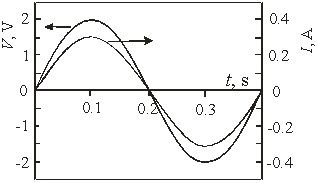 -The figure shows the voltage and current for a device.The average power consumed by the device is
 (Multiple Choice)
4.8/5 (69)
(69) Use the following figure for the next problem.  An AC power supply, V = 20 V sin
 where
 = 200 rad/s is connect to an inductor L = 180 mH and a capacitor C = 25
 XL = 36 ohms, XC = 200 ohms, Z = 43.9 ohms
-What is the peak current flow through the inductor?
An AC power supply, V = 20 V sin where = 200 rad/s is connect to an inductor L = 180 mH and a capacitor C = 25 XL = 36 ohms, XC = 200 ohms, Z = 43.9 ohms
-What is the peak current flow through the inductor? (Multiple Choice)
4.9/5 (73)
(73) A flat,rectangular coil measuring 0.10 m by 0.20 m and containing 50 turns of wire is rotating at a constant speed of 100 rad/s in a magnetic field of 0.20 T.The maximum EMF induced in this coil is approximately
(Multiple Choice)
4.9/5 (72)
(72) 
Filters
- Essay(0)
- Multiple Choice(0)
- Short Answer(0)
- True False(0)
- Matching(0)