



 Chat with AI
Exam 16: Superposition and Standing Waves

Exam 1: Systems of Measurement86 Questions
Exam 2: Motion in One Dimension83 Questions
Exam 3: Motion in Two and Three Dimensions60 Questions
Exam 4: Newtons Laws106 Questions
Exam 5: Applications of Newtons Laws73 Questions
Exam 6: Work and Energy60 Questions
Exam 7: Conservation of Energy56 Questions
Exam 8: Systems of Particles and Conservation of Linear Momentum92 Questions
Exam 9: Rotation105 Questions
Exam 10: Conservation of Angular Momentum66 Questions
Exam 11: Gravity84 Questions
Exam 12: Static Equilibrium and Elasticity58 Questions
Exam 13: Fluids77 Questions
Exam 14: Oscillations126 Questions
Exam 15: Wave Motion112 Questions
Exam 16: Superposition and Standing Waves87 Questions
Exam 17: Temperature and the Kinetic Theory of Gases78 Questions
Exam 18: Heat and the First Law of Thermodynamics100 Questions
Exam 19: The Second Law of Thermodynamics59 Questions
Exam 20: Thermal Properties and Processes50 Questions
Exam 21: The Electric Field I: Discrete Charge Distributions55 Questions
Exam 22: The Electric Field Ii: Continuous Charge Distributions64 Questions
Exam 23: Electric Potential87 Questions
Exam 24: Capacitance63 Questions
Exam 25: Electric Current and Direct-Current Circuits107 Questions
Exam 26: The Magnetic Field33 Questions
Exam 27: Sources of the Magnetic Field86 Questions
Exam 28: Magnetic Induction56 Questions
Exam 29: Alternating-Current Circuits106 Questions
Exam 30: Maxwells Equations and Electromagnetic Waves57 Questions
Exam 31: Properties of Light82 Questions
Exam 32: Optical Images106 Questions
Exam 33: Interference and Diffraction91 Questions
Exam 34: Wave Particle Duality and Quantum Physics140 Questions
Exam 35: Applications of the Schrodinger Equation42 Questions
Exam 36: Atoms113 Questions
Exam 37: Molecules39 Questions
Exam 38: Solids and the Theory of Conduction75 Questions
Exam 39: Relativity82 Questions
Exam 40: Nuclear Physics107 Questions
Exam 41: Elementary Particles and the Beginning of the Universe68 Questions
Select questions type


The wave function y(x,t)for a standing wave on a string fixed at both ends is given by y(x,t)= 0.080 sin 6.0x cos 600t where the units are SI.The wavelength of this wave is
(Multiple Choice)
4.7/5  (69)
(69) Two speakers face each other at a distance of 1 m and are driven by a common audio oscillator.A first minimum in sound intensity is found 16.1 cm from the midpoint.If the velocity of sound is 330 m/s,find the frequency of the oscillator.
(Multiple Choice)
4.8/5 (85)
(85) A piano tuner hears a beat every 0.33 seconds when he hits a note and compares it to his reference tone at 163 Hz.What is the lowest possible frequency of the piano note?
(Multiple Choice)
4.8/5 (87)
(87) The three curves show the harmonics of a pipe that is closed one end and open the other end.The fundamental frequency is fo.The three harmonics are 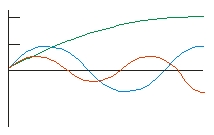
(Multiple Choice)
4.9/5 (71)
(71) The electronic music synthesizer is based on the results of
(Multiple Choice)
4.8/5 (81)
(81) The reason we can tell the difference between a trumpet and a clarinet when they both play the same pitch is that they have
(Multiple Choice)
4.9/5 (91)
(91) Use the figure to the right to answer the next problem.
The graph shows three harmonics. 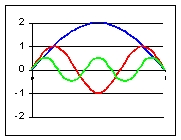 -The frequency spectrum of the composite wave is best represented by
 (Multiple Choice)
4.9/5 (79)
(79) Tuning fork A has a frequency of 440 Hz.When A and a second tuning fork B are struck simultaneously,four beats per second are heard.When a small mass is added to one of the tines of B,the two forks struck simultaneously produce two beats per second.The original frequency of tuning fork B was
(Multiple Choice)
4.8/5 (94)
(94) Use the figure below to answer the next problem.
The graph shows a wave pulse of width w = 5 cm and speed v = 100 m / s.  -The range of frequencies is
 (Multiple Choice)
4.9/5 (84)
(84) A string fixed at both ends is driven by a tuning fork to produce standing waves.If the tension in the string is increased,
(Multiple Choice)
5.0/5 (71)
(71) If fo is the fundamental frequency,the three harmonics and their relative intensities can best be written as
(Multiple Choice)
4.8/5 (75)
(75) Wire A is the same mass per unit length as wire B.However wire A is twice as long as wire B and has three times as much tension on it.Calculate the fundamental frequency of wire A divided by wire B.
(Multiple Choice)
4.8/5 (75)
(75) If both the tension and the length of a vibrating string are doubled while the linear density remains constant,the fundamental frequency of the string is multiplied by
(Multiple Choice)
4.9/5 (86)
(86) A string whose length is 1 m is fixed at both ends and vibrates according to the equation  where the units are SI.The total number of nodes exhibited by the string is
 (Multiple Choice)
4.7/5 (84)
(84) The air columns in two identical pipes vibrate at frequencies of 150 Hz.The percentage of change needed in the length of one of the pipes to produce 3 beats per second is
(Multiple Choice)
4.8/5 (85)
(85) If the amplitude of a standing wave is doubled,the energy in the wave increases by a factor of
(Multiple Choice)
4.7/5 (91)
(91) Two wave trains of the same frequency are traveling in opposite directions down a string.When they meet,these wave trains will not
(Multiple Choice)
4.9/5 (76)
(76) Two trumpet players are both playing a pitch with a frequency of 440 Hz,corresponding to the musical pitch A above middle C.However,one of the trumpet players is marching away from you so that you hear a beat frequency of 4 Hz from the two trumpets.With what speed is the departing trumpet player moving away from you? (The speed of sound in air is 340 m/s)
(Multiple Choice)
4.9/5 (69)
(69) 
Filters
- Essay(0)
- Multiple Choice(0)
- Short Answer(0)
- True False(0)
- Matching(0)