



 Chat with AI
Exam 14: Oscillations

Exam 1: Systems of Measurement86 Questions
Exam 2: Motion in One Dimension83 Questions
Exam 3: Motion in Two and Three Dimensions60 Questions
Exam 4: Newtons Laws106 Questions
Exam 5: Applications of Newtons Laws73 Questions
Exam 6: Work and Energy60 Questions
Exam 7: Conservation of Energy56 Questions
Exam 8: Systems of Particles and Conservation of Linear Momentum92 Questions
Exam 9: Rotation105 Questions
Exam 10: Conservation of Angular Momentum66 Questions
Exam 11: Gravity84 Questions
Exam 12: Static Equilibrium and Elasticity58 Questions
Exam 13: Fluids77 Questions
Exam 14: Oscillations126 Questions
Exam 15: Wave Motion112 Questions
Exam 16: Superposition and Standing Waves87 Questions
Exam 17: Temperature and the Kinetic Theory of Gases78 Questions
Exam 18: Heat and the First Law of Thermodynamics100 Questions
Exam 19: The Second Law of Thermodynamics59 Questions
Exam 20: Thermal Properties and Processes50 Questions
Exam 21: The Electric Field I: Discrete Charge Distributions55 Questions
Exam 22: The Electric Field Ii: Continuous Charge Distributions64 Questions
Exam 23: Electric Potential87 Questions
Exam 24: Capacitance63 Questions
Exam 25: Electric Current and Direct-Current Circuits107 Questions
Exam 26: The Magnetic Field33 Questions
Exam 27: Sources of the Magnetic Field86 Questions
Exam 28: Magnetic Induction56 Questions
Exam 29: Alternating-Current Circuits106 Questions
Exam 30: Maxwells Equations and Electromagnetic Waves57 Questions
Exam 31: Properties of Light82 Questions
Exam 32: Optical Images106 Questions
Exam 33: Interference and Diffraction91 Questions
Exam 34: Wave Particle Duality and Quantum Physics140 Questions
Exam 35: Applications of the Schrodinger Equation42 Questions
Exam 36: Atoms113 Questions
Exam 37: Molecules39 Questions
Exam 38: Solids and the Theory of Conduction75 Questions
Exam 39: Relativity82 Questions
Exam 40: Nuclear Physics107 Questions
Exam 41: Elementary Particles and the Beginning of the Universe68 Questions
Select questions type


A 2-kg mass oscillates in one dimension with simple harmonic motion on the end of a massless spring on a horizontal frictionless table according to  where the units are SI.The total mechanical energy of this system is
 (Multiple Choice)
4.7/5  (86)
(86) A simple way to test if a device can withstand high "g-force" is to attach the device to a vibrating platform.Suppose a device has to withstand up to 5g's,and the amplitude of the oscillation is 5 cm,the frequency of the vibration should be
(Multiple Choice)
4.7/5 (75)
(75) Both a mass-spring system and a simple pendulum have a period of 1 s.Both are taken to the moon in a lunar landing module.While they are inside the module on the surface of the moon,
(Multiple Choice)
4.9/5 (92)
(92) The top graph represents the variation of displacement with time for a particle executing simple harmonic motion.Which curve in the bottom graph represents the variation of acceleration with time for the same particle? 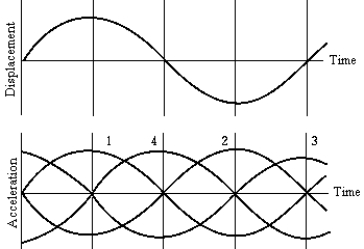
(Multiple Choice)
4.8/5 (68)
(68) Use the following to answer the question: 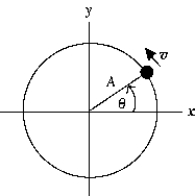 -The object in the diagram is in circular motion with frequency f.At t = 0 it was at (A,0).The y component of its velocity is given by
 (Multiple Choice)
4.7/5 (84)
(84) Use the following to answer question: 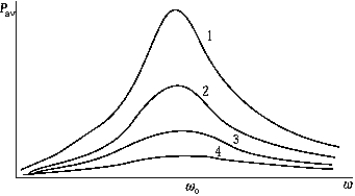 -The graph shows the average power delivered to an oscillating system as a function of the driving frequency.According to these data
 (Multiple Choice)
5.0/5 (103)
(103) The mass on the end of the spring (which stretches linearly)is in equilibrium as shown.It is pulled down so that the pointer is opposite the 11-cm mark and then released.The mass experiences its maximum upward velocity at which of the following positions? 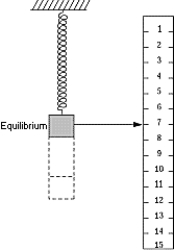
(Multiple Choice)
4.9/5 (78)
(78) A 1.0-kg mass oscillates along the x axis with simple harmonic motion.Its position as a function of time is given by  where the units are SI.When t = 2 s,the kinetic energy of the mass is
 (Multiple Choice)
4.8/5 (89)
(89) In simple harmonic motion,the magnitude of the acceleration of a body is always directly proportional to its
(Multiple Choice)
4.9/5 (83)
(83) The shattering of a crystal glass by an intense sound is an example of
(Multiple Choice)
4.8/5 (76)
(76) Use the following to answer question:
-The graph shows the average power delivered to an oscillating system as a function of the driving frequency.According to these data,the damping is least for system(s)
-The graph shows the average power delivered to an oscillating system as a function of the driving frequency.According to these data,the damping is least for system(s) (Multiple Choice)
4.7/5 (68)
(68) If the amplitude of a simple harmonic oscillator is doubled,the total energy is
(Multiple Choice)
4.9/5 (74)
(74) A body of mass M suspended from a spring oscillates with a period T.If the mass of the spring can be neglected,a body of mass 2M,suspended from the same spring,oscillates with a period of
(Multiple Choice)
4.8/5 (89)
(89) Use the figure to answer the next problem. A spring of negligible mass and spring constant k is attached to the wall on one end,and the other end is attached to the center of mass axis of a solid sphere of mass m and radius r.The spring is stretched a distance A from equilibrium and let go.The sphere rolls freely on a smooth surface. 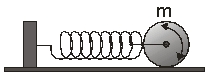 -The angular frequency of the oscillation is
 (Multiple Choice)
4.7/5 (71)
(71) A mass on a spring oscillates with an amplitude of 5.0 cm.What is the position of the mass when the kinetic and potential energies are equal?
(Multiple Choice)
4.8/5 (79)
(79) The energy of a simple harmonic oscillator could be doubled by increasing the amplitude by a factor of
(Multiple Choice)
4.7/5 (74)
(74) Use the figure to the right to answer the next problem. A ball of mass m = 100 g and radius r = 10 cm is suspended from a light spring with spring constant k = 4 N / m.The ball is then immersed in oil with viscosity = 0.2 Pa.s , and set into oscillation with an initial amplitude of A = 2 cm. 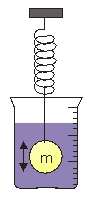 -The oscillation is
 (Multiple Choice)
4.8/5 (63)
(63) When an object is oscillating in simple harmonic motion in the vertical direction,its maximum speed occurs when the object
(Multiple Choice)
4.8/5 (77)
(77) An object is moving with simple harmonic motion.When the object is displaced 4 cm from its equilibrium point,its acceleration is 20 cm/s2.Calculate the period T.
(Multiple Choice)
4.9/5 (94)
(94) Use the following to answer question: 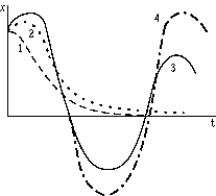 -The graph shows the displacement of an oscillator as a function of time.The oscillator that is undamped is
 (Multiple Choice)
4.9/5 (75)
(75) 
Filters
- Essay(0)
- Multiple Choice(0)
- Short Answer(0)
- True False(0)
- Matching(0)