



 Chat with AI
Exam 15: Money, Banking, and Central Banking

Exam 1: The Nature of Economics348 Questions
Exam 2: Scarcity and the World of Trade-Offs411 Questions
Exam 3: Demand and Supply451 Questions
Exam 4: Extensions of Demand and Supply Analysis401 Questions
Exam 5: Public Spending and Public Choice362 Questions
Exam 6: Funding the Public Sector201 Questions
Exam 7: The Macroeconomy: Unemployment, Inflation, and Deflation413 Questions
Exam 8: Measuring the Economys Performance416 Questions
Exam 9: Global Economic Growth and Development290 Questions
Exam 10: Real GDP and the Price Level in the Long Run298 Questions
Exam 11: Classical and Keynesian Macro Analyses368 Questions
Exam 12: Consumption, Real GDP, and the Multiplier452 Questions
Exam 13: Fiscal Policy274 Questions
Exam 14: Deficit Spending and the Public Debt146 Questions
Exam 15: Money, Banking, and Central Banking516 Questions
Exam 16: Domestic and International Dimensions of Monetary Policy357 Questions
Exam 17: Stabilization in an Integrated World Economy321 Questions
Exam 18: Policies and Prospects for Global Economic Growth228 Questions
Exam 19: Demand and Supply Elasticity412 Questions
Exam 20: Consumer Choice459 Questions
Exam 21: Rents, Profits, and the Financial Environment of Business445 Questions
Exam 22: The Firm: Cost and Output Determination391 Questions
Exam 23: Perfect Competition432 Questions
Exam 24: Monopoly386 Questions
Exam 25: Monopolistic Competition307 Questions
Exam 26: Oligopoly and Strategic Behavior308 Questions
Exam 27: Regulation and Antitrust Policy in a Globalized Economy310 Questions
Exam 28: The Labor Market: Demand, Supply and Outsourcing376 Questions
Exam 29: Unions and Labor Market Monopoly Power319 Questions
Exam 30: Income, Poverty, and Health Care304 Questions
Exam 31: Environmental Economics299 Questions
Exam 32: Comparative Advantage and the Open Economy282 Questions
Exam 33: Exchange Rates and the Balance of Payments285 Questions
Select questions type


If an asset can be disposed of without much risk of losing its nominal value, it is said to be
(Multiple Choice)
4.9/5  (74)
(74) Money as a medium of exchange I. Facilitates the exchange of goods
II) Reduces the incentive to barter
(Multiple Choice)
4.8/5 (85)
(85) Money that we have today can be set aside to purchase things in the future. This function of money is known as
(Multiple Choice)
4.9/5 (76)
(76) The reserve ratio is 10 percent. A check for $1 million is deposited in Bank A, written on an account from Bank B. After the check clears what are the new excess reserves at Bank A, and by how much does the money supply change if all banks make loans so that they have zero excess reserves?
(Multiple Choice)
4.8/5 (81)
(81) All of the following are examples of financial intermediaries EXCEPT
(Multiple Choice)
4.9/5 (83)
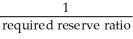
(83) 
The fact that individuals whose credit worthiness is less than it appears to be are those who are most willing to borrow funds at any given interest rate is an example of
(Multiple Choice)
4.7/5 (60)
(60) The price tag on an Under Armour shirt illustrates how money performs the function of a
(Multiple Choice)
4.7/5 (75)
(75) The reason we are willing to accept money with no intrinsic value is that
(Multiple Choice)
4.8/5 (71)
(71) For the past several decades, the U.S. M1 multiplier has been between
(Multiple Choice)
4.8/5 (73)
(73) For the money expansion process to produce the maximum potential multiplier effect
(Multiple Choice)
4.8/5 (61)
(61) Following a new deposit of $500, the loans of a commercial bank increase by $450. In this situation, the reserve ratio is most likely
(Multiple Choice)
4.8/5 (81)
(81) The actual money multiplier multiplied by the change in total reserves is the
(Multiple Choice)
4.7/5 (79)
(79) The Fed buys securities and gives a bond dealer a check for the amount. After the check has cleared
(Multiple Choice)
4.8/5 (80)
(80) The possibility that a borrower might engage in riskier behavior after a loan has been obtained is
(Multiple Choice)
4.7/5 (74)
(74) 
Filters
- Essay(0)
- Multiple Choice(0)
- Short Answer(0)
- True False(0)
- Matching(0)