



 Chat with AI
Exam 15: Money, Banking, and Central Banking

Exam 1: The Nature of Economics348 Questions
Exam 2: Scarcity and the World of Trade-Offs411 Questions
Exam 3: Demand and Supply451 Questions
Exam 4: Extensions of Demand and Supply Analysis401 Questions
Exam 5: Public Spending and Public Choice362 Questions
Exam 6: Funding the Public Sector201 Questions
Exam 7: The Macroeconomy: Unemployment, Inflation, and Deflation413 Questions
Exam 8: Measuring the Economys Performance416 Questions
Exam 9: Global Economic Growth and Development290 Questions
Exam 10: Real GDP and the Price Level in the Long Run298 Questions
Exam 11: Classical and Keynesian Macro Analyses368 Questions
Exam 12: Consumption, Real GDP, and the Multiplier452 Questions
Exam 13: Fiscal Policy274 Questions
Exam 14: Deficit Spending and the Public Debt146 Questions
Exam 15: Money, Banking, and Central Banking516 Questions
Exam 16: Domestic and International Dimensions of Monetary Policy357 Questions
Exam 17: Stabilization in an Integrated World Economy321 Questions
Exam 18: Policies and Prospects for Global Economic Growth228 Questions
Exam 19: Demand and Supply Elasticity412 Questions
Exam 20: Consumer Choice459 Questions
Exam 21: Rents, Profits, and the Financial Environment of Business445 Questions
Exam 22: The Firm: Cost and Output Determination391 Questions
Exam 23: Perfect Competition432 Questions
Exam 24: Monopoly386 Questions
Exam 25: Monopolistic Competition307 Questions
Exam 26: Oligopoly and Strategic Behavior308 Questions
Exam 27: Regulation and Antitrust Policy in a Globalized Economy310 Questions
Exam 28: The Labor Market: Demand, Supply and Outsourcing376 Questions
Exam 29: Unions and Labor Market Monopoly Power319 Questions
Exam 30: Income, Poverty, and Health Care304 Questions
Exam 31: Environmental Economics299 Questions
Exam 32: Comparative Advantage and the Open Economy282 Questions
Exam 33: Exchange Rates and the Balance of Payments285 Questions
Select questions type


Following a new deposit of $100 at a bank, drawn on funds previously held on deposit at another bank, when the reserve ratio is 10 percent, the maximum potential increase in the money supply will be
(Multiple Choice)
4.9/5  (66)
(66) By affecting the amount of reserves in the banking system, the Fed can
(Multiple Choice)
4.7/5 (82)
(82) Which of the following depository institutions is NOT regulated by a government agency?
(Multiple Choice)
4.9/5 (74)
(74) Given a required reserve ratio of 20 percent, a commercial bank that has received a new deposit of $100 can make additional loans of
(Multiple Choice)
4.7/5 (82)
(82) When money provides a yardstick that allows individuals to compare the relative values of goods and services, it is functioning as a
(Multiple Choice)
4.9/5 (70)
(70) The likelihood that individuals who seek to borrow money may use the funds for unworthy, high-risk projects is
(Multiple Choice)
4.8/5 (88)
(88) A statement of assets and liabilities of any business entity is
(Multiple Choice)
4.7/5 (81)
(81) Why does the money supply increase when the Fed buys a bond but does NOT change when a business buys a bond?
(Essay)
4.9/5 (83)
(83) People with savings often deposit their funds in a commercial bank, rather than investing them directly with business enterprises, in order to
(Multiple Choice)
4.9/5 (75)
(75) Suppose that the actual money multiplier equals the maximum potential money multiplier. If the reserve ratio is 10 percent, in order for the banking system to increase deposits by $2.5 million, the Fed must
(Multiple Choice)
4.9/5 (83)
(83) The Federal Reserve System acts as the government's fiscal agent by
(Multiple Choice)
4.8/5 (85)
(85) When you make a purchase at a retail store by giving your bank an instruction to transfer funds directly from your bank account to the store's bank account, you have most likely made the purchase using
(Multiple Choice)
4.9/5 (90)
(90) The U.S. central bank performs all the following roles for the nation EXCEPT
(Multiple Choice)
5.0/5 (79)
(79) A deposit in a financial institution that requires notice of intent to withdraw is a
(Multiple Choice)
4.8/5 (80)
(80) 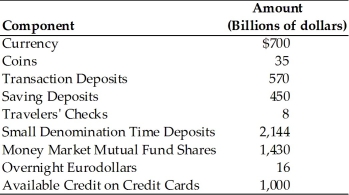 -According to the above table, the value of M2 is
If depository insurance exists, bank managers may make riskier loans than they would have otherwise, which is an example of
(Multiple Choice)
4.9/5 (86)
(86) Assuming a reserve ratio of 20 percent, if a bank receives $100,000 in deposits how much can the bank loan out?
(Multiple Choice)
4.9/5 (95)
(95) 
Filters
- Essay(0)
- Multiple Choice(0)
- Short Answer(0)
- True False(0)
- Matching(0)