



 Chat with AI
Exam 16: Domestic and International Dimensions of Monetary Policy

Exam 1: The Nature of Economics348 Questions
Exam 2: Scarcity and the World of Trade-Offs411 Questions
Exam 3: Demand and Supply451 Questions
Exam 4: Extensions of Demand and Supply Analysis401 Questions
Exam 5: Public Spending and Public Choice362 Questions
Exam 6: Funding the Public Sector201 Questions
Exam 7: The Macroeconomy: Unemployment, Inflation, and Deflation413 Questions
Exam 8: Measuring the Economys Performance416 Questions
Exam 9: Global Economic Growth and Development290 Questions
Exam 10: Real GDP and the Price Level in the Long Run298 Questions
Exam 11: Classical and Keynesian Macro Analyses368 Questions
Exam 12: Consumption, Real GDP, and the Multiplier452 Questions
Exam 13: Fiscal Policy274 Questions
Exam 14: Deficit Spending and the Public Debt146 Questions
Exam 15: Money, Banking, and Central Banking516 Questions
Exam 16: Domestic and International Dimensions of Monetary Policy357 Questions
Exam 17: Stabilization in an Integrated World Economy321 Questions
Exam 18: Policies and Prospects for Global Economic Growth228 Questions
Exam 19: Demand and Supply Elasticity412 Questions
Exam 20: Consumer Choice459 Questions
Exam 21: Rents, Profits, and the Financial Environment of Business445 Questions
Exam 22: The Firm: Cost and Output Determination391 Questions
Exam 23: Perfect Competition432 Questions
Exam 24: Monopoly386 Questions
Exam 25: Monopolistic Competition307 Questions
Exam 26: Oligopoly and Strategic Behavior308 Questions
Exam 27: Regulation and Antitrust Policy in a Globalized Economy310 Questions
Exam 28: The Labor Market: Demand, Supply and Outsourcing376 Questions
Exam 29: Unions and Labor Market Monopoly Power319 Questions
Exam 30: Income, Poverty, and Health Care304 Questions
Exam 31: Environmental Economics299 Questions
Exam 32: Comparative Advantage and the Open Economy282 Questions
Exam 33: Exchange Rates and the Balance of Payments285 Questions
Select questions type


People demand money for all of the following reasons EXCEPT
(Multiple Choice)
4.8/5  (81)
(81) When considering the demand for money curve, the interest rate
(Multiple Choice)
4.9/5 (76)
(76) 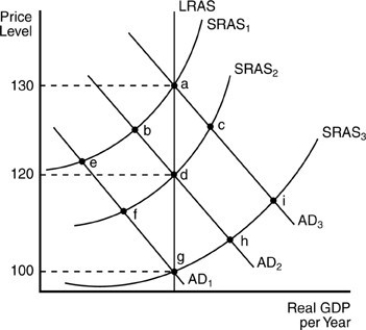 -In the above figure, assume the economy starts out in equilibrium at point d. If the Fed increases the money supply so that the new aggregate demand curve is AD3, then the new short-run equilibrium will be at point
 (Multiple Choice)
4.7/5 (81)
(81) Why is it more difficult for the Fed to control the money supply today than it was fifty years ago?
(Essay)
4.8/5 (97)
(97) By saying that the equation of exchange is an accounting identity, we mean that
(Multiple Choice)
4.9/5 (88)
(88) The relationship between the quantity of money balances demanded and the interest rate is
(Multiple Choice)
4.7/5 (84)
(84) The asset demand for money is related to which function of money?
(Multiple Choice)
4.8/5 (71)
(71) Which of the following actions by the Fed would lead to an increase in the money supply?
(Multiple Choice)
4.7/5 (81)
(81) The opportunity cost of holding excess reserves is equal to
(Multiple Choice)
4.7/5 (74)
(74) A major difference between the transactions demand for money and the precautionary demand is that the
(Multiple Choice)
4.7/5 (76)
(76) George makes $250 a week working as a student aid. When he cashes his check he takes $100 to the cashiers office to pay part of his tuition. $25 goes to paying off his books, $75 goes for entertainment and $50 he keeps for unexpected expenditures. Which of the following statements is TRUE?
(Multiple Choice)
4.9/5 (85)
(85) As nominal Gross Domestic Product (GDP) decreases, people hold
(Multiple Choice)
4.8/5 (79)
(79) According to the interest-rate-based transmission mechanism for monetary policy, a decrease in the money supply will cause the
(Multiple Choice)
4.9/5 (74)
(74) Briefly describe the effects of an open market sale by the Federal Reserve, according to the interest-rate-based approach to the monetary policy transmission mechanism.
(Essay)
4.9/5 (77)
(77) Which of the following is NOT a reason why people are motivated to hold money?
(Multiple Choice)
5.0/5 (82)
(82) Using the interest rate as a measure of the opportunity cost of holding money, the demand for money curve
(Multiple Choice)
4.8/5 (75)
(75) 
Filters
- Essay(0)
- Multiple Choice(0)
- Short Answer(0)
- True False(0)
- Matching(0)