



 Chat with AI
Exam 16: Domestic and International Dimensions of Monetary Policy

Exam 1: The Nature of Economics348 Questions
Exam 2: Scarcity and the World of Trade-Offs411 Questions
Exam 3: Demand and Supply451 Questions
Exam 4: Extensions of Demand and Supply Analysis401 Questions
Exam 5: Public Spending and Public Choice362 Questions
Exam 6: Funding the Public Sector201 Questions
Exam 7: The Macroeconomy: Unemployment, Inflation, and Deflation413 Questions
Exam 8: Measuring the Economys Performance416 Questions
Exam 9: Global Economic Growth and Development290 Questions
Exam 10: Real GDP and the Price Level in the Long Run298 Questions
Exam 11: Classical and Keynesian Macro Analyses368 Questions
Exam 12: Consumption, Real GDP, and the Multiplier452 Questions
Exam 13: Fiscal Policy274 Questions
Exam 14: Deficit Spending and the Public Debt146 Questions
Exam 15: Money, Banking, and Central Banking516 Questions
Exam 16: Domestic and International Dimensions of Monetary Policy357 Questions
Exam 17: Stabilization in an Integrated World Economy321 Questions
Exam 18: Policies and Prospects for Global Economic Growth228 Questions
Exam 19: Demand and Supply Elasticity412 Questions
Exam 20: Consumer Choice459 Questions
Exam 21: Rents, Profits, and the Financial Environment of Business445 Questions
Exam 22: The Firm: Cost and Output Determination391 Questions
Exam 23: Perfect Competition432 Questions
Exam 24: Monopoly386 Questions
Exam 25: Monopolistic Competition307 Questions
Exam 26: Oligopoly and Strategic Behavior308 Questions
Exam 27: Regulation and Antitrust Policy in a Globalized Economy310 Questions
Exam 28: The Labor Market: Demand, Supply and Outsourcing376 Questions
Exam 29: Unions and Labor Market Monopoly Power319 Questions
Exam 30: Income, Poverty, and Health Care304 Questions
Exam 31: Environmental Economics299 Questions
Exam 32: Comparative Advantage and the Open Economy282 Questions
Exam 33: Exchange Rates and the Balance of Payments285 Questions
Select questions type


Quantitative easing refers to a policy action in which a central bank
(Multiple Choice)
4.8/5  (78)
(78) 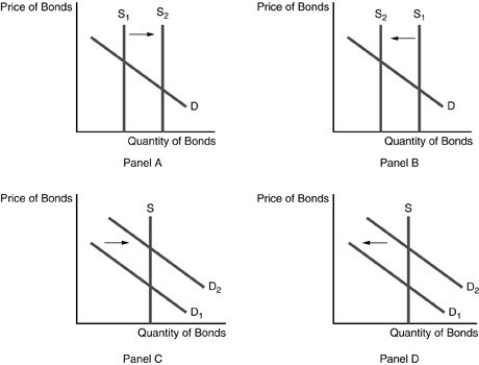 -Refer to the above figure. Which panels could represent the situation if the Fed had engaged in open market operations?
 (Multiple Choice)
4.9/5 (95)
(95) Assume (other things constant) that the Fed increases the money supply. The mechanism through which aggregate demand increases is, according to interest-rate-based transmission mechanism, summarized as follows:
(Multiple Choice)
4.8/5 (77)
(77) A person is preparing for a long automobile trip and cashes in a certificate of deposit for cash in case of emergencies along the way. This is an example of the
(Multiple Choice)
4.8/5 (71)
(71) The amount of money people wish to hold shows an inverse relationship to
(Multiple Choice)
4.9/5 (77)
(77) Travis always carries $100 in his wallet to pay for groceries. This is an example of the
(Multiple Choice)
4.9/5 (85)
(85) John gets paid monthly and pays for everything with cash. When he cashes his check he keeps $200 for food, $100 for utilities, $900 for rent, $50 for transportation, $100 for entertainment and $300 for unexpected expenditures. Which of the following statements is TRUE?
(Multiple Choice)
5.0/5 (67)
(67) The interest-rate-based transmission mechanism assumes that the Fed can stimulate investment by
(Multiple Choice)
4.8/5 (71)
(71) Suppose that the Fed has decided to utilize the Taylor rule to implement monetary policy. If the actual federal funds rate target is presently below the level specified by the Taylor rule and has been lower then this level for several weeks, then this would be a signal that
(Multiple Choice)
4.9/5 (76)
(76) If we assume that velocity is constant, and if the money supply increases by 2 percent, we would expect, ceteris paribus, that the price level would
(Multiple Choice)
4.9/5 (82)
(82) The transactions demand for money exists because households
(Multiple Choice)
4.7/5 (78)
(78) 
Filters
- Essay(0)
- Multiple Choice(0)
- Short Answer(0)
- True False(0)
- Matching(0)