



 Chat with AI
Exam 2: Scarcity and the World of Trade-Offs

Exam 1: The Nature of Economics348 Questions
Exam 2: Scarcity and the World of Trade-Offs411 Questions
Exam 3: Demand and Supply451 Questions
Exam 4: Extensions of Demand and Supply Analysis401 Questions
Exam 5: Public Spending and Public Choice362 Questions
Exam 6: Funding the Public Sector201 Questions
Exam 7: The Macroeconomy: Unemployment, Inflation, and Deflation413 Questions
Exam 8: Measuring the Economys Performance416 Questions
Exam 9: Global Economic Growth and Development290 Questions
Exam 10: Real GDP and the Price Level in the Long Run298 Questions
Exam 11: Classical and Keynesian Macro Analyses368 Questions
Exam 12: Consumption, Real GDP, and the Multiplier452 Questions
Exam 13: Fiscal Policy274 Questions
Exam 14: Deficit Spending and the Public Debt146 Questions
Exam 15: Money, Banking, and Central Banking516 Questions
Exam 16: Domestic and International Dimensions of Monetary Policy357 Questions
Exam 17: Stabilization in an Integrated World Economy321 Questions
Exam 18: Policies and Prospects for Global Economic Growth228 Questions
Exam 19: Demand and Supply Elasticity412 Questions
Exam 20: Consumer Choice459 Questions
Exam 21: Rents, Profits, and the Financial Environment of Business445 Questions
Exam 22: The Firm: Cost and Output Determination391 Questions
Exam 23: Perfect Competition432 Questions
Exam 24: Monopoly386 Questions
Exam 25: Monopolistic Competition307 Questions
Exam 26: Oligopoly and Strategic Behavior308 Questions
Exam 27: Regulation and Antitrust Policy in a Globalized Economy310 Questions
Exam 28: The Labor Market: Demand, Supply and Outsourcing376 Questions
Exam 29: Unions and Labor Market Monopoly Power319 Questions
Exam 30: Income, Poverty, and Health Care304 Questions
Exam 31: Environmental Economics299 Questions
Exam 32: Comparative Advantage and the Open Economy282 Questions
Exam 33: Exchange Rates and the Balance of Payments285 Questions
Select questions type


A student has a job that pays a wage rate of $10 per hour. The night before an economics exam, the student has set aside four hours to study for the exam, estimating that for each hour spent studying, her grade will rise by 5 points. That night, she gets a call from her employer to come to work for a wage rate of $15 per hour for that night. She decides to work for three hours and earn an extra $45.00. The next day she takes the test and gets a grade of 75. The opportunity cost for her work is
(Multiple Choice)
4.8/5  (83)
(83) On an afternoon that a class meets, you could alternatively study for an exam that will take place in another class the next morning, go to a movie with a friend, or, most desirable to you at present, take a nap. The opportunity cost of attending the afternoon class is
(Multiple Choice)
4.9/5 (71)
(71) In order for an economy to increase its production possibilities, the economy must
(Multiple Choice)
4.9/5 (80)
(80) If Irene can make either four chairs or one table in an hour and Greg can make either three chairs or two tables in an hour, then
(Multiple Choice)
4.8/5 (87)
(87) In the above figure, the combination of personal computers and televisions shown by point w
(Multiple Choice)
4.9/5 (75)
(75) 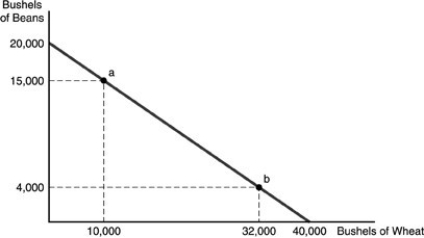 -Refer to the above figure. If the farmer is growing 8,000 bushels of beans and 8,000 bushels of wheat, then we know that
 (Multiple Choice)
4.7/5 (74)
(74) When productive activities are organized according to the principle of the division of labor
(Multiple Choice)
4.8/5 (86)
(86) The trade-off between the present and future consumption is measured by
(Multiple Choice)
4.8/5 (78)
(78) 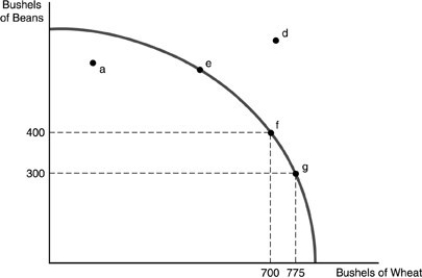 -Refer to the above figure. Which of the following points indicates an efficient use of resources?
 (Multiple Choice)
4.9/5 (78)
(78) 
Filters
- Essay(0)
- Multiple Choice(0)
- Short Answer(0)
- True False(0)
- Matching(0)