



 Chat with AI
Exam 2: Scarcity and the World of Trade-Offs

Exam 1: The Nature of Economics348 Questions
Exam 2: Scarcity and the World of Trade-Offs411 Questions
Exam 3: Demand and Supply451 Questions
Exam 4: Extensions of Demand and Supply Analysis401 Questions
Exam 5: Public Spending and Public Choice362 Questions
Exam 6: Funding the Public Sector201 Questions
Exam 7: The Macroeconomy: Unemployment, Inflation, and Deflation413 Questions
Exam 8: Measuring the Economys Performance416 Questions
Exam 9: Global Economic Growth and Development290 Questions
Exam 10: Real GDP and the Price Level in the Long Run298 Questions
Exam 11: Classical and Keynesian Macro Analyses368 Questions
Exam 12: Consumption, Real GDP, and the Multiplier452 Questions
Exam 13: Fiscal Policy274 Questions
Exam 14: Deficit Spending and the Public Debt146 Questions
Exam 15: Money, Banking, and Central Banking516 Questions
Exam 16: Domestic and International Dimensions of Monetary Policy357 Questions
Exam 17: Stabilization in an Integrated World Economy321 Questions
Exam 18: Policies and Prospects for Global Economic Growth228 Questions
Exam 19: Demand and Supply Elasticity412 Questions
Exam 20: Consumer Choice459 Questions
Exam 21: Rents, Profits, and the Financial Environment of Business445 Questions
Exam 22: The Firm: Cost and Output Determination391 Questions
Exam 23: Perfect Competition432 Questions
Exam 24: Monopoly386 Questions
Exam 25: Monopolistic Competition307 Questions
Exam 26: Oligopoly and Strategic Behavior308 Questions
Exam 27: Regulation and Antitrust Policy in a Globalized Economy310 Questions
Exam 28: The Labor Market: Demand, Supply and Outsourcing376 Questions
Exam 29: Unions and Labor Market Monopoly Power319 Questions
Exam 30: Income, Poverty, and Health Care304 Questions
Exam 31: Environmental Economics299 Questions
Exam 32: Comparative Advantage and the Open Economy282 Questions
Exam 33: Exchange Rates and the Balance of Payments285 Questions
Select questions type


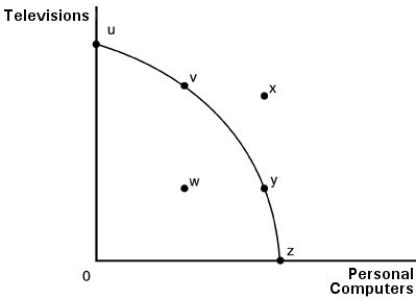 -In the above figure, the combination of computers and televisions shown by point x
 (Multiple Choice)
4.7/5  (82)
(82) The production possibilities curve represents the maximum feasible production combinations resulting from
(Multiple Choice)
4.8/5 (73)
(73) Bill Bonecrusher graduates from college with a choice of playing professional football at $2 million a year or coaching for $50,000 a year. He decides to play football, but eight years later he quits football to make movies for $3 million a year. His opportunity cost at graduation was ________ and eight years later was ________.
(Multiple Choice)
4.8/5 (65)
(65) Jose and Maria work at a restaurant. Jose can make either 10 pancakes or 4 waffles; Maria can make either 8 pancakes or 2 waffles. According to this scenario, the opportunity cost of making one waffle for Maria is
(Multiple Choice)
4.9/5 (69)
(69) In economic terminology, the accumulated training and education that workers receive to increase their productivity is referred to as
(Multiple Choice)
4.8/5 (75)
(75) In economics, international trade is based on the existence of
(Multiple Choice)
4.9/5 (95)
(95) If you can make $25,000 a year teaching, $20,000 a year writing computer programs, $30,000 a year driving a cab, and $40,000 a year as an actor or actress. You have a comparative advantage in
(Multiple Choice)
4.9/5 (88)
(88) Explain how comparative advantage, specialization and division of labor are related.
(Essay)
4.8/5 (76)
(76) When a society takes increasing amounts of resources and applies them to the production of a specific good, resulting in increasing opportunity costs for each additional unit produced, which of the following applies?
(Multiple Choice)
4.8/5 (79)
(79) As an economy moves from point to point along its production possibilities curve, which one of the following variables changes?
(Multiple Choice)
4.7/5 (76)
(76) If a country increased the production of its capital goods, then
(Multiple Choice)
5.0/5 (87)
(87) Suppose an acre of land yields 100 bushels of corn and that one bushel of corn provides enough seed for one-quarter of an acre of land. The opportunity cost of consuming another 100 bushels of corn today is
(Multiple Choice)
4.8/5 (68)
(68) Labor, human capital, and entrepreneurship are resources related to human beings. Distinguish among the three resources.
(Essay)
4.8/5 (85)
(85) At a zero price, which of the following conditions is TRUE for an economic good?
(Multiple Choice)
4.9/5 (73)
(73) 
Filters
- Essay(0)
- Multiple Choice(0)
- Short Answer(0)
- True False(0)
- Matching(0)