



 Chat with AI
Exam 23: Perfect Competition

Exam 1: The Nature of Economics348 Questions
Exam 2: Scarcity and the World of Trade-Offs411 Questions
Exam 3: Demand and Supply451 Questions
Exam 4: Extensions of Demand and Supply Analysis401 Questions
Exam 5: Public Spending and Public Choice362 Questions
Exam 6: Funding the Public Sector201 Questions
Exam 7: The Macroeconomy: Unemployment, Inflation, and Deflation413 Questions
Exam 8: Measuring the Economys Performance416 Questions
Exam 9: Global Economic Growth and Development290 Questions
Exam 10: Real GDP and the Price Level in the Long Run298 Questions
Exam 11: Classical and Keynesian Macro Analyses368 Questions
Exam 12: Consumption, Real GDP, and the Multiplier452 Questions
Exam 13: Fiscal Policy274 Questions
Exam 14: Deficit Spending and the Public Debt146 Questions
Exam 15: Money, Banking, and Central Banking516 Questions
Exam 16: Domestic and International Dimensions of Monetary Policy357 Questions
Exam 17: Stabilization in an Integrated World Economy321 Questions
Exam 18: Policies and Prospects for Global Economic Growth228 Questions
Exam 19: Demand and Supply Elasticity412 Questions
Exam 20: Consumer Choice459 Questions
Exam 21: Rents, Profits, and the Financial Environment of Business445 Questions
Exam 22: The Firm: Cost and Output Determination391 Questions
Exam 23: Perfect Competition432 Questions
Exam 24: Monopoly386 Questions
Exam 25: Monopolistic Competition307 Questions
Exam 26: Oligopoly and Strategic Behavior308 Questions
Exam 27: Regulation and Antitrust Policy in a Globalized Economy310 Questions
Exam 28: The Labor Market: Demand, Supply and Outsourcing376 Questions
Exam 29: Unions and Labor Market Monopoly Power319 Questions
Exam 30: Income, Poverty, and Health Care304 Questions
Exam 31: Environmental Economics299 Questions
Exam 32: Comparative Advantage and the Open Economy282 Questions
Exam 33: Exchange Rates and the Balance of Payments285 Questions
Select questions type


 -In the above figure, if the market price is $8, the firm

In a perfectly competitive market, a firm's short-run supply curve is
(Multiple Choice)
4.9/5  (67)
(67) The short-run supply curve for the perfectly competitive firm is the portion of its
(Multiple Choice)
4.9/5 (71)
(71) Consider an industry that is in long-run equilibrium. An increase in demand leads to an increase in the price of the good. We know that this is
(Multiple Choice)
4.8/5 (75)
(75) Which of the following statements about the perfect competitor is INCORRECT?
(Multiple Choice)
4.7/5 (77)
(77) Suppose a perfectly competitive cotton farmer can produce 10 containers of cotton at an output at which marginal cost equals marginal revenue. The price per container of cotton is $100 and the average total cost is $75. What is the profit or loss that this cotton farmer is earning?
(Multiple Choice)
4.8/5 (83)
(83) When considering perfect competition the absence of entry barriers implies that
(Multiple Choice)
4.9/5 (79)
(79) In a perfectly competitive market structure both buyers and sellers have equal access to information. This implies
(Multiple Choice)
4.8/5 (89)
(89) 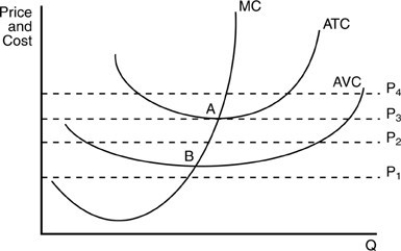 -In the above figure, what happens to the firm's optimal level of output if the price it receives for its product increases from P2 to P3?
 (Multiple Choice)
4.9/5 (82)
(82) In the long run when a perfectly competitive firm experiences positive economic profits
(Multiple Choice)
4.8/5 (81)
(81) When a perfectly competitive firm experiences zero economic profits
(Multiple Choice)
4.9/5 (90)
(90)  -Refer to the above figure for the individual firm in a perfectly competitive market. If the firm's average costs are given by AC3, then
 (Multiple Choice)
4.9/5 (75)
(75) If the costs of production do NOT change as output increases in the long run in a perfectly competitive industry, then this is a
(Multiple Choice)
4.8/5 (90)
(90) Which of the following is closest to a perfectly competitive market?
(Multiple Choice)
4.7/5 (96)
(96) What is a price taker? Discuss the assumptions used to obtain the perfectly competitive model.
(Essay)
4.9/5 (77)
(77) Suppose a perfectly competitive ukulele factory can produce 35 ukuleles at an output at which marginal cost equals marginal revenue. The price per ukulele is $1300 and the average total cost is $1500. What is the profit or loss that this furniture factory is earning?
(Multiple Choice)
4.9/5 (70)
(70)  -Refer to the above figure. The firm will just be covering all of its variable cost but none of its fixed cost
 (Multiple Choice)
4.8/5 (96)
(96) 
Filters
- Essay(0)
- Multiple Choice(0)
- Short Answer(0)
- True False(0)
- Matching(0)