



 Chat with AI
Exam 3: Demand and Supply

Exam 1: The Nature of Economics348 Questions
Exam 2: Scarcity and the World of Trade-Offs411 Questions
Exam 3: Demand and Supply451 Questions
Exam 4: Extensions of Demand and Supply Analysis401 Questions
Exam 5: Public Spending and Public Choice362 Questions
Exam 6: Funding the Public Sector201 Questions
Exam 7: The Macroeconomy: Unemployment, Inflation, and Deflation413 Questions
Exam 8: Measuring the Economys Performance416 Questions
Exam 9: Global Economic Growth and Development290 Questions
Exam 10: Real GDP and the Price Level in the Long Run298 Questions
Exam 11: Classical and Keynesian Macro Analyses368 Questions
Exam 12: Consumption, Real GDP, and the Multiplier452 Questions
Exam 13: Fiscal Policy274 Questions
Exam 14: Deficit Spending and the Public Debt146 Questions
Exam 15: Money, Banking, and Central Banking516 Questions
Exam 16: Domestic and International Dimensions of Monetary Policy357 Questions
Exam 17: Stabilization in an Integrated World Economy321 Questions
Exam 18: Policies and Prospects for Global Economic Growth228 Questions
Exam 19: Demand and Supply Elasticity412 Questions
Exam 20: Consumer Choice459 Questions
Exam 21: Rents, Profits, and the Financial Environment of Business445 Questions
Exam 22: The Firm: Cost and Output Determination391 Questions
Exam 23: Perfect Competition432 Questions
Exam 24: Monopoly386 Questions
Exam 25: Monopolistic Competition307 Questions
Exam 26: Oligopoly and Strategic Behavior308 Questions
Exam 27: Regulation and Antitrust Policy in a Globalized Economy310 Questions
Exam 28: The Labor Market: Demand, Supply and Outsourcing376 Questions
Exam 29: Unions and Labor Market Monopoly Power319 Questions
Exam 30: Income, Poverty, and Health Care304 Questions
Exam 31: Environmental Economics299 Questions
Exam 32: Comparative Advantage and the Open Economy282 Questions
Exam 33: Exchange Rates and the Balance of Payments285 Questions
Select questions type


If the market price falls from P0 to P1 in the above figure, then
(Multiple Choice)
4.8/5  (79)
(79) 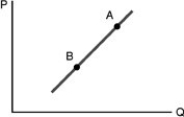 -Refer to the above figure. A movement from point A to point B for a good is most likely a result of
 (Multiple Choice)
4.8/5 (79)
(79) All of the following are non-price determinants of demand EXCEPT
(Multiple Choice)
4.9/5 (67)
(67) Suppose that goods X and Y are substitutes and the price of good Y falls. We would then expect
(Multiple Choice)
4.7/5 (76)
(76) 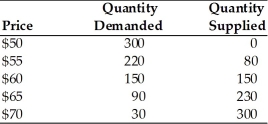 -Using the above table, the market clearing price is ________ and equilibrium quantity is ________.
 (Multiple Choice)
4.9/5 (77)
(77) Which of the following will NOT cause a shift in the demand for portable power banks?
(Multiple Choice)
4.9/5 (74)
(74) All of the following will cause a shift in the supply of portable power banks EXCEPT
(Multiple Choice)
4.8/5 (80)
(80) 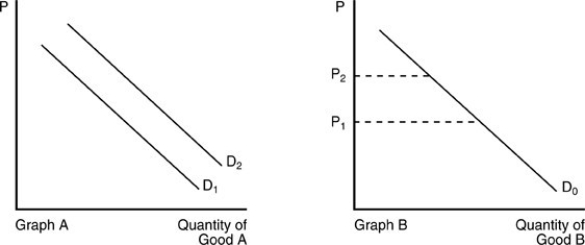 -In the above figure, when the price of Good B increases, the result can be shown by
 (Multiple Choice)
4.8/5 (77)
(77) 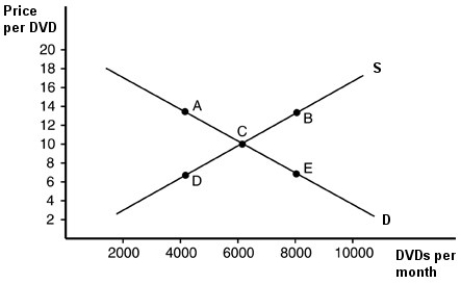 -According to the above figure, equilibrium is at point
If an increase in the incomes of people who live in the Los Angeles area leads to an increase in the demand for season tickets for games played by the Los Angeles Lakers professional basketball team, then these season tickets are
(Multiple Choice)
4.7/5 (70)
(70) The price of a gallon of gasoline increased from $2.00 to $2.25 while the price of a ride on the city bus increased from 50 cents to 75 cents. The relative price of riding the city bus
(Multiple Choice)
4.9/5 (85)
(85) Mary increases her consumption of Good X after the price of Good Y decreased. For Mary
(Multiple Choice)
4.9/5 (73)
(73) Distinguish between a change in quantity supplied and a change in supply.
(Essay)
4.8/5 (91)
(91) Which of the following will NOT cause market supply to increase?
(Multiple Choice)
4.9/5 (78)
(78) Which of the following is TRUE of the activities of ticket scalpers?
(Multiple Choice)
4.9/5 (71)
(71) 
Filters
- Essay(0)
- Multiple Choice(0)
- Short Answer(0)
- True False(0)
- Matching(0)