



 Chat with AI
Exam 3: Demand and Supply

Exam 1: The Nature of Economics348 Questions
Exam 2: Scarcity and the World of Trade-Offs411 Questions
Exam 3: Demand and Supply451 Questions
Exam 4: Extensions of Demand and Supply Analysis401 Questions
Exam 5: Public Spending and Public Choice362 Questions
Exam 6: Funding the Public Sector201 Questions
Exam 7: The Macroeconomy: Unemployment, Inflation, and Deflation413 Questions
Exam 8: Measuring the Economys Performance416 Questions
Exam 9: Global Economic Growth and Development290 Questions
Exam 10: Real GDP and the Price Level in the Long Run298 Questions
Exam 11: Classical and Keynesian Macro Analyses368 Questions
Exam 12: Consumption, Real GDP, and the Multiplier452 Questions
Exam 13: Fiscal Policy274 Questions
Exam 14: Deficit Spending and the Public Debt146 Questions
Exam 15: Money, Banking, and Central Banking516 Questions
Exam 16: Domestic and International Dimensions of Monetary Policy357 Questions
Exam 17: Stabilization in an Integrated World Economy321 Questions
Exam 18: Policies and Prospects for Global Economic Growth228 Questions
Exam 19: Demand and Supply Elasticity412 Questions
Exam 20: Consumer Choice459 Questions
Exam 21: Rents, Profits, and the Financial Environment of Business445 Questions
Exam 22: The Firm: Cost and Output Determination391 Questions
Exam 23: Perfect Competition432 Questions
Exam 24: Monopoly386 Questions
Exam 25: Monopolistic Competition307 Questions
Exam 26: Oligopoly and Strategic Behavior308 Questions
Exam 27: Regulation and Antitrust Policy in a Globalized Economy310 Questions
Exam 28: The Labor Market: Demand, Supply and Outsourcing376 Questions
Exam 29: Unions and Labor Market Monopoly Power319 Questions
Exam 30: Income, Poverty, and Health Care304 Questions
Exam 31: Environmental Economics299 Questions
Exam 32: Comparative Advantage and the Open Economy282 Questions
Exam 33: Exchange Rates and the Balance of Payments285 Questions
Select questions type


We observe that people buy less steak and more potatoes when the price of steak relative to potatoes increases. This indicates that steak and potatoes are
(Multiple Choice)
4.9/5  (72)
(72) By summing the quantities demanded by individuals at each price we obtain the
(Multiple Choice)
5.0/5 (79)
(79) The Chunnel auto tunnel allows motorists to travel between England and France. As an alternative, there is ferry service across the English Channel. What would happen in the market for ferry service if fees for using the Chunnel were increased?
(Multiple Choice)
4.8/5 (67)
(67) If the government imposes a per-unit tax on sales of an industry's product, then we would expect
(Multiple Choice)
5.0/5 (83)
(83) When the term "price" is used in the law of demand, price refers to
(Multiple Choice)
4.7/5 (72)
(72) The quantity supplied of a particular good is the amount of the good that
(Multiple Choice)
4.9/5 (76)
(76) Which of the following causes a movement along a supply curve?
(Multiple Choice)
4.8/5 (81)
(81) Ceteris paribus, as the price of a good or service increases
(Multiple Choice)
5.0/5 (84)
(84)  -Refer to the above figure. The market clearing price is
A schedule of how much of a good people will purchase for a range of possible prices during a specified time period, other things constant, is the definition of
(Multiple Choice)
4.8/5 (85)
(85) Suppose it is discovered that consumption of chocolate leads to a longer life. This information would lead to
(Multiple Choice)
4.9/5 (101)
(101) Which of the following is an example of the law of demand?
(Multiple Choice)
4.9/5 (75)
(75) 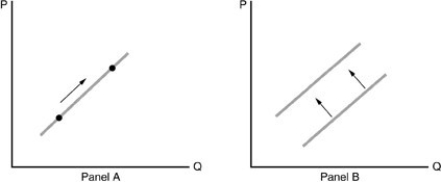 -Refer to the above figure. Which of the following statements is TRUE?
 (Multiple Choice)
4.8/5 (86)
(86) A change in the ceteris paribus conditions for supply will lead to a
(Multiple Choice)
4.8/5 (83)
(83) Adding the quantities demanded by all consumers at every price will yield
(Multiple Choice)
5.0/5 (77)
(77) The direct relationship between changes in price and changes in quantity supplied is
(Multiple Choice)
4.8/5 (85)
(85) 
Filters
- Essay(0)
- Multiple Choice(0)
- Short Answer(0)
- True False(0)
- Matching(0)