



 Chat with AI
Exam 9: Activity-Based Costing

Exam 1: Cost Accounting: Information for Decision Making111 Questions
Exam 2: Cost Concepts and Behavior105 Questions
Exam 3: Fundamentals of Cost-Volume-Profit Analysis105 Questions
Exam 4: Fundamentals of Cost Analysis for Decision Making72 Questions
Exam 5: Cost Estimation84 Questions
Exam 6: Fundamentals of Product and Service Costing88 Questions
Exam 7: Job Costing91 Questions
Exam 8: Process Costing91 Questions
Exam 9: Activity-Based Costing87 Questions
Exam 10: Fundamentals of Cost Management106 Questions
Exam 11: Service Department and Joint Cost Allocation99 Questions
Exam 12: Fundamentals of Management Control Systems101 Questions
Exam 13: Planning and Budgeting87 Questions
Exam 14: Business Unit Performance Measurement76 Questions
Exam 15: Transfer Pricing82 Questions
Exam 16: Fundamentals of Variance Analysis90 Questions
Exam 17: Additional Topics in Variance Analysis78 Questions
Exam 18: Performance Measurement to Support Business Strategy91 Questions
Select questions type


Smelly Perfume Company manufactures and distributes several different products.The company currently uses a plantwide allocation method for allocating overhead at a rate of $7 per direct labor hour.Cindy is the department manager of Department C which produces Products J and P.Department C has $16,200 in traceable overhead.Diane is the department manager of Department D which manufactures Product X.Department D has $11,100 in traceable overhead.The product costs (per case of 24 bottles)and other information are as follows: 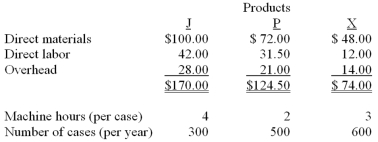 If Smelly changes its allocation basis to machine hours,what is the total product cost per case for Product P?
 (Multiple Choice)
4.7/5  (78)
(78) Smelly Perfume Company manufactures and distributes several different products.The company currently uses a plantwide allocation method for allocating overhead at a rate of $7 per direct labor hour.Cindy is the department manager of Department C which produces Products J and P.Department C has $16,200 in traceable overhead.Diane is the department manager of Department D which manufactures Product X.Department D has $11,100 in traceable overhead.The product costs (per case of 24 bottles)and other information are as follows: 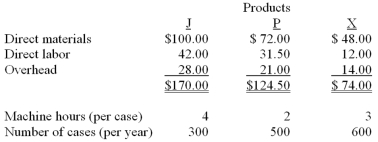 Department D has recently purchased and installed new computerized equipment for Product X.This equipment will increase the overhead costs by $2,700 and decrease labor costs (due to time savings)in Department D by $3.00 per case.Machine hours will not change.If Smelly uses a plantwide rate based on direct labor hours,what is the revised product cost per case for Product X?
 (Multiple Choice)
4.7/5 (61)
(61) RS Company manufactures and distributes two products,R and S.Overhead costs are currently allocated using the number of units produced as the allocation base.The controller has recommended changing to an activity-based costing (ABC)system.She has collected the following information:  What is the total overhead per unit allocated to Product S using activity-based costing (ABC)?
 (Multiple Choice)
4.9/5 (81)
(81) When overhead is applied based on the volume of output,high-volume products tend to "subsidize" low-volume products.When overhead is applied based on the volume of output,high-volume products are allocated relatively more overhead than are low-volume products.High-volume products "subsidize" low-volume products.
(True/False)
4.8/5 (79)
(79) Which of the following should not be used as the allocation base in a company that appropriately uses a single plantwide rate?
(Multiple Choice)
4.8/5 (71)
(71) Activity-based costing (ABC)provides more detailed measures of costs than do plantwide or department allocation methods.This is due to ABC using more causal relationships that are not limited to the production floor.
(True/False)
4.9/5 (90)
(90) 
Filters
- Essay(0)
- Multiple Choice(0)
- Short Answer(0)
- True False(0)
- Matching(0)