



 Chat with AI
Exam 15: Transfer Pricing

Exam 1: Cost Accounting: Information for Decision Making111 Questions
Exam 2: Cost Concepts and Behavior105 Questions
Exam 3: Fundamentals of Cost-Volume-Profit Analysis105 Questions
Exam 4: Fundamentals of Cost Analysis for Decision Making72 Questions
Exam 5: Cost Estimation84 Questions
Exam 6: Fundamentals of Product and Service Costing88 Questions
Exam 7: Job Costing91 Questions
Exam 8: Process Costing91 Questions
Exam 9: Activity-Based Costing87 Questions
Exam 10: Fundamentals of Cost Management106 Questions
Exam 11: Service Department and Joint Cost Allocation99 Questions
Exam 12: Fundamentals of Management Control Systems101 Questions
Exam 13: Planning and Budgeting87 Questions
Exam 14: Business Unit Performance Measurement76 Questions
Exam 15: Transfer Pricing82 Questions
Exam 16: Fundamentals of Variance Analysis90 Questions
Exam 17: Additional Topics in Variance Analysis78 Questions
Exam 18: Performance Measurement to Support Business Strategy91 Questions
Select questions type


The general principle on setting transfer prices that are in the organization's best interests is:

Free
(Multiple Choice)
4.9/5  (65)
(65) Correct Answer: Verified
A
In general,negotiated transfer prices fall in a range between the selling division's differential costs and the buying division's market price.The seller's differential costs are the lowest the seller would accept;the buyer's market price is the highest the buyer would be willing to pay.
Free
(True/False)
4.9/5 (69)
(69) Correct Answer:Verified
VerifiedTrue
Given the following data for Division A: 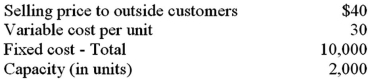 Assume that Division A is selling all it can produce to outside customers.If it sells to Division B,$1 can be avoided in variable cost per unit.Division B is presently purchasing from an outside supplier at $38 per unit.From the point of view of the company as a whole,any sales to Division B should be priced at:
Free
(Multiple Choice)
4.7/5 (77)
(77) Correct Answer:Verified
VerifiedE
Multinational firms often face conflicting pressures when developing transfer pricing policies.Tax avoidance results when:
(Multiple Choice)
4.9/5 (83)
(83) Tax avoidance is unethical when inflated transfer prices are used in international transactions to shift profits from a division in one country to a division in another country.The key is "inflated" prices.Market based prices would not be unethical.
(True/False)
4.8/5 (83)
(83) Which of the following statements is (are)false? (A)From an organization's viewpoint,transfer prices have no effect on total profits assuming the transfer occurs between the two responsibility centers.(B)A transfer price is the value assigned to the transfer of goods or services between divisions within the same organization.
(Multiple Choice)
4.7/5 (84)
(84) Chipper Division of Acme Corp.sells 80,000 units of part Z-25 to the outside market.Part Z-25 sells for $40,has a variable cost of $22,and a fixed cost per unit of $10.Chipper has a capacity to produce 100,000 units per period.Jones Division currently purchases 10,000 units of part Z-25 from Chipper for $40.Jones has been approached by an outside supplier willing to supply the parts for $36.If Acme uses a negotiated transfer pricing system,what is the maximum transfer price that should be charged for this transaction?
(Multiple Choice)
4.8/5 (83)
(83) Cruises,Inc. ,operates two divisions: (1)a management division that owns and manages cruise ships in the Florida Keys and (2)a repair division that operates a dry dock in Marble Sand Florida.The repair division works on company ships,as well as other large-hull ships.The repair division has an estimated variable cost of $28.50 per labor-hour.The repair division has a backlog of work for outside ships.They charge $48.00 per hour for labor,which is standard for this type of work.The management division complained that it could hire its own repair workers for $30.00 per hour,including leasing an adequate work area.If the repair division had idle capacity,what is the minimum transfer price that the repair division should obtain?
(Multiple Choice)
4.9/5 (89)
(89) A transfer price is the value assigned to the transfer of goods or services between divisions within the same organization.This is the definition of transfer pricing.
(True/False)
4.8/5 (82)
(82) Cohasset Company currently manufactures all component parts used in the manufacture of various hand tools.Hurley Division produces a steel handle used in three different tools.The budget for these handles is 120,000 units with the following unit cost. 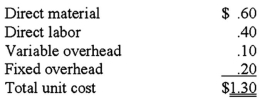 Ironwood Division purchases 20,000 handles from Hurley Division and completes the hand tools.An outside supplier,R & M Steel,has offered to supply 20,000 units of the handle to Ironwood Division for $1.25 per unit.Hurley currently has idle capacity that cannot be used.If Cohasset would like to develop a range of transfer prices,what would be the minimum transfer price that Hurley would be willing to accept?
 (Multiple Choice)
4.7/5 (73)
(73) Chipper Division of Acme Corp.sells 80,000 units of part Z-25 to the outside market.Part Z-25 sells for $40,has a variable cost of $22,and a fixed cost per unit of $10.Chipper has a capacity to produce 100,000 units per period.Jones Division currently purchases 10,000 units of part Z-25 from Chipper for $40.Jones has been approached by an outside supplier willing to supply the parts for $36.If Acme uses a negotiated transfer pricing system,what is the minimum transfer price that should be charged for this transaction?
(Multiple Choice)
4.8/5 (81)
(81) Which of the following responsibility centers is affected by the use of market-based transfer prices?
(Multiple Choice)
4.9/5 (87)
(87) Cascade Cliffs,Inc. ,operates two divisions: (1)a management division that owns and manages bulk carriers on the Great Lakes and (2)a repair division that operates a dry dock in Cheboygan,Michigan.The repair division works on company ships,as well as other large-hull ships.The repair division has an estimated variable cost of $37 per labor-hour.The repair division has a backlog of work for outside ships.They charge $70.00 per hour for labor,which is standard for this type of work.The management division complained that it could hire its own repair workers for $45.00 per hour,including leasing an adequate work area.What is the maximum transfer price per hour that the management division should pay?
(Multiple Choice)
4.8/5 (80)
(80) The optimal transfer price when there are intermediate markets is:
(Multiple Choice)
4.7/5 (72)
(72) Some managers prefer to use cost rather than market price in controlling transfers between divisions.If cost is to be used,then it should be:
(Multiple Choice)
4.9/5 (75)
(75) Which of the following transfer pricing methods must be used in segment reporting by the oil and gas industry?
(Multiple Choice)
4.8/5 (84)
(84) A company is highly centralized.Division X,which is operating at capacity,produces a component that it currently sells in a perfectly competitive market for $13 per unit.At the current level of production,the fixed cost of producing this component is $4 per unit and the variable cost is $7 per unit.Division Y would like to purchase this component from Division X.The price that Division X should charge Division Y per unit for this component is:
(Multiple Choice)
4.8/5 (84)
(84) Which of the following is not an appropriate use of transfer pricing?
(Multiple Choice)
4.8/5 (69)
(69) A transfer made at cost does not motivate the selling division to transfer its goods or services internally.There is no profit for the selling division.
(True/False)
4.8/5 (73)
(73) 
Filters
- Essay(0)
- Multiple Choice(0)
- Short Answer(0)
- True False(0)
- Matching(0)