



 Chat with AI
Exam 4: Process Costing and Hybrid Product-Costing Systems

Exam 1: The Changing Role of Managerial Accounting in a Dynamic Business Environment62 Questions
Exam 2: Basic Cost Management Concepts85 Questions
Exam 3: Product Costing and Cost Accumulation in a Batch Production Environment80 Questions
Exam 4: Process Costing and Hybrid Product-Costing Systems84 Questions
Exam 5: Activity-Based Costing and Management85 Questions
Exam 6: Activity Analysis, Cost Behavior, and Cost Estimation93 Questions
Exam 7: Cost-Volume-Profit Analysis89 Questions
Exam 8: Variable Costing and the Costs of Quality and Sustainability64 Questions
Exam 9: Financial Planning and Analysis: the Master Budget95 Questions
Exam 10: Standard Costing and Analysis of Direct Costs80 Questions
Exam 11: Flexible Budgeting and Analysis of Overhead Costs91 Questions
Exam 12: Responsibility Accounting, Operational Performance Measures, and the Balanced Scorecard72 Questions
Exam 13: Investment Centers and Transfer Pricing95 Questions
Exam 14: Decision Making: Relevant Costs and Benefits90 Questions
Exam 15: Target Costing and Cost Analysis for Pricing Decisions99 Questions
Exam 16: Capital Expenditure Decisions104 Questions
Exam 17: Allocation of Support Activity Costs and Joint Costs81 Questions
Exam 18: The Sarbanes-Oxley Act, Internal Controls, and Management Accounting14 Questions
Exam 19: Compound Interest and the Concept of Present Value24 Questions
Exam 20: Inventory Management14 Questions
Select questions type


Colonial Products employs a process-costing system for its manufacturing operations. All materials are added at the beginning of the process, and conversion costs are incurred uniformly throughout production. The information that follows relates to September. 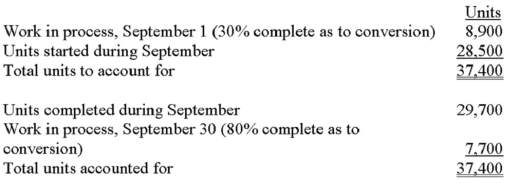 Required:
A. Calculate equivalent units of direct material for September.
B. Calculate equivalent units of conversion activity for September.
Required:
A. Calculate equivalent units of direct material for September.
B. Calculate equivalent units of conversion activity for September. (Essay)
5.0/5  (74)
(74) Equivalent-unit calculations are necessary to allocate manufacturing costs between units sold and ending work in process.
(True/False)
4.9/5 (80)
(80) Edge Company had a beginning work-in-process inventory of 30,000 units on June 1. These units contained $120,000 of direct materials and $272,000 of conversion cost. The following data relate to activity during June:
Edge uses a weighted-average process-costing system. All materials are added at the start of manufacturing; in contrast, conversion cost is incurred evenly throughout production.
Required:
A. Compute the total equivalent units for direct material and conversion cost.
B. Compute the cost per equivalent unit of direct material and conversion cost.
C. Determine the cost of completed production.
D. Determine the cost of the June 30 work in process.
(Essay)
4.9/5 (83)
(83) Equivalent-unit calculations are necessary to allocate manufacturing costs between:
(Multiple Choice)
4.8/5 (73)
(73) 
Filters
- Essay(0)
- Multiple Choice(0)
- Short Answer(0)
- True False(0)
- Matching(0)