



 Chat with AI
Exam 6: Activity Analysis, Cost Behavior, and Cost Estimation

Exam 1: The Changing Role of Managerial Accounting in a Dynamic Business Environment62 Questions
Exam 2: Basic Cost Management Concepts85 Questions
Exam 3: Product Costing and Cost Accumulation in a Batch Production Environment80 Questions
Exam 4: Process Costing and Hybrid Product-Costing Systems84 Questions
Exam 5: Activity-Based Costing and Management85 Questions
Exam 6: Activity Analysis, Cost Behavior, and Cost Estimation93 Questions
Exam 7: Cost-Volume-Profit Analysis89 Questions
Exam 8: Variable Costing and the Costs of Quality and Sustainability64 Questions
Exam 9: Financial Planning and Analysis: the Master Budget95 Questions
Exam 10: Standard Costing and Analysis of Direct Costs80 Questions
Exam 11: Flexible Budgeting and Analysis of Overhead Costs91 Questions
Exam 12: Responsibility Accounting, Operational Performance Measures, and the Balanced Scorecard72 Questions
Exam 13: Investment Centers and Transfer Pricing95 Questions
Exam 14: Decision Making: Relevant Costs and Benefits90 Questions
Exam 15: Target Costing and Cost Analysis for Pricing Decisions99 Questions
Exam 16: Capital Expenditure Decisions104 Questions
Exam 17: Allocation of Support Activity Costs and Joint Costs81 Questions
Exam 18: The Sarbanes-Oxley Act, Internal Controls, and Management Accounting14 Questions
Exam 19: Compound Interest and the Concept of Present Value24 Questions
Exam 20: Inventory Management14 Questions
Select questions type


Sunshine Valley Meat Company produces one of the best sausage products in Pennsylvania. The company's controller compiled the following information by analyzing the accounting records:
1. Meat costs the company $3.25 per pound of sausage produced.
2. Compensation of production employees is $2.25 per pound of sausage produced.
3. Supervisory salaries total $23,000 per month.
4. The company incurs utility costs of $9,000 per month plus $0.35 per pound of sausage produced.
5. Insurance and property taxes average $6,400 per month.
Required:
A. Classify each cost as variable, fixed, or semivariable.
B. Write a formula to express the behavior of the firm's production costs. (Use the form Y = a + bX, where X denotes the quantity of sausage produced.)
(Essay)
4.9/5  (75)
(75) Which of the following statements about the visual-fit method is (are) true?
I. The method results in the creation of a scatter diagram.
II. The method is not totally objective because of the manner in which the cost line is determined.
III. The method is especially helpful in the determination of outliers.
(Multiple Choice)
4.8/5 (79)
(79) What type of cost exhibits the behavior shown below? Manufacturing Total Cost Volume (Units) Cost Per Unit 50,000 \ 150,000 \ 3.00 80,000 150,000 1.88
(Multiple Choice)
5.0/5 (62)
(62) Bowman, Inc., has only variable costs and fixed costs. A review of the company's records disclosed that when 200,000 units were produced, fixed manufacturing costs amounted to $800,000 and the cost per unit manufactured totaled $11. On the basis of this information, how much cost would the firm anticipate at an activity level of 205,000 units?
(Multiple Choice)
4.9/5 (78)
(78) Temperance, Inc. is studying marketing cost and sales volume, and has generated the following information by use of a scatter diagram and a least-squares regression analysis:  Temperance is now preparing an estimate for monthly sales of 18,000 units. On the basis of the data presented, compute the most accurate sales forecast possible.
 (Multiple Choice)
4.8/5 (69)
(69) Yang Manufacturing, which uses the high-low method, makes a product called Yin. The company incurs three different cost types (A, B, and C) and has a relevant range of operation between 2,500 units and 10,000 units per month. Per-unit costs at two different activity levels for each cost type are presented below. Type A Type B Type C Total 5,000 units \ 4 \ 9 \ 4 \ 17 7,500 units \ 4 \ 6 \ 3 \ 13 The cost types shown above are identified by behavior as: 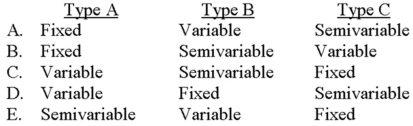
(Multiple Choice)
4.9/5 (75)
(75) A variable cost that has a definitive physical relationship to the activity measure is called a (n):
(Multiple Choice)
4.8/5 (77)
(77) Ellington Corporation uses least-squares regression to analyze a variety of operating costs. A staff assistant determined that monthly machine hours (MH) have a strong cause-and-effect relationship with total maintenance costs, and generated the following statistics:
Intercept: $170,000
b coefficient: $3.80
Total machine hours for the year: 36,500
Required:
A. Construct the company's regression equation.
B. Based on your answer in part "A," identify Ellington's dependent variable and independent variable.
C. What does the b coefficient really represent?
D. Predict the company's maintenance cost in a month when 3,200 machine hours are worked.
(Essay)
4.7/5 (80)
(80) Which of the following tools is not associated with cost estimation?
(Multiple Choice)
4.8/5 (83)
(83) The following selected data were taken from the accounting records of Schein Industrial Manufacturing: Month Machine Hours Manufacturing Overhead May 46,000 \ 889,000 June 60,000 1,130,000 July 68,000 1,274,000 August 52,000 980,000
Manufacturing overhead consists of three different costs; (1) machine supplies (variable), (2) property taxes (fixed), and (3) plant maintenance (semivariable). July's overhead costs were $170,000 for machine supplies, $24,000 for property taxes, and $1,080,000 for plant maintenance.
Required:
A. Determine the machine supplies and property taxes for May.
B. By using the high-low method, analyze Schein's plant maintenance cost and calculate the monthly fixed portion and the variable cost per machine hour.
C. Assume that present cost behavior patterns continue into future months. Estimate the total amount of manufacturing overhead the company can expect in September if 56,000 machine hours are worked.
(Essay)
4.8/5 (69)
(69) The following data relate to the Lisle Company for May and August of the current year: May August Maintenance hours 25,000 29,000 Maintenance cost \ 1,175,000 \ 1,247,000 May and August were the lowest and highest activity levels, and Lisle uses the high-low method to analyze cost behavior. If maintenance hours are estimated to be 26,000 hours in October, which of the following statements is true?
(Multiple Choice)
4.8/5 (79)
(79) Differentiate between committed costs and discretionary costs. Be sure to present two examples of each and explain which of the two cost types would likely be cut should a company encounter financial difficulties.
(Essay)
4.9/5 (84)
(84) In regression analysis, the variable that is being predicted is known as the:
(Multiple Choice)
4.8/5 (72)
(72) Which of the following is (are) example(s) of a mixed cost?
I. A building that is used for both manufacturing and sales activities.
II. An employee's compensation, which consists of a flat salary plus a commission.
III. Depreciation that relates to five different machines.
IV. Maintenance cost that must be split between sales and administrative offices.
(Multiple Choice)
5.0/5 (88)
(88) Shortly after being hired as an analyst with Harbor Rentals in upstate New York, Raul Gomez was asked to prepare a report that focused on the company's order processing costs-a cost driven largely by the number of rental invoices written. Raul knew that he could use several different tools to analyze cost behavior, including scatter diagrams, least-squares regression, and the high-low method. In addition, he knew that he could present the results of his analysis in the form of algebraic equations. Those equations follow.
Scatter diagram: OP = $56,000 + $6.80RI
Least-squares regression: OP = $59,000 + $6.75RI
High-low method: OP = $53,500 + $7.25RI
where OP = total order processing costs and RI = number of rental invoices written
Raul had analyzed data over the past 12 months and built equations based on these data, purposely including the slowest month of the year and the busiest month so that things would "¼ tend to even out." He observed that February was especially slow because of a paralyzing blizzard, one that forced the company to close for four days.
Required:
A. Will scatter diagrams, least-squares regression, and the high-low method normally result in the same equation? Why?
B. Assuming the use of least-squares regression, explain what the $59,000 and $6.75 figures represent.
C. Assuming the use of a scatter diagram, predict the order processing cost of an upcoming month when Harbor expects to write 2,500 rental invoices.
D. Did Raul err in constructing the equations on data of the past 12 months? Briefly discuss. If "yes," determine which of the three tools is likely to be affected the most and explain why.
(Essay)
4.7/5 (83)
(83) Wooster has the following budgeted costs at its anticipated production level (expressed in hours): variable overhead, $165,000; fixed overhead, $250,000. If Wooster now revises its anticipated production slightly upward, it would expect:
(Multiple Choice)
4.9/5 (67)
(67) Mastel Company has a variable selling cost. If sales volume increases, how will the total variable cost and the variable cost per unit behave? 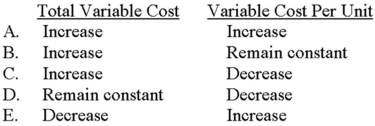
(Multiple Choice)
5.0/5 (84)
(84) Normal Company pays a sales commission of 4% on each unit sold. If a graph is prepared, with the vertical axis representing per-unit cost and the horizontal axis representing units sold, how would a line that depicts sales commissions be drawn?
(Multiple Choice)
4.8/5 (79)
(79) 
Filters
- Essay(0)
- Multiple Choice(0)
- Short Answer(0)
- True False(0)
- Matching(0)