



 Chat with AI
Exam 9: Financial Planning and Analysis: the Master Budget

Exam 1: The Changing Role of Managerial Accounting in a Dynamic Business Environment62 Questions
Exam 2: Basic Cost Management Concepts85 Questions
Exam 3: Product Costing and Cost Accumulation in a Batch Production Environment80 Questions
Exam 4: Process Costing and Hybrid Product-Costing Systems84 Questions
Exam 5: Activity-Based Costing and Management85 Questions
Exam 6: Activity Analysis, Cost Behavior, and Cost Estimation93 Questions
Exam 7: Cost-Volume-Profit Analysis89 Questions
Exam 8: Variable Costing and the Costs of Quality and Sustainability64 Questions
Exam 9: Financial Planning and Analysis: the Master Budget95 Questions
Exam 10: Standard Costing and Analysis of Direct Costs80 Questions
Exam 11: Flexible Budgeting and Analysis of Overhead Costs91 Questions
Exam 12: Responsibility Accounting, Operational Performance Measures, and the Balanced Scorecard72 Questions
Exam 13: Investment Centers and Transfer Pricing95 Questions
Exam 14: Decision Making: Relevant Costs and Benefits90 Questions
Exam 15: Target Costing and Cost Analysis for Pricing Decisions99 Questions
Exam 16: Capital Expenditure Decisions104 Questions
Exam 17: Allocation of Support Activity Costs and Joint Costs81 Questions
Exam 18: The Sarbanes-Oxley Act, Internal Controls, and Management Accounting14 Questions
Exam 19: Compound Interest and the Concept of Present Value24 Questions
Exam 20: Inventory Management14 Questions
Select questions type


The budgeting technique that helps managers assess the company's future and know if they are reaching their performance goals is called life-cycle budgeting.
(True/False)
4.9/5  (84)
(84) Millage Manufacturing has a cash balance of $8,000 on August 1 of the current year. The company's controller forecast the following cash receipts and cash disbursements for the upcoming two months of activity: Cash Receipts Cash Payments August \ 45,000 \ 57,000 September 66,000 56,000
Management desires to maintain a minimum cash balance of $8,000 at all times. If necessary, additional financing can be obtained in $1,000 multiples at a 12% interest rate. All borrowings are made at the beginning of the month; debt retirement, on the other hand, occurs at the end of the month. Interest is paid at the time of repaying loan principal and is computed on the portion of debt repaid.
Required:
A. Determine the ending cash balance in August both before and after any necessary financing or debt retirement.
B. Repeat part "A" for September.
(Essay)
4.9/5 (90)
(90) James Corporation, headquartered in Chicago, has a manufacturing plant in Dallas. Plant managers desire to participate in the company's budget efforts, which, for the past 10 years, have been handled solely by top executives in Chicago. Dallas managers feel that by becoming involved, they can make great strides in terms of improving operating performance of their aging facility.
Required:
Briefly discuss this situation, focusing on the benefits and problems of letting Dallas managers participate in the company's budgetary efforts.
(Essay)
4.7/5 (81)
(81) Discuss the importance of budgeting and identify five purposes of budgeting systems.
(Essay)
4.8/5 (92)
(92) Coleman, Inc. anticipates sales of 50,000 units, 48,000 units, 51,000 units and 50,000 units in July, August, September and October, respectively. Company policy is to maintain an ending finished-goods inventory equal to 40% of the following month's sales. On the basis of this information, how many units would the company plan to produce in September?
(Multiple Choice)
4.8/5 (83)
(83) Sainte Claire Corporation has a highly automated production facility. Which of the following correctly shows the two factors that would likely have the most direct influence on the company's manufacturing overhead budget?
(Multiple Choice)
4.9/5 (80)
(80) The Gingham Company's budgeted income statement reflects the following amounts: January \ 120,000 \ 78,000 \ 24,000 February 110,000 66,000 24,200 March 125,000 81,250 27,000 April 130,000 84,500 28,600 Sales are collected 50% in the month of sale, 30% in the month following sale, and 19% in the second month following sale. One percent of sales is uncollectible and expensed at the end of the year.
Gingham pays for all purchases in the month following purchase and takes advantage of a 3% discount. The following balances are as of January 1: Cash \ 88,000 Accounts receivable* 58,000 Accounts payable 72,000
*Of this balance, $35,000 will be collected in January and the remaining amount will be collected in February.
The monthly expense figures include $5,000 of depreciation. The expenses are paid in the month incurred.
Gingham's budgeted cash payments in February are:
(Multiple Choice)
4.8/5 (79)
(79) A company's plan for the acquisition of long-lived assets, such as buildings and equipment, is commonly called a:
(Multiple Choice)
4.9/5 (83)
(83) A company's sales forecast would likely not consider general economic and industry trends.
(True/False)
4.8/5 (83)
(83) The following selected data pertain to Phineus Corporation: Cash operating expenses, July 1-31 \ 180,000 Depreciation 60,000 Merchandise purchases in July 560,000 Estimated payments in July for purchases in June 220,000 Estimated payments in July for purchases prior to June 50,000 Estimated payments in July for purchases in July 40\% July's cash disbursements are expected to be:
(Multiple Choice)
4.8/5 (79)
(79) Which of the following budgets is based on many other master-budget components?
(Multiple Choice)
4.9/5 (93)
(93) The master budget contains the following components, among others: (1) direct-material budget, (2) budgeted balance sheet, (3) production budget, and (4) cash budget. Which of these components would be prepared first and which would be prepared last? 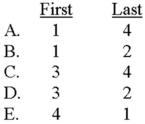
(Multiple Choice)
4.7/5 (92)
(92) Which of the following statements about financial planning models (FPMs) is (are) false?
(Multiple Choice)
4.9/5 (73)
(73) Coleman, Inc. anticipates sales of 50,000 units, 48,000 units, and 51,000 units in July, August, and September, respectively. Company policy is to maintain an ending finished-goods inventory equal to 40% of the following month's sales. On the basis of this information, how many units would the company plan to produce in July?
(Multiple Choice)
4.8/5 (82)
(82) Quattro began operations in April of this year. It makes all sales on account, subject to the following collection pattern: 30% are collected in the month of sale; 60% are collected in the first month after sale; and 10% are collected in the second month after sale. If sales for April, May, and June were $60,000, $80,000, and $70,000, respectively, what were the firm's budgeted collections for April?
(Multiple Choice)
4.8/5 (79)
(79) Which of the following choices correctly denotes managerial functions that are commonly associated with budgeting? 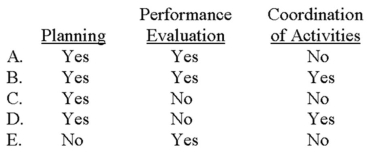
(Multiple Choice)
4.8/5 (84)
(84) Sherman Company provides services in the retail flooring industry. The following information is available for 20x5:
• Twenty percent of the firm's services are for cash and the remaining 80% are on account. Of the credit services, 40% are collected in the month that the service is provided, with the remaining 60% collected in the following month.
• Services provided in January are expected to total $250,000 and grow at the rate of 5% per month thereafter.
• January's cash collections are expected to be $240,400, and month-end receivables are forecast at $120,000.
• Monthly cash operating costs and depreciation during the first quarter of the year are approximated at $250,000 and $15,000, respectively.
• Sherman's December 31, 20x4 balance sheet revealed accounts payable balances of $28,000. This amount is related to the company's operating costs and is expected to grow to $36,000 by the end of 20x5's first quarter. All operating costs are paid within 30 days of incurrence.
• Company policy requires that a $20,000 minimum cash balance be maintained, and Sherman's 20x4 year-end balance sheet showed that the firm was in compliance with policy by having cash of $23,000.
Required:
A. Determine the sales revenue earned that will appear on the income statement for the quarter ended March 31, 20x5.
B. Compute the company's first-quarter cash collections.
C. Compute the cash balance that would appear on the March 31, 20x5 balance sheet.
D. What are some possible actions the company could pursue if, at any time during the quarter, it finds that the cash balance has fallen below the stated minimum?
(Essay)
4.9/5 (89)
(89) Digregory makes all purchases on account, subject to the following payment pattern:
Paid in the month of purchase: 30%
Paid in the first month following purchase: 60%
Paid in the second month following purchase: 10%
If purchases for January, February, and March were $200,000, $180,000, and $230,000, respectively, what were the firm's budgeted payments in March?
(Multiple Choice)
4.8/5 (74)
(74) Which of the following organizations is not likely to use budgets?
(Multiple Choice)
4.9/5 (79)
(79) 
Filters
- Essay(0)
- Multiple Choice(0)
- Short Answer(0)
- True False(0)
- Matching(0)