



 Chat with AI
Exam 13: Investment Centers and Transfer Pricing

Exam 1: The Changing Role of Managerial Accounting in a Dynamic Business Environment62 Questions
Exam 2: Basic Cost Management Concepts85 Questions
Exam 3: Product Costing and Cost Accumulation in a Batch Production Environment80 Questions
Exam 4: Process Costing and Hybrid Product-Costing Systems84 Questions
Exam 5: Activity-Based Costing and Management85 Questions
Exam 6: Activity Analysis, Cost Behavior, and Cost Estimation93 Questions
Exam 7: Cost-Volume-Profit Analysis89 Questions
Exam 8: Variable Costing and the Costs of Quality and Sustainability64 Questions
Exam 9: Financial Planning and Analysis: the Master Budget95 Questions
Exam 10: Standard Costing and Analysis of Direct Costs80 Questions
Exam 11: Flexible Budgeting and Analysis of Overhead Costs91 Questions
Exam 12: Responsibility Accounting, Operational Performance Measures, and the Balanced Scorecard72 Questions
Exam 13: Investment Centers and Transfer Pricing95 Questions
Exam 14: Decision Making: Relevant Costs and Benefits90 Questions
Exam 15: Target Costing and Cost Analysis for Pricing Decisions99 Questions
Exam 16: Capital Expenditure Decisions104 Questions
Exam 17: Allocation of Support Activity Costs and Joint Costs81 Questions
Exam 18: The Sarbanes-Oxley Act, Internal Controls, and Management Accounting14 Questions
Exam 19: Compound Interest and the Concept of Present Value24 Questions
Exam 20: Inventory Management14 Questions
Select questions type


General Auto's Northern Division is currently purchasing a part from an outside supplier. The company's Southern Division, which has excess capacity, makes and sells this part for external customers at a variable cost of $19 and a selling price of $31. If Southern begins sales to Northern, it (1) will use the general transfer-pricing rule and (2) will be able to reduce variable cost on internal transfers by $3. On the basis of this information, Southern would establish a transfer price of:
(Multiple Choice)
4.8/5  (67)
(67) Jasper Corporation is organized in three separate divisions. The three divisional managers are evaluated at year-end, and bonuses are awarded based on ROI. Last year, the overall company produced a 12% return on its investment.
Managers of Jasper's Iowa Division recently studied an investment opportunity that would assist in the division's future growth. Relevant data follow. Iowa Division Investment Opportunity Income \ 12,800,000 \ 4,200,000 Invested capital 80,000,000 30,000,000
Required:
A. Compute the current ROI of the Iowa Division and the division's ROI if the investment opportunity is pursued.
B. What is the likely reaction of divisional management toward the acquisition? Why?
C. What is the likely reaction of Jasper's corporate management toward the investment? Why?
D. Assume that Jasper uses residual income to evaluate performance and desires an 11% minimum return on invested capital. Compute the current residual income of the Iowa Division and the division's residual income if the investment is made. Will divisional management likely change its attitude toward the acquisition? Why?
(Essay)
4.7/5 (64)
(64) Consider the following statements about goal congruence:
I. Goal congruence is obtained when managers of subunits throughout an organization strive to achieve the goals set by top management.
II. Managers are often more concerned about the performance of their own subunits rather than the performance of the entire organization.
III. Achieving goal congruence in most organizations is relatively straightforward and easy to accomplish.
Which of the above statements is(are) true?
(Multiple Choice)
4.8/5 (77)
(77) Nevada, Inc. has two divisions, one located in Las Vegas and the other located in Reno. Las Vegas sells selected goods to Reno for use in various end-products. Assume that the transfer between the two divisions takes place regardless of the transfer price set by Las Vegas. Which of the following correctly describes the impact of the transfer prices on divisional profits and overall company profit? 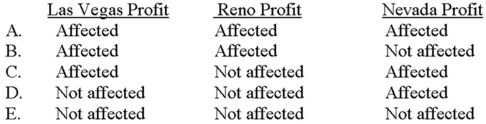
(Multiple Choice)
4.8/5 (79)
(79) Which of the following is used in the calculation of both return on investment and residual income?
(Multiple Choice)
4.9/5 (79)
(79) For the period just ended, Techno Corporation's Stocker Division reported profit of $54 million and invested capital of $450 million. Assuming an imputed interest rate of 10%, which of the following choices correctly denotes Stocker's return on investment (ROI) and residual income? ROI Residual Income A. 12.0\% \ 9 million B. 12.0\% \ (9 million ) C. 10.0\% \ 9 million D. \ 9 million 12\% E. None of the other answers are correct.
(Multiple Choice)
4.9/5 (73)
(73) Mount Vernon Corporation's Gauge Division manufactures and sells product no. 24, which is used in refrigeration systems. Per-unit variable manufacturing and selling costs amount to $23 and $7, respectively. The Division can sell this item to external domestic customers for $40 or, alternatively, transfer the product to the company's Refrigeration Division. Refrigeration is currently purchasing a similar unit from Taiwan for $36. Assume use of the general transfer-pricing rule.
Required:
A. What is the most that the Refrigeration Division would be willing to pay the Gauge Division for one unit?
B. If Gauge had excess capacity, what transfer price would the Division's management set?
C. If Gauge had no excess capacity, what transfer price would the Division's management set?
D. Repeat part "C," assuming that Gauge was able to reduce the variable cost of internal transfers by $5 per unit.
(Essay)
4.9/5 (84)
(84) A division's return on investment may be improved by increasing sales margin and cost of capital.
(True/False)
4.8/5 (71)
(71) The following information relates to the Cliff Division of Mountain Enterprises:
Income for the period just ended: $1,500,000
Invested capital: $12,000,000
If the company has an imputed interest rate of 11%, Cliff's residual income would be:
(Multiple Choice)
5.0/5 (74)
(74) One element of the general transfer-pricing rule is opportunity cost. Briefly define the term "opportunity cost" and then explain how it is computed for (1) companies that have excess capacity and (2) companies that have no excess capacity.
(Essay)
4.7/5 (68)
(68) Hallen Division has been stagnant over the past five years, neither growing nor contracting in size and profitability. Investments in new property, plant, and equipment have been minimal. Would the division's use of total assets (valued at net book value) when measuring ROI result in (1) using numbers that are consistent with those on the balance sheet and (2) a rising ROI over time? Consistent with Numbers Produce a Rising Return on on the Balance Sheet? Investment Over Time? A. Yes Yes B. Yes No C. No Yes D. No No E. Yes Need more information to judge
(Multiple Choice)
5.0/5 (83)
(83) Which of the following transfer-pricing methods can lead to dysfunctional decision-making behavior by managers?
(Multiple Choice)
5.0/5 (89)
(89) Gamma Division of Vaughn Corporation produces electric motors, 20% of which are sold to Vaughan's Omega Division and 80% to outside customers. Vaughn treats its divisions as profit centers and allows division managers to choose whether to sell to or buy from internal divisions. Corporate policy requires that all interdivisional sales and purchases be transferred at variable cost. Gamma Division's estimated sales and standard cost data for the year ended December 31, based on a capacity of 60,000 units, are as follows: 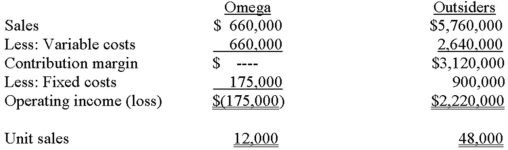 Gamma has an opportunity to sell the 12,000 units shown above to an outside customer at $80 per unit. Omega can purchase the units it needs from an outside supplier for $92 each.
Required:
A. Assuming that Gamma desires to maximize operating income, should it take on the new customer and discontinue sales to Omega? Why? (Note: Answer this question from Gamma's perspective.)
B. Assume that Vaughn allows division managers to negotiate transfer prices. The managers agreed on a tentative price of $80 per unit, to be reduced by an equal sharing of the additional Gamma income that results from the sale to Omega of 12,000 motors at $80 per unit. On the basis of this information, compute the company's new transfer price.
Gamma has an opportunity to sell the 12,000 units shown above to an outside customer at $80 per unit. Omega can purchase the units it needs from an outside supplier for $92 each.
Required:
A. Assuming that Gamma desires to maximize operating income, should it take on the new customer and discontinue sales to Omega? Why? (Note: Answer this question from Gamma's perspective.)
B. Assume that Vaughn allows division managers to negotiate transfer prices. The managers agreed on a tentative price of $80 per unit, to be reduced by an equal sharing of the additional Gamma income that results from the sale to Omega of 12,000 motors at $80 per unit. On the basis of this information, compute the company's new transfer price. (Essay)
4.9/5 (76)
(76) The Fitzhugh Division of General Enterprises has a negative residual income of $540,000. Fitzhugh's management is contemplating an investment opportunity that will reduce this negative amount to $400,000. The investment:
(Multiple Choice)
4.8/5 (67)
(67) Carolina Corporation has an after-tax operating income of $3,200,000 and a 9% weighted-average cost of capital. Assets total $7,000,000 and current liabilities total $1,800,000. On the basis of this information, Carolina's economic value added is:
(Multiple Choice)
4.8/5 (94)
(94) Tunley Corporation has excess capacity. If the firm desires to implement the general transfer-pricing rule, opportunity cost would be equal to:
(Multiple Choice)
4.8/5 (90)
(90) Which of the following describes the goal that should be pursued when setting transfer prices?
(Multiple Choice)
4.9/5 (70)
(70) Which of the following elements is not used when calculating the weighted-average cost of capital?
(Multiple Choice)
4.9/5 (86)
(86) 
Filters
- Essay(0)
- Multiple Choice(0)
- Short Answer(0)
- True False(0)
- Matching(0)