



 Chat with AI
Exam 2: Job-Order Costing

Exam 1: Managerial Accounting and Cost Concepts187 Questions
Exam 2: Job-Order Costing144 Questions
Exam 3: Activity-Based Costing208 Questions
Exam 4: Process Costing82 Questions
Exam 5: Cost-Volume-Profit Relationships121 Questions
Exam 6: Variable Costing and Segment Reporting: Tools for Management187 Questions
Exam 7: Master Budgeting229 Questions
Exam 8: Flexible Budgets, Standard Costs, and Variance Analysis173 Questions
Exam 9: Performance Measurement in Decentralized Organizations423 Questions
Exam 10: Differential Analysis: the Key to Decision Making115 Questions
Exam 11: Capital Budgeting Decisions118 Questions
Exam 12: Statement of Cash Flows132 Questions
Exam 13: Financial Statement Analysis289 Questions
Exam 14: Predetermined Overhead Rates and Overhead Analysis in a Standard Costing System111 Questions
Exam 15: Journal Entries to Record Variances56 Questions
Exam 16: The Concept of Present Value13 Questions
Exam 17: The Direct Method of Determining the Net Cash Provided by Operating Activities56 Questions
Select questions type


Clear Colors Corporation uses a predetermined overhead rate based on direct labor costs to apply manufacturing overhead to jobs. At the beginning of the year the Corporation estimated its total manufacturing overhead cost at $350,000 and its direct labor costs at $200,000. The actual overhead cost incurred during the year was $362,000 and the actual direct labor costs incurred on jobs during the year was $208,000. The manufacturing overhead for the year would be:
(Multiple Choice)
4.8/5  (92)
(92) Baker Corporation applies manufacturing overhead on the basis of direct labor-hours. At the beginning of the most recent year, the company based its predetermined overhead rate on total estimated overhead of $210,600 and 6,000 estimated direct labor-hours. Actual manufacturing overhead for the year amounted to $209,000 and actual direct labor-hours were 5,980. The overhead for the year was:
(Multiple Choice)
4.7/5 (66)
(66) Allenton Company is a manufacturing firm that uses job-order costing. At the beginning of the year, the company's inventory balances were as follows:  The company applies overhead to jobs using a predetermined overhead rate based on machine-hours. At the beginning of the year, the company estimated that it would work 31,000 machine-hours and incur $248,000 in manufacturing overhead cost. The following transactions were recorded for the year:
a. Raw materials were purchased, $411,000.
b. Raw materials were requisitioned for use in production, $409,000 ($388,000 direct and $21,000 indirect).
c. The following employee costs were incurred: direct labor, $145,000; indirect labor, $61,000; and administrative salaries, $190,000.
d. Selling costs, $148,000.
e. Factory utility costs, $12,000.
f. Depreciation for the year was $121,000 of which $114,000 is related to factory operations and $7,000 is related to selling, general, and administrative activities.
g. Manufacturing overhead was applied to jobs. The actual level of activity for the year was 29,000 machine-hours.
h. The cost of goods manufactured for the year was $783,000.
i. Sales for the year totaled $1,107,000 and the costs on the job cost sheets of the goods that were sold totaled $768,000.
j. The balance in the Manufacturing Overhead account was closed out to Cost of Goods Sold.
Required:
Prepare the appropriate journal entry for each of the items above (a. through j.). You can assume that all transactions with employees, customers, and suppliers were conducted in cash.
The company applies overhead to jobs using a predetermined overhead rate based on machine-hours. At the beginning of the year, the company estimated that it would work 31,000 machine-hours and incur $248,000 in manufacturing overhead cost. The following transactions were recorded for the year:
a. Raw materials were purchased, $411,000.
b. Raw materials were requisitioned for use in production, $409,000 ($388,000 direct and $21,000 indirect).
c. The following employee costs were incurred: direct labor, $145,000; indirect labor, $61,000; and administrative salaries, $190,000.
d. Selling costs, $148,000.
e. Factory utility costs, $12,000.
f. Depreciation for the year was $121,000 of which $114,000 is related to factory operations and $7,000 is related to selling, general, and administrative activities.
g. Manufacturing overhead was applied to jobs. The actual level of activity for the year was 29,000 machine-hours.
h. The cost of goods manufactured for the year was $783,000.
i. Sales for the year totaled $1,107,000 and the costs on the job cost sheets of the goods that were sold totaled $768,000.
j. The balance in the Manufacturing Overhead account was closed out to Cost of Goods Sold.
Required:
Prepare the appropriate journal entry for each of the items above (a. through j.). You can assume that all transactions with employees, customers, and suppliers were conducted in cash. (Essay)
4.8/5 (77)
(77) Hacken Company has a job-order costing system. The company applies manufacturing overhead to jobs using a predetermined overhead rate based on direct labor cost. The information below has been taken from the cost records of Hacken Company for the past year: 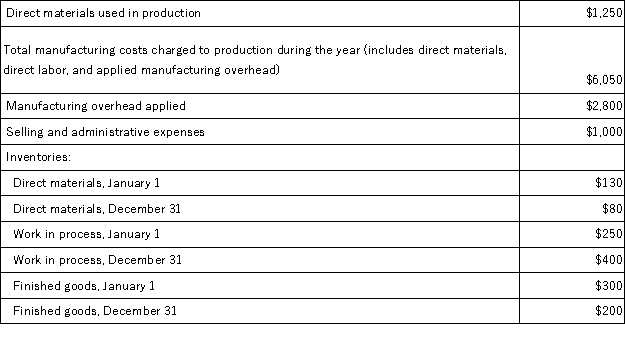 Required:
a. Compute the cost of direct materials purchased during the year.
b. Compute the predetermined overhead rate that was used during the past year.
c. Compute the Cost of Goods Manufactured for the past year.
d. Compute the unadjusted Cost of Goods Sold for the past year.
Required:
a. Compute the cost of direct materials purchased during the year.
b. Compute the predetermined overhead rate that was used during the past year.
c. Compute the Cost of Goods Manufactured for the past year.
d. Compute the unadjusted Cost of Goods Sold for the past year. (Essay)
4.8/5 (82)
(82) Buker Corporation bases its predetermined overhead rate on the estimated machine-hours for the upcoming year. Data for the upcoming year appear below:  The predetermined overhead rate for the recently completed year was closest to:
 (Multiple Choice)
4.9/5 (91)
(91) The use of a predetermined overhead rate in a job-order cost system makes it possible to compute the total cost of a job before production is begun.
(True/False)
4.8/5 (91)
(91) Which of the following entries would record correctly the monthly salaries earned by the top management of a manufacturing company?
(Multiple Choice)
4.9/5 (86)
(86) Longstaff Inc. has provided the following data for the month of March. There were no beginning inventories; consequently, the direct materials, direct labor, and manufacturing overhead applied listed below are all for the current month.  Manufacturing overhead for the month was overapplied by $5,000. The Corporation allocates any underapplied or overapplied manufacturing overhead among work in process, finished goods, and cost of goods sold at the end of the month on the basis of the manufacturing overhead applied during the month in those accounts.
The journal entry to record the allocation of any underapplied or overapplied manufacturing overhead for March would include the following:
Manufacturing overhead for the month was overapplied by $5,000. The Corporation allocates any underapplied or overapplied manufacturing overhead among work in process, finished goods, and cost of goods sold at the end of the month on the basis of the manufacturing overhead applied during the month in those accounts.
The journal entry to record the allocation of any underapplied or overapplied manufacturing overhead for March would include the following: (Multiple Choice)
4.7/5 (78)
(78) Huckeby Corporation bases its predetermined overhead rate on the estimated machine-hours for the upcoming year. Data for the upcoming year appear below:  Required:
Compute the company's predetermined overhead rate.
Required:
Compute the company's predetermined overhead rate. (Essay)
4.9/5 (84)
(84) On August 1, Shead Corporation had $35,000 of raw materials on hand. During the month, the company purchased an additional $56,000 of raw materials. During August, $69,000 of raw materials were requisitioned from the storeroom for use in production. These raw materials included both direct and indirect materials. The indirect materials totaled $6,000. Prepare journal entries to record these events. Use those journal entries to answer the following questions: The debits to the Work in Process account as a consequence of the raw materials transactions in August total:
(Multiple Choice)
4.9/5 (82)
(82) The following partially completed T-accounts summarize transactions for Farwest Corporation during the year: 
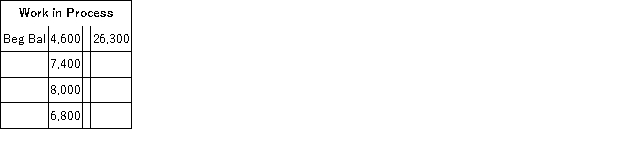



 The manufacturing overhead was:
 (Multiple Choice)
4.8/5 (75)
(75) Caber Corporation applies manufacturing overhead on the basis of machine-hours. At the beginning of the most recent year, the company based its predetermined overhead rate on total estimated overhead of $60,600. Actual manufacturing overhead for the year amounted to $59,000 and actual machine-hours were 5,900. The company's predetermined overhead rate for the year was $10.10 per machine-hour. The applied manufacturing overhead for the year was closest to:
(Multiple Choice)
4.7/5 (91)
(91) The following partially completed T-accounts summarize transactions for Farwest Corporation during the year: 
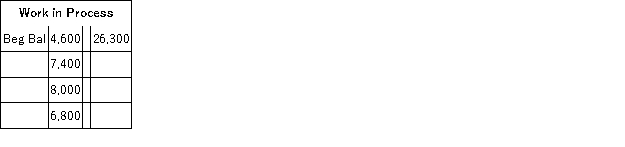



 The direct labor cost was:
 (Multiple Choice)
4.9/5 (71)
(71) The cost of a completed job in a job-order costing system typically consists of the actual direct materials cost of the job, the actual direct labor cost of the job, and the manufacturing overhead cost applied to the job.
(True/False)
4.8/5 (90)
(90) Dagger Corporation uses direct labor-hours in its predetermined overhead rate. At the beginning of the year, the total estimated manufacturing overhead was $423,870. At the end of the year, actual direct labor-hours for the year were 19,400 hours, manufacturing overhead for the year was underapplied by $5,650, and the actual manufacturing overhead was $418,870. The predetermined overhead rate for the year must have been closest to:
(Multiple Choice)
4.9/5 (77)
(77) Meyers Corporation had the following inventory balances at the beginning and end of November:  During November, $39,000 in raw materials (all direct materials) were drawn from inventory and used in production. The company's predetermined overhead rate was $8 per direct labor-hour, and it paid its direct labor workers $10 per hour. A total of 300 hours of direct labor time had been expended on the jobs in the beginning Work in Process inventory account. The ending Work in Process inventory account contained $4,700 of direct materials cost. The Corporation incurred $28,000 of actual manufacturing overhead cost during the month and applied $26,400 in manufacturing overhead cost. The raw materials purchased during November totaled:
 (Multiple Choice)
4.8/5 (80)
(80) Schoff Corporation has provided the following data for the most recent month: 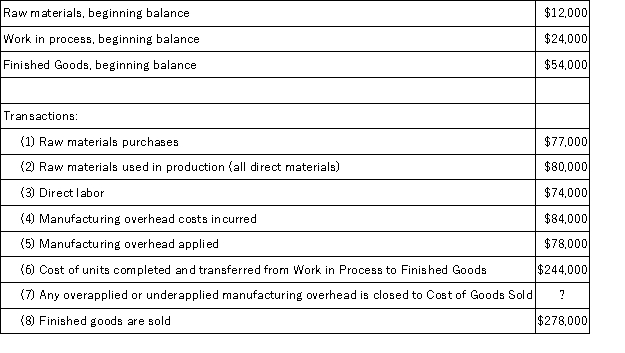 Required:
Prepare T-accounts for Raw Materials, Work in Process, Finished Goods, Manufacturing Overhead, and Cost of Goods Sold. Record the beginning balances and each of the transactions listed above. Finally, determine the ending balances.
Required:
Prepare T-accounts for Raw Materials, Work in Process, Finished Goods, Manufacturing Overhead, and Cost of Goods Sold. Record the beginning balances and each of the transactions listed above. Finally, determine the ending balances. (Essay)
4.9/5 (78)
(78) The following T-accounts have been constructed from last year's records at C&C Manufacturing: 


 C&C Manufacturing uses job-order costing with a predetermined overhead rate and applies manufacturing overhead to jobs based on direct labor costs. What is the predetermined overhead rate?
 (Multiple Choice)
4.9/5 (84)
(84) Dillon Corporation applies manufacturing overhead to jobs using a predetermined overhead rate of 75% of direct labor cost. Any under or overapplied manufacturing overhead cost is closed out to Cost of Goods Sold at the end of the month. During May, the following transactions were recorded by the company: 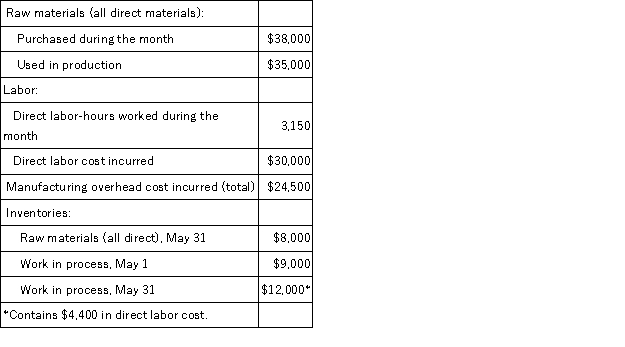 The Cost of Goods Manufactured for May was:
 (Multiple Choice)
4.8/5 (81)
(81) During May at Shatswell Corporation, $57,000 of raw materials were requisitioned from the storeroom for use in production. These raw materials included both direct and indirect materials. The indirect materials totaled $7,000. The journal entry to record this requisition would include a debit to Manufacturing Overhead of:
(Multiple Choice)
4.7/5 (73)
(73) 
Filters
- Essay(0)
- Multiple Choice(0)
- Short Answer(0)
- True False(0)
- Matching(0)